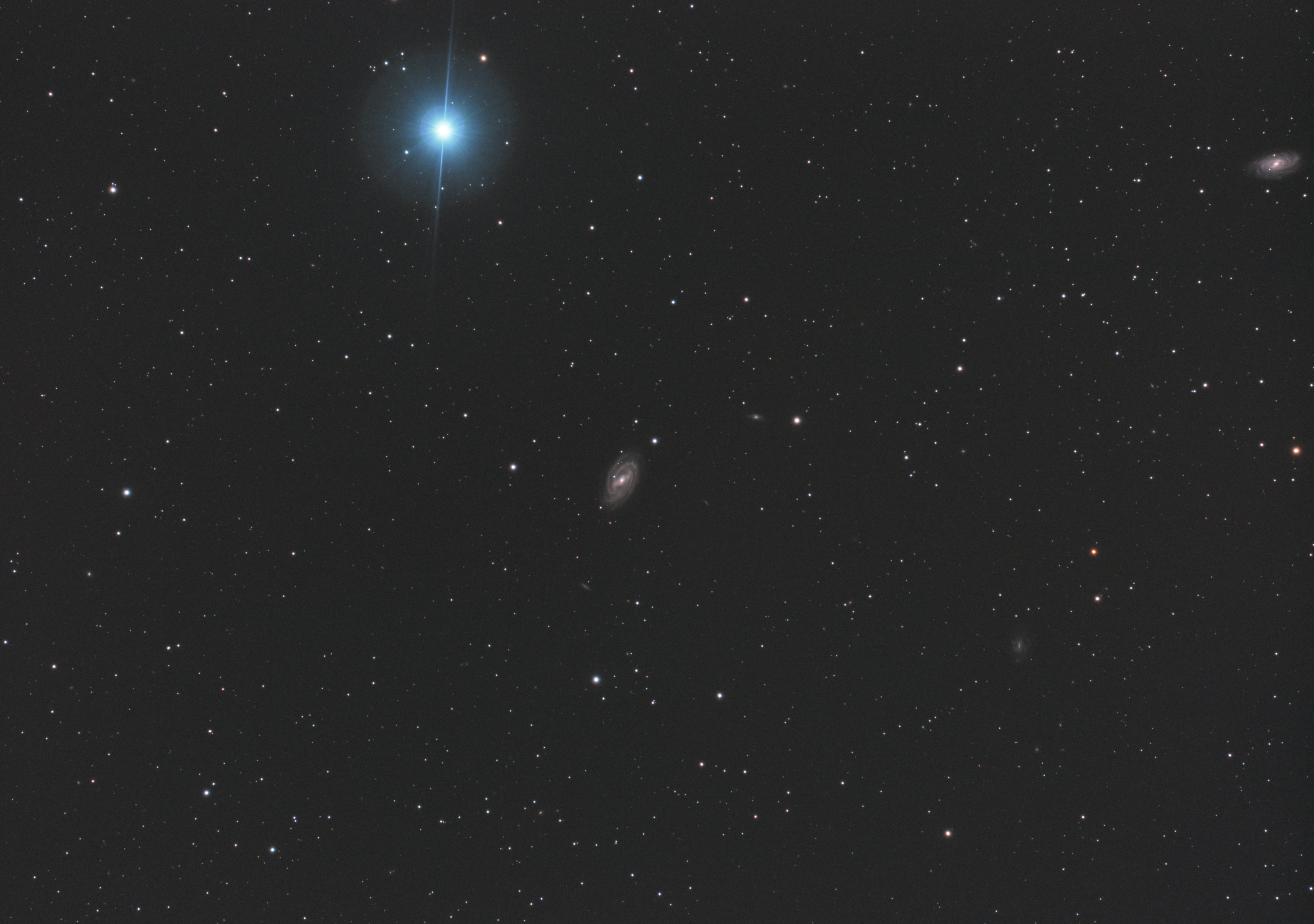
Posted in March 2020, this astrophotography project documents an observation of Messier 109, a galaxy located approximately 55 million light-years distant, positioned alongside Phecda, a principal star of the Ursa Major constellation.
Technical Acquisition
The image was produced using a Takahashi FSQ-85EDX super apo 85mm quadruplet refractor mounted on a Skywatcher N-EQ6 Pro. A QHY163C color camera captured the data through an IDAS LPS D1 filter system, with total integration time reaching 5.28 hours. The observation comprised 126 exposures of 120 seconds each and 13 exposures of 300 seconds, with the camera cooled to -20 degrees Celsius. Setup sampling was 1.74 arcseconds per pixel, providing a field of view of 2.25 by 1.7 degrees.
Observation Conditions and Processing
The observation was conducted under Bortle 5 to 10 sky conditions with a Sky Quality Meter reading of 19.55. The astronomer noted light pollution and multiple nights of observation were required, with some artifact present on the star image. Processing used Pixinsight and Adobe Photoshop, with standard calibration frames including darks, flats, and bias corrections applied.
Frequently asked questions
How distant is Messier 109?
Messier 109 is located approximately 55 million light-years away.
What is Phecda?
Phecda is a principal star of the Ursa Major constellation, visible in this observation alongside Messier 109.
How long was the total exposure time?
The integration time totaled 5.28 hours across multiple exposures using the IDAS LPS D1 filter.