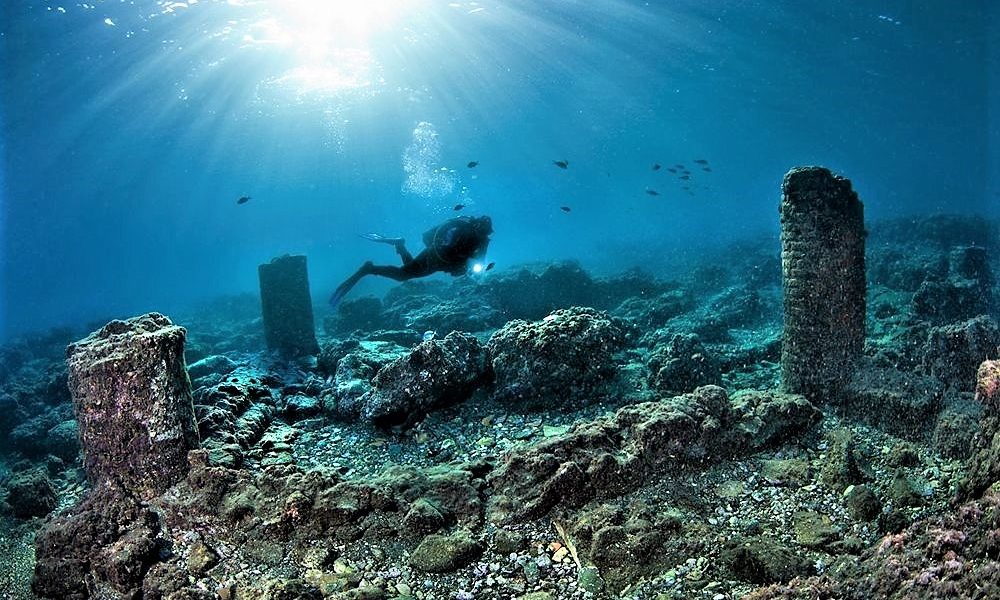
In April 2019, Google Earth imagery brought renewed attention to Sinuessa, an ancient Roman colony on the Campania coast whose port lies submerged beneath the Tyrrhenian Sea near present-day Sessa Aurunca. The site presents a geological puzzle: the land has subsided approximately eight metres since Roman times, and the harbour now rests ten metres underwater. A Roman causeway leads to the beach before disappearing into sand, and divers must descend three metres to reach the submerged structures below.
A Colony of Importance
Sinuessa was founded in 296 BC and became one of the most prosperous centres in Campania Felix. The settlement was renowned for its thermal baths and white sand beaches, which attracted Rome’s aristocracy to build villas there. Yet it was far more than a resort destination. Its strategic location made it a major commercial hub, with ships departing its port laden with Falerno wine, one of the most prized wines of the Roman Empire. Nearby, prestigious structures such as the impressive theatre at Sessa Aurunca were constructed.
The Unexplained Subsidence
While bradisism—a volcanic phenomenon involving ground uplift and subsidence—has affected other sites in the region such as Pozzuoli’s Temple of Serapis and the submerged Portus Iulius, scientists believe a different cause underlies Sinuessa’s collapse. The ten-metre drop in less than two thousand years is too rapid for typical geological processes. Initially researchers hypothesised a single catastrophic event such as a tsunami, but excavation evidence suggests the complex was not abandoned suddenly; instead, a series of events likely caused the inundation. Adding to the mystery, researchers discovered twenty-four limestone blocks weighing over sixty tonnes each, originally used to mark docking points. Several have shifted metres from their original positions—a movement difficult to attribute to human action.
A Submerged Treasure
Studying Sinuessa’s remains presents significant challenges. Sediments from the nearby Garigliano River create turbid water conditions, making visibility poor. Although periodic surveys and investigations continue, the site remains largely inaccessible without specialized equipment, effectively rendering it a submerged mystery that geologists and ENEA researchers continue to investigate.
Frequently asked questions
When was Sinuessa founded and what was its importance?
Sinuessa was founded in 296 BC and was one of the most prosperous centres in Campania Felix, known for its thermal baths, beaches, and role as a major commercial hub exporting Falerno wine throughout the Roman Empire.
Why is the subsidence at Sinuessa considered unusual?
The eight-metre drop in land level over approximately two thousand years is too rapid for typical geological processes; while bradisism affected other nearby sites, the cause of Sinuessa’s subsidence remains unexplained and was likely caused by a series of events rather than a single catastrophic occurrence.
What makes it difficult to study the sunken port today?
Sediments from the Garigliano River create turbid water conditions, and the site is only accessible with specialized diving equipment, making it challenging to conduct regular archaeological research.
Sources
- S1 — Carandini, Andrea. Archeologia classica: Vedere il tempo antico con gli occhi del presente. Einaudi, 2008. ISBN 978-88-06-19349-2.
- S2 — Settis, Salvatore. Il futuro del 'classico'. Einaudi, 2004. ISBN 978-88-06-14382-4.
Spotted an error? Write to editorial@culturalheritageonline.com and we correct it the same day.