
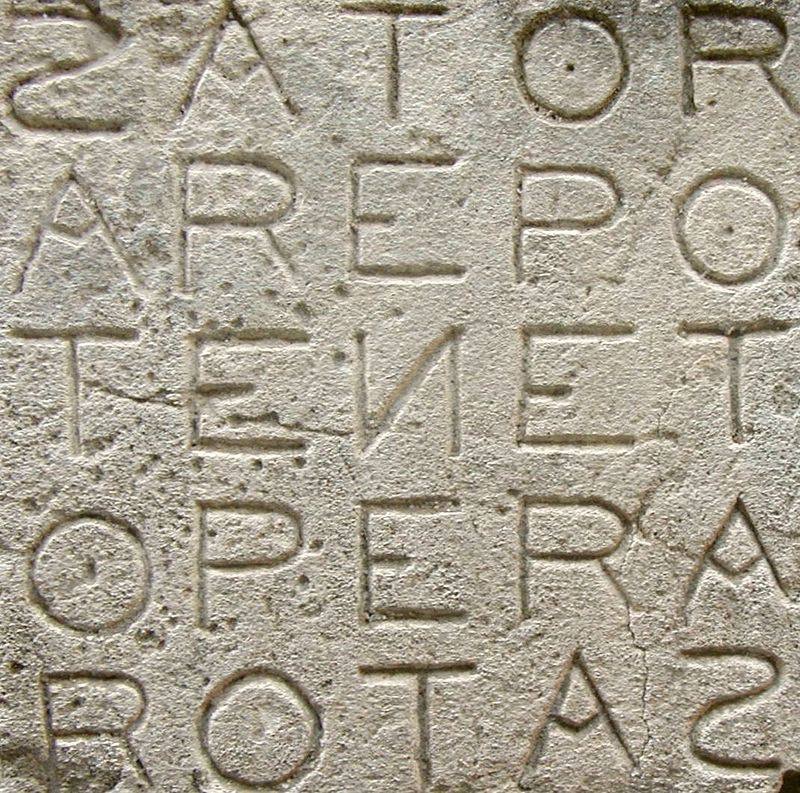
Discovered in 1925 during excavations in Pompeii, the Sator Square is a recurring Latin inscription in the form of a magical square that appears across a surprisingly wide range of archaeological finds scattered throughout Europe. The square comprises five words—Sator, Arepo, Tenet, Opera, and Rotas—arranged to form a palindrome readable identically from left to right or right to left. The Pompeian example was incised on a column in the house of Publius Paquius Proclus before the eruption of 79 AD.
Meaning and Interpretation
Establishing the literal meaning of the phrase proves difficult, primarily because Arepo is not strictly a Latin term. One interpretation treats Arepo as a proper name, yielding the meaning: “Arepo the sower holds the plough with skill.” If rotas refers to celestial wheels, an alternative reading emerges: “The Creator of lands holds, that is governs, the celestial wheels.” The concept of unity between the immanent and transcendent worlds finds expression in the cross-shaped arrangement of the word Tenet, symbolically representing the union of heaven and earth.
Layered Readings
The Sator Square may have functioned as an anagram deliberately containing multiple keys of interpretation, revealing different meanings according to the reader’s knowledge and depth of understanding. A less educated reader would have grasped the literal sense and perhaps recognized symbolic meanings common to the ancient world, such as the Pythagorean four elements, reading line by line: “The sower holds the scythe, agricultural works, wheels.” A more perceptive reader would have understood the wordplay and transferred it from the terrestrial to the celestial sphere, perceiving the link between the agricultural sower and the heavenly Sower, reading: “The Creator holds the Great Chariot, constellations, stars.” Those possessing both literary and philosophical knowledge would have intuited the bustrophedon interpretation rich in metaphor: “God takes care of Creation as man takes care of his fields.” An alternative reading, following reversed direction at the end of each row or column, produces “Sator opera tenet arepo rotas,” where Sator means sower and Arepo represents a contraction of Areopagus (supreme tribunal), suggesting a moral meaning: “Man decides his daily actions, but only God decides his destiny.”
Frequently asked questions
Where was the most famous Sator Square discovered?
The most celebrated example was found in Pompeii in 1925, inscribed on a column in the house of Publius Paquius Proclus before the city’s eruption in 79 AD.
Is Arepo a Latin word?
No; Arepo is not strictly Latin, which contributes to the difficulty in determining the square’s literal meaning and has led to multiple interpretations throughout history.
What does the cross shape of Tenet symbolize?
The cross formed by the word Tenet symbolically expresses the union of heaven and earth, representing the concept of unity between the immanent and transcendent worlds.


