
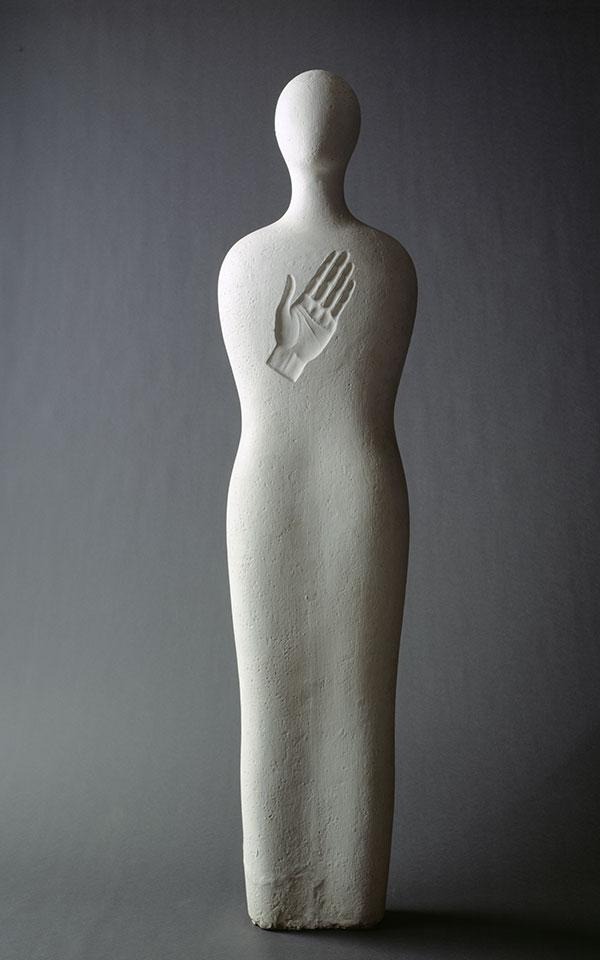
Costante uomo is a sculpture created by Fausto Melotti in 1936. Melotti (1901–1986) was an Italian sculptor, ceramicist, poet and theorist whose career spanned much of the twentieth century, working across multiple artistic disciplines and mediums.
Born in Rovereto in northeastern Italy, Melotti received rigorous technical training in both engineering and fine art. He studied physics and mathematics at university before enrolling at the Accademia di Brera in Milan, where he worked under sculptor Adolfo Wildt and alongside Lucio Fontana. This dual foundation in scientific method and artistic practice informed his approach to form and composition throughout his career.
About Fausto Melotti
Melotti divided his professional life between sculpture, ceramics, poetry and theoretical writing. His work encompassed various modernist tendencies and materials. He lived and worked primarily in Milan, where he remained based after completing his studies in 1924. Melotti died in Milan in 1986, leaving behind a substantial body of work that was later documented through a foundation established by his daughter Marta.
Details
- Created: 1936
- Artist: Fausto Melotti (1901–1986)
- Medium: Sculpture
- Birthplace: Rovereto, northeastern Italy
On video
Frequently asked questions
Who was Fausto Melotti?
Fausto Melotti was an Italian sculptor, ceramicist, poet and theorist born in Rovereto in 1901. He studied engineering and mathematics before training in sculpture at the Accademia di Brera in Milan under Adolfo Wildt.
Where did Melotti work?
Melotti was based primarily in Milan after completing his studies at the Politecnico di Milano in 1924. He lived and worked there until his death in 1986.
What disciplines did Melotti practice?
Beyond sculpture, Melotti worked in ceramics, poetry and theoretical writing, bringing his background in physics and mathematics to his artistic practice across multiple mediums.
Sources
- S1 — Panzetta, Alfonso. Nuovo dizionario degli scultori italiani dell'Ottocento e del primo Novecento. AdArte, 2003. ISBN 978-88-422-1158-7.
- S2 — Pontiggia, Elena. Il Novecento Italiano. Abscondita, 2003. ISBN 978-88-8416-048-5.
Spotted an error? Write to editorial@culturalheritageonline.com and we correct it the same day.


