
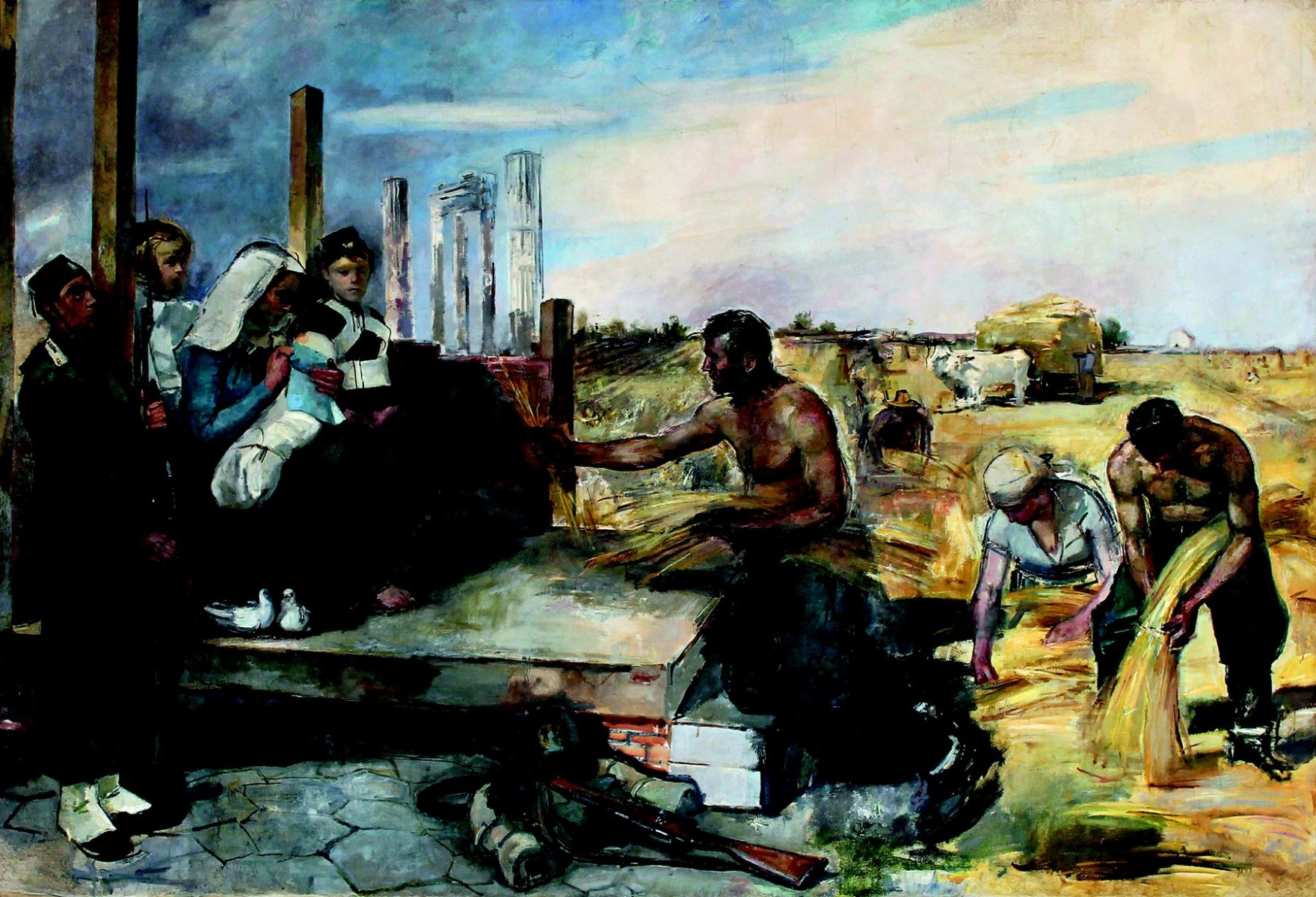
La battaglia del grano is a 1940 work by Neno Mori, the Venetian painter and master of landscape and still-life composition. Mori (1899–1968) trained at the Academy of Fine Arts in Venice and emerged as a significant figurative artist, maintaining distance from contemporary artistic fashions while building a reputation throughout Italy.
The work dates to the height of Mori’s career, when he was exhibiting regularly at major national institutions including the Venice Biennale, the Rome Quadriennale, and the Fondazione Bevilacqua La Masa. His disciplined approach to subject matter—grounded in close observation of landscape and still life—earned him several awards, among them the Premio Cremona and multiple prizes at Venice Biennales. Mori’s work from this period reflects the restrained aesthetic sensibility that defined his artistic practice across five decades of exhibition activity.
About Neno Mori
Neno Mori was born in Venice on 3 November 1899 and studied under Vittorio Emanuele Bressanin at the Academy of Fine Arts. From 1920 onward, he exhibited regularly at Ca’ Pesaro and encountered artists of the second generation of the Burano School, including Eugenio Da Venezia, Fioravante Seibezzi, Marco Novati, and Mario Varagnolo. A reserved figure who resisted artistic trends of his era, he died in Venice on 2 November 1968.
Details
- Artist: Neno Mori (Venice, 1899–1968)
- Year: 1940
- Movement: Figurative painting, Venetian School
- Exhibition history: Eight Venice Biennales, three Rome Quadriennales, Fondazione Bevilacqua La Masa
On video
Explore more: 318 heritage places in Venezia
Frequently asked questions
Who was Neno Mori?
Neno Mori (1899–1968) was a Venetian painter trained at the Academy of Fine Arts in Venice. He distinguished himself as a landscape and still-life painter, avoiding contemporary artistic fashions and earning national and international recognition through major exhibitions and awards.
Where did Mori exhibit his work?
Mori exhibited eight times at the Venice Biennale, three times at the Rome Quadriennale, and regularly at the Fondazione Bevilacqua La Masa, as well as at numerous national and international venues. He was a regular exhibitor at Ca’ Pesaro from 1920 onward.
What artistic circle did Mori belong to?
Mori encountered and worked alongside artists of the second generation of the Burano School, including Eugenio Da Venezia, Fioravante Seibezzi, Marco Novati, and Mario Varagnolo, though he remained a reserved, independent figure within the Venetian artistic community.
Sources
- S1 — Pontiggia, Elena. Il Novecento Italiano. Abscondita, 2003. ISBN 978-88-8416-048-5.
- S2 — Bossaglia, Rossana. Il Novecento italiano. Electa, 1995. ISBN 978-88-435-6178-0.
Spotted an error? Write to editorial@culturalheritageonline.com and we correct it the same day.


