
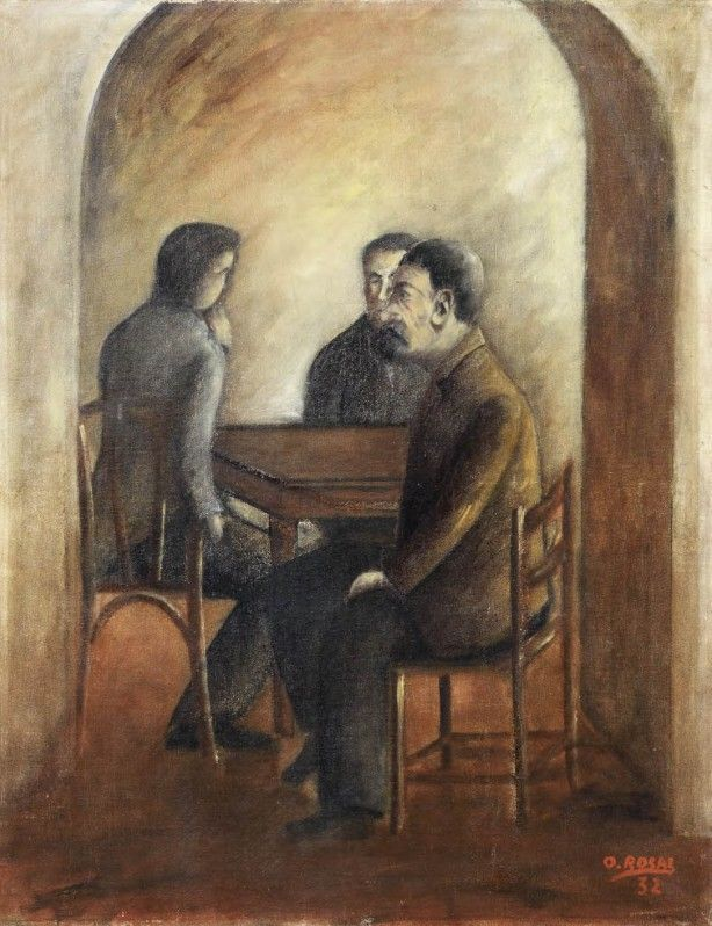
I professori is a painting completed in 1932 by Ottone Rosai, an Italian artist from Florence. The work dates to Rosai’s mature period, when he had established himself within the Novecento Italiano movement and the critical discourse of Italian modernism.
Rosai graduated from the Florence Academy of Fine Arts in 1912 and developed his artistic vision through contact with Florentine Futurist circles and the broader European avant-garde. After service in the First World War, he embraced the climate of return to order that characterised Italian art in the 1920s, turning his attention to the study of early Italian painters. By 1932, when I professori was created, Rosai had become a significant figure in contemporary Italian art, having exhibited at the Seconda Mostra del Novecento Italiano in Milan in 1929 and participated in the Venice Biennale from 1930 onwards.
About Ottone Rosai
Rosai (1895–1957) worked across painting, etching and drawing, maintaining a commitment to figuration and Italian artistic tradition throughout his career. His practice reflected the intellectual preoccupations of the Novecento Italiano: a negotiation between modernist formal innovation and the heritage of Italian art history.
Details
- Artist: Ottone Rosai (1895–1957)
- Title: I professori
- Year: 1932
- Born: Florence
- Movement: Novecento Italiano
Explore more: 118 heritage places in Firenze
Frequently asked questions
Who was Ottone Rosai?
Ottone Rosai was an Italian painter born in Florence in 1895. A graduate of the Florence Academy of Fine Arts, he was associated with early Futurist circles before adopting the return to order in the 1920s, and became a prominent figure in the Novecento Italiano movement.
What was the Novecento Italiano?
The Novecento Italiano was an artistic movement of early twentieth-century Italy that sought to reconcile modernist innovation with Italian cultural and artistic tradition, emphasizing figuration and a return to classical principles.
When did Rosai gain recognition?
Rosai held his first solo exhibition at Palazzo Capponi in Florence in 1920 and participated in the Seconda Mostra del Novecento Italiano in Milan in 1929, followed by regular participation in the Venice Biennale from 1930 onwards.
Sources
- S1 — Pontiggia, Elena. Il Novecento Italiano. Abscondita, 2003. ISBN 978-88-8416-048-5.
- S2 — Bossaglia, Rossana. Il Novecento italiano. Electa, 1995. ISBN 978-88-435-6178-0.
Spotted an error? Write to editorial@culturalheritageonline.com and we correct it the same day.


