
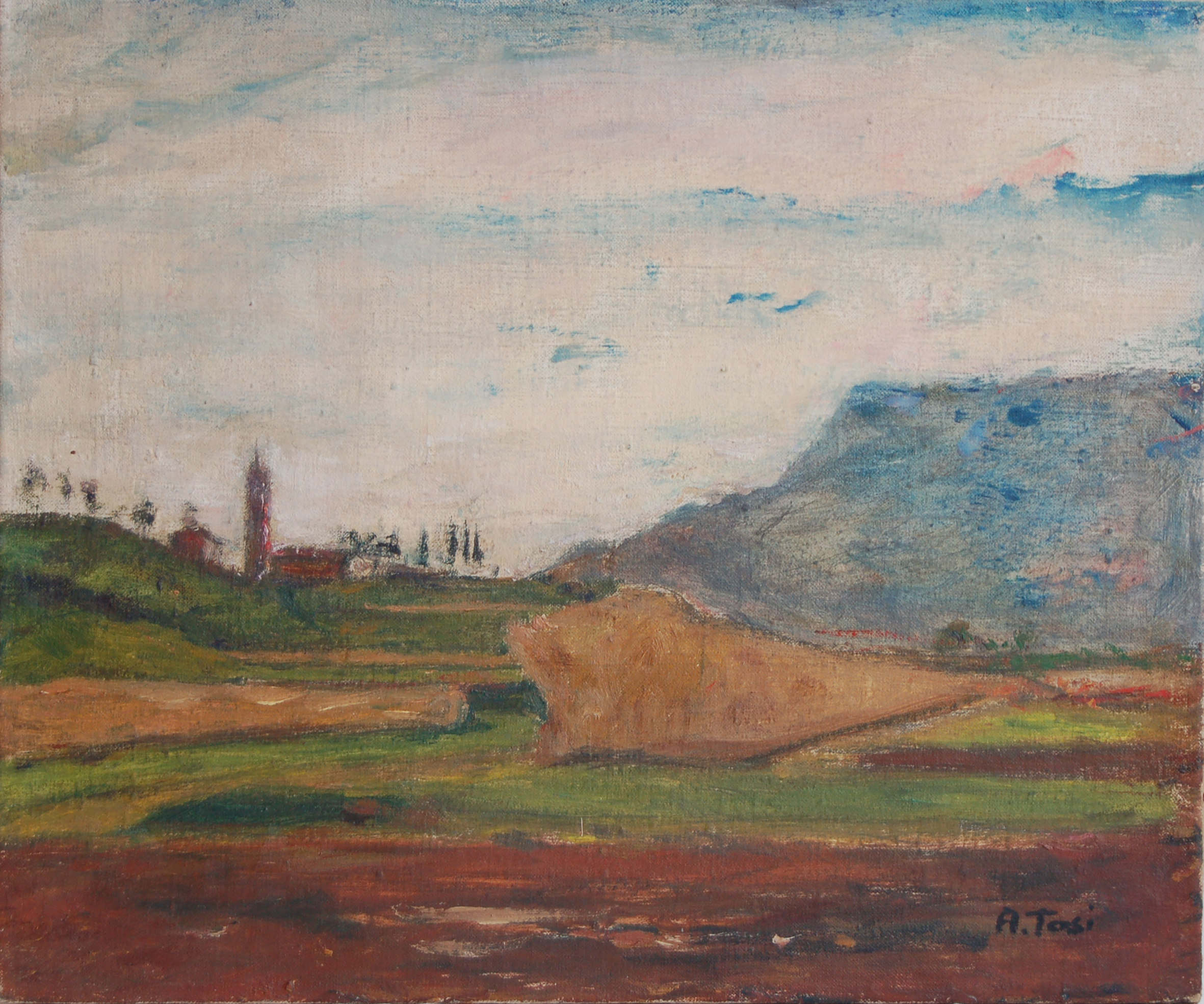
La Chiesetta di S. Lorenzo is a painting by Arturo Tosi, created in 1935. The work depicts a small church and reflects the artist’s sustained interest in landscape subjects during the interwar years.
Tosi was born in Busto Arsizio in 1871 and spent his career specialising in landscapes, particularly those of the Bergamo valleys. He studied at the Brera Academy of Fine Arts in Milan and participated in major Italian exhibitions from 1891 onwards, including the Venice Biennale beginning in 1909. In the 1920s, Tosi came into contact with critic Margherita Sarfatti and became an active member of the Novecento Italiano movement, participating in its exhibitions of 1926 and 1929 as well as international presentations of the group’s work.
About Arturo Tosi
By the 1930s, Tosi had established himself as one of Italy’s most respected painters. His practice remained rooted in landscape painting and the formal vocabulary developed through the Novecento Italiano, a movement that sought to return to order and tradition in Italian art. Tosi continued exhibiting regularly until his death in 1956.
Details
- Creator: Arturo Tosi
- Year: 1935
- Medium: Painting
- Movement: Novecento Italiano
Frequently asked questions
Who was Arturo Tosi?
Arturo Tosi (1871–1956) was an Italian painter known for his landscapes, particularly of the Bergamo valleys. He was a founding member of the Novecento Italiano movement and exhibited regularly at the Venice Biennale from 1909 until his death.
What was the Novecento Italiano?
The Novecento Italiano was an Italian artistic movement of the early twentieth century that advocated a return to formal order and classical tradition. Tosi participated in the movement’s exhibitions in Milan in 1926 and 1929, as well as international presentations.
What subjects did Tosi typically paint?
Tosi specialised in landscape painting throughout his career, with particular focus on the valleys around Bergamo and the broader Lombardy region.
Sources
- S1 — Pontiggia, Elena. Il Novecento Italiano. Abscondita, 2003. ISBN 978-88-8416-048-5.
- S2 — Bossaglia, Rossana. Il Novecento italiano. Electa, 1995. ISBN 978-88-435-6178-0.
Spotted an error? Write to editorial@culturalheritageonline.com and we correct it the same day.


