
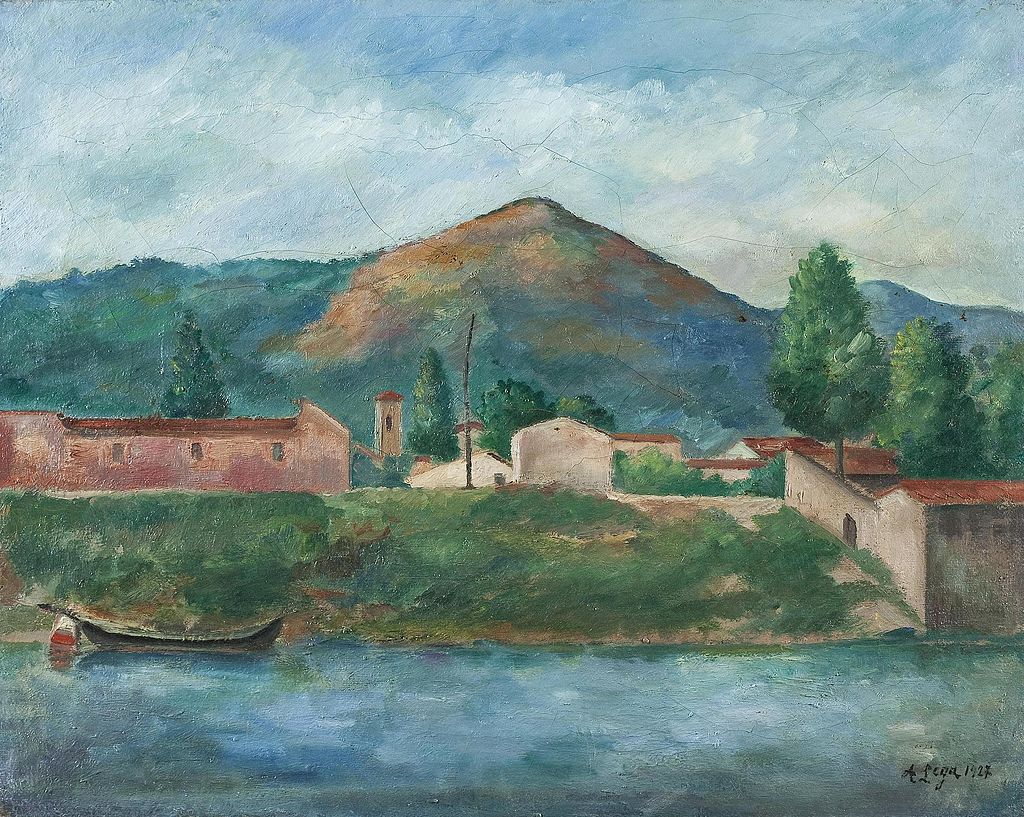
Achille Lega painted Arno in 1927. The work dates from the artist’s mature period, when he synthesized his earlier engagement with futurism and an emerging interest in cubist form.
Lega (1899–1934) was a Florentine painter whose artistic formation spanned the early twentieth-century avant-gardes. After studying under Ludovico Tommasi and at the Academy of Fine Arts in Florence, he gravitated toward the futurist circle that gathered at Caffè Giubbe Rosse, where he encountered Ardengo Soffici, Umberto Boccioni, and Filippo Tommaso Marinetti. These contacts shaped his approach to simplified, dynamic composition. By the 1920s, his work reflected a more structured cubist vocabulary while maintaining figurative clarity—a characteristic tension in interwar Italian modernism.
Arno exemplifies this phase: the river subject, rooted in Florentine geography and art tradition, receives treatment through fractured planes and consolidated forms rather than impressionistic observation. The painting documents Lega’s artistic trajectory during a decade of formal experimentation that ended with his death in 1934.
About Achille Lega
Lega was born in Brisighella in 1899 and settled in Florence at age ten. His early training emphasized Post-Macchiaioli naturalism, but contact with the futurist avant-garde redirected his practice toward abstraction and formal innovation. He maintained close artistic friendships, notably with painter Ottone Rosai, throughout his brief but productive career.
Details
- Artist: Achille Lega
- Title: Arno
- Year: 1927
- Artistic movements: Futurism, Cubism, Italian modernism
Frequently asked questions
Who was Achille Lega?
Achille Lega (1899–1934) was an Italian painter born in Brisighella who worked in Florence. He progressed from Post-Macchiaioli training to futurism and later cubism, influenced by circles that included Ardengo Soffici and Umberto Boccioni.
What artistic movements shaped this work?
By 1927, Lega had moved beyond pure futurism toward a cubist vocabulary, simplifying forms and using fractured compositional planes while maintaining figurative representation—a characteristic approach of Italian interwar modernism.
What is the significance of the Arno subject?
The Arno is Florence’s principal river and a recurring subject in Florentine art tradition; Lega’s treatment of it through modernist abstraction reflects his dialogue between local artistic heritage and twentieth-century formal innovation.
Sources
- S1 — Pontiggia, Elena. Il Novecento Italiano. Abscondita, 2003. ISBN 978-88-8416-048-5.
- S2 — Bossaglia, Rossana. Il Novecento italiano. Electa, 1995. ISBN 978-88-435-6178-0.
Spotted an error? Write to editorial@culturalheritageonline.com and we correct it the same day.


