
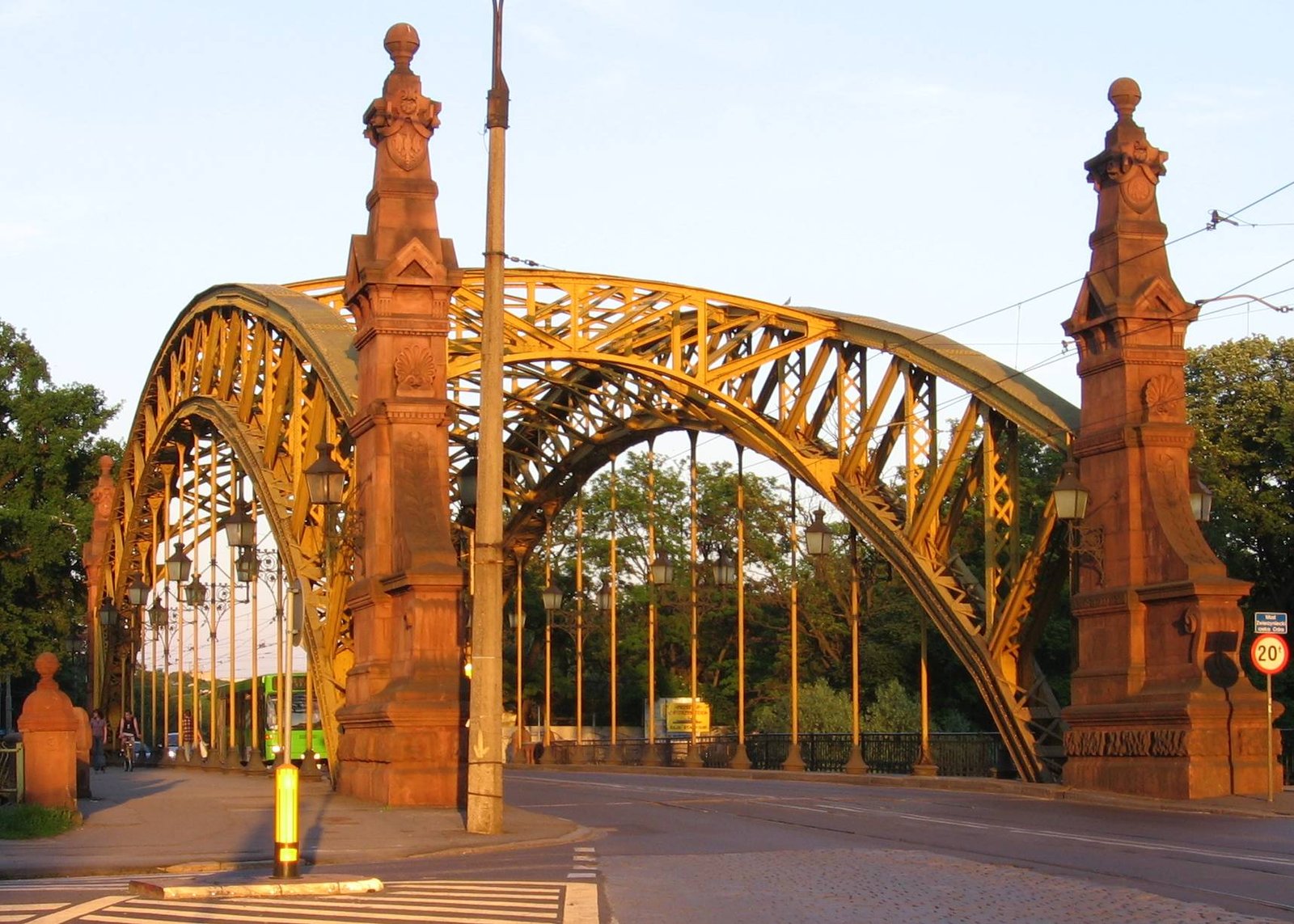
A steel arch bridge spanning the Oder River, celebrated for its Art Nouveau sandstone obelisks and pioneering engineering design from the late 19th century.
At a glance
Zwierzyniecki Bridge crosses the Oder in eastern Wrocław, linking the city centre to the zoo and Centennial Hall exhibition grounds. The single-span steel structure exemplifies turn-of-the-century industrial design, crowned with distinctive red sandstone ornaments and vintage street lamps.
History
A wooden bridge stood on this site from around 1655. By the 1890s, growing traffic demanded modernisation. Between 1895 and 1897, engineer Karl Klimm redesigned the crossing under city architect Richard Plüddemann’s supervision, with engineer A. Fruhwirth’s assistance.
During the 1945 siege of Festung Breslau, German soldiers planted explosives to prevent an expected attack from the east. The Red Army’s assault came from the south instead, leaving Zwierzyniecki Bridge untouched when so many others fell.
What you see
Two parallel-braced rib steel arches, spaced 12.5 metres apart, form the bridge’s core—a daring single-span design supported by granite abutments. Four Art Nouveau obelisks of red sandstone rise from the approaches, their geometric severity softened by period street lamps that illuminate the bridge after dark.
Cultural significance
Zwierzyniecki Bridge represents a pivotal moment when industrial engineering met artistic ambition. Its Art Nouveau ornaments signal Wrocław’s fin-de-siècle prosperity, while its survival through wartime destruction preserves a tangible link to the city’s complex 20th-century history.
Key facts
- Country: Poland
- City: Wrocław
- Completed: 1897
- Designer: Karl Klimm
- Coordinates: 51.1081°N, 17.07°E
Practical information & getting there
The bridge is in eastern Wrocław near the zoo and Centennial Hall. A nearby marina (Przystań Zwierzyniecka) operates tourist excursion boats along the Oder. For current access and visiting information, consult local tourism resources.
Sources & resources
Find it on the map
See this place and what’s around it →📷 Become a Cultural Heritage Online photographer
Share your photos of places: they stay published under your name as the author. The more they're seen, the more you get noticed — and soon a contest will reward the most appreciated photos.
Log in or sign up free to add a photoIs this page about you?
This page is read by travellers and heritage enthusiasts who find it on Google. Tell us how you are connected to this place and we will take it from there.