
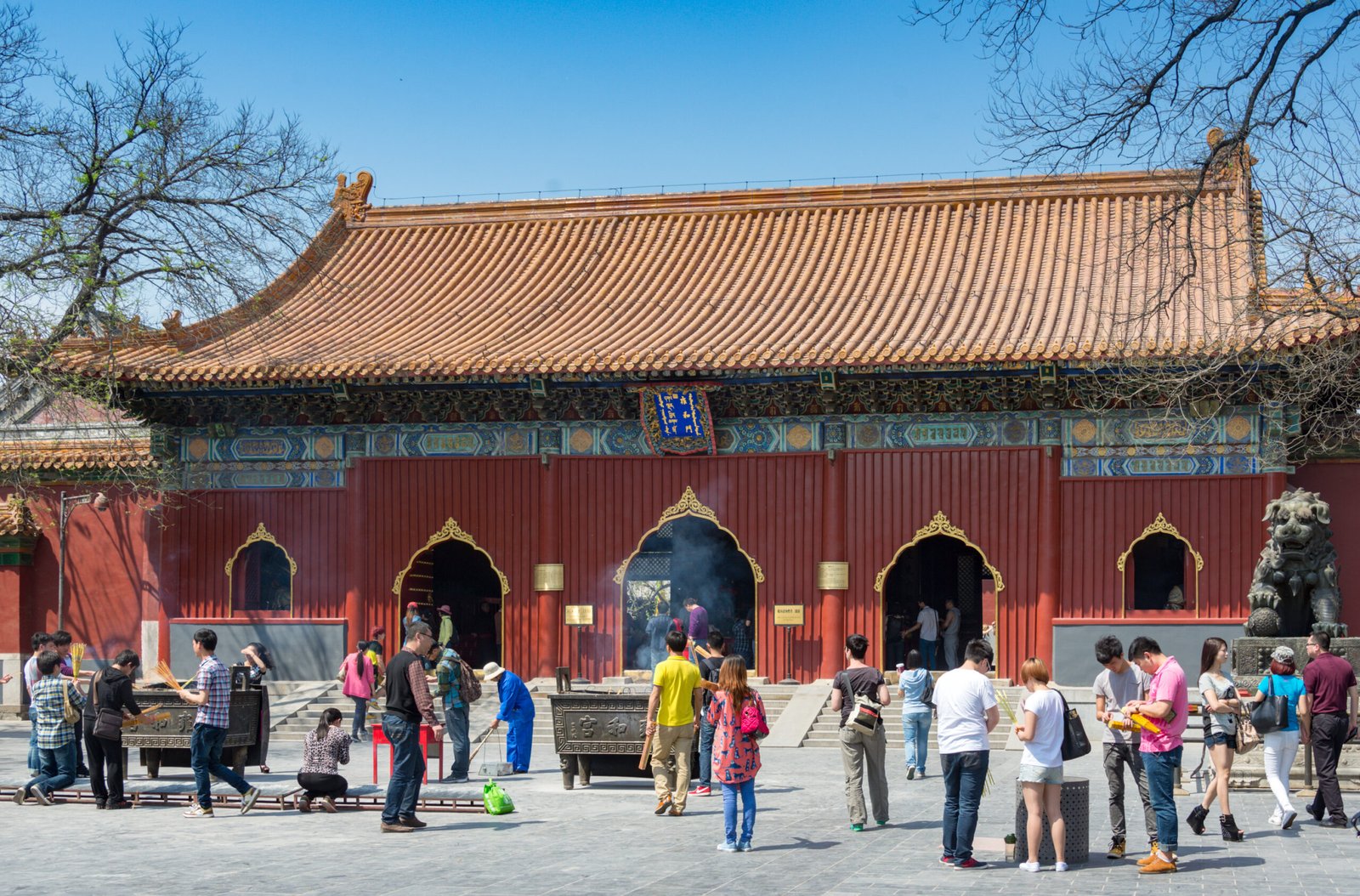
A harmonious synthesis of Han Chinese and Tibetan architectural traditions, this monastery stands as one of China’s most significant centers of Gelug Buddhism.
At a glance
The Yonghe Temple (雍和宮, ‘Palace of Harmony and Peace’) is a functioning monastery and temple complex in Beijing’s Dongcheng District. Its architectural fabric blends two distinct traditions into a unified whole. Today it remains a major pilgrimage site and cultural institution.
History
During the middle and late Qing dynasty, the Yonghe Temple held the highest Buddhist religious status in the country. Its prominence reflects the imperial court’s engagement with Tibetan Buddhism and the complex spiritual landscape of imperial China. The monastery continues its religious functions today under the direction of Lama Hu Xuefeng.
What you see
The temple and its artwork represent a deliberate fusion of Han Chinese and Tibetan styles. This combination is visible throughout the complex—from structural design to decorative schemes. The integration of these traditions creates a distinctive aesthetic found nowhere else in China proper. The monastery complex contains multiple halls and courtyards arranged according to Buddhist liturgical principles.
Cultural significance
The Yonghe Temple is among the largest Tibetan Buddhist monasteries within China proper, making it a crucial touchstone for understanding both Buddhist practice and Sino-Tibetan cultural exchange. Its architectural style documents historical contact and creative synthesis between distinct religious and aesthetic traditions. The temple remains an active center for Buddhist teaching and ritual practice.
Key facts
- Location: 12 Yonghegong Street, Dongcheng District, Beijing, China
- Coordinates: 39.9469°N, 116.4111°E
- Affiliation: Gelug school of Tibetan Buddhism
- Current abbot: Lama Hu Xuefeng
- Architectural style: Han Chinese and Tibetan fusion
Practical information & getting there
The temple is accessible year-round to visitors. You can reach it via Beijing’s public transportation network—the site’s central location in Dongcheng District makes it convenient to access from other major cultural institutions. Check opening hours and any entry requirements before your visit.
Sources & resources
Find it on the map
See this place and what’s around it →📷 Become a Cultural Heritage Online photographer
Share your photos of places: they stay published under your name as the author. The more they're seen, the more you get noticed — and soon a contest will reward the most appreciated photos.
Log in or sign up free to add a photoIs this page about you?
This page is read by travellers and heritage enthusiasts who find it on Google. Tell us how you are connected to this place and we will take it from there.