
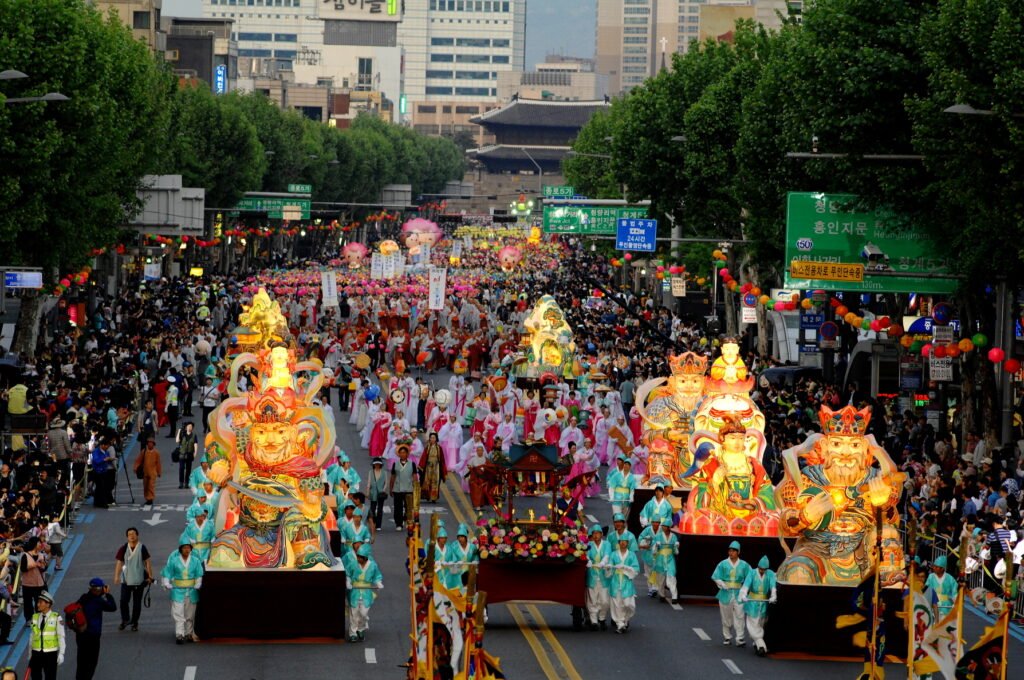
A lantern-lighting festival celebrating Buddha’s Birthday, where thousands of paper lanterns—glowing symbols of light, hope, and unity—illuminate Korean streets and temples across the lunar calendar’s fourth month.
At a glance
Yeondeunghoe is Korea’s most significant Buddhist festival, observed on the eighth day of the fourth lunar month. The practice centers on the creation and lighting of lanterns, which participants carry through streets and display in temples, transforming public and sacred spaces into fields of soft illumination. The festival draws families, monks, and devotees across South Korea.
Origins & history
Yeondeunghoe marks the commemoration of Buddha’s Birthday within Korea’s Buddhist tradition. The practice of lighting lanterns as spiritual offering and celebration has deep roots in Korean religious life, weaving together Buddhism with community ritual.
The practice
Participants craft and display lanterns of diverse shapes and sizes, from traditional lotus-shaped paper lanterns to elaborate figural forms. The lanterns, lit from within, create scenes of collective luminescence across temples, streets, and waterways. Processions move through neighborhoods carrying lanterns aloft; temples host evening gatherings where the glow accumulates into visual prayer. The lanterns themselves embody the festival’s central meanings: light dispelling darkness, hope kindled through community, and unity expressed through shared participation.
Cultural significance
Yeondeunghoe represents a living fusion of Buddhist spirituality and Korean social identity. The festival reinforces connection between individuals, families, and the broader community through collective ritual. For practitioners, the act of lighting and displaying lanterns carries both spiritual intention and aesthetic power, renewing cultural memory and religious devotion across generations.
Key facts
- Celebrated on the eighth day of the fourth lunar month in South Korea
- UNESCO Intangible Cultural Heritage (2008, reference 00882)
- Anchor community: Seoul
- Festival name translates variously as Lotus Lantern Festival or Lantern-Lighting Festival
- Lanterns symbolize light, hope, and unity
Where to experience it
Seoul remains the festival’s heartland, where temples and streets host public gatherings and lantern displays during the lunar calendar’s fourth month. Major Buddhist temples throughout South Korea also organize Yeondeunghoe celebrations and processions.
Sources & resources
Find it on the map
See this place and what’s around it →📷 Become a Cultural Heritage Online photographer
Share your photos of places: they stay published under your name as the author. The more they're seen, the more you get noticed — and soon a contest will reward the most appreciated photos.
Log in or sign up free to add a photo