For over a thousand years, artisans in Xuancheng have crafted xuan paper, the soft, fine-textured sheet prized by calligraphers and painters across East Asia. Each sheet emerges from a labour-intensive process that transforms plant fibres into a surface capable of holding both the most delicate brushstroke and the boldest ink wash.
In UNESCO’s words
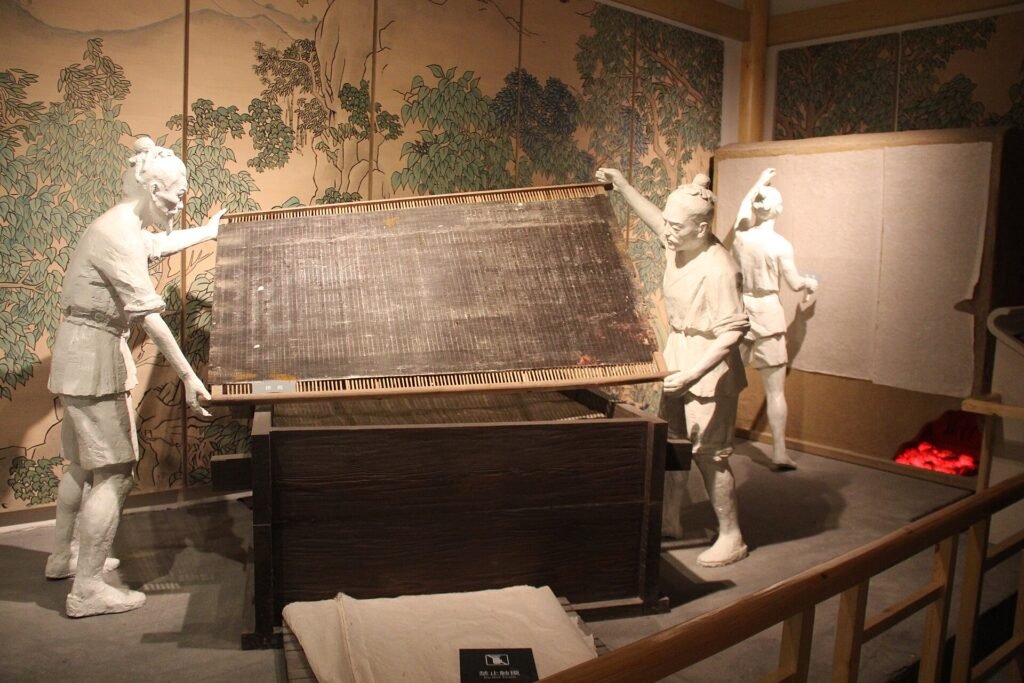
The unique water quality and mild climate of Jing County in Anhui Province in eastern China are two of the key ingredients in the craft of making Xuan paper that thrives there. Handmade from the tough bark of the Tara Wing-Celtis or Blue Sandalwood tree and rice straw, Xuan paper is known for its strong, smooth surface, its ability to absorb water and moisten ink, and fold repeatedly without breaking. It has been widely used in calligraphy, painting and book printing. The traditional process passed down orally over generations and still followed today proceeds strictly by hand through more than a hundred steps such as steeping, washing, fermenting, bleaching, pulping, sunning and cutting – all of which lasts more than two years. The production of the ‘Paper of Ages’ or ‘King of Papers’ is a major part of the economy in Jing County, where the industry directly or indirectly employs one in nine locals and the craft is taught in local schools. True mastery of the entire complicated process is won only by a lifetime of dedicated work. Xuan paper has become synonymous with the region, where a score of artisans still keep the craft alive.
Official description, UNESCO Intangible Cultural Heritage List — Traditional handicrafts of making Xuan paper
At a glance
Xuan paper is handmade writing and painting paper produced in Jing County in eastern China. Made from the bark of the Tara Wing-Celtis or Blue Sandalwood tree and rice straw, it is prized for its strong, smooth surface, its ability to absorb water and moisten ink, and its capacity to fold repeatedly without breaking. The paper has been widely used in calligraphy, painting and book printing.
Origins & history
The traditional process of making Xuan paper has been passed down orally over generations and continues to follow the same methods today. The craft developed in response to the unique water quality and mild climate of Jing County, conditions that remain central to production. True mastery of the entire complicated process requires a lifetime of dedicated work.
The practice
Production follows a strict handmade process of more than a hundred steps—steeping, washing, fermenting, bleaching, pulping, sunning and cutting—lasting more than two years. All work is done by hand without mechanization. The craft is taught in local schools, and knowledge passes through generations. A score of artisans still keep the craft alive in Jing County.
Cultural significance
Xuan paper production is a major part of the economy in Jing County, directly or indirectly employing one in nine locals. The paper has become synonymous with the region itself. Its continuation depends on maintaining both the traditional methods and the community's commitment to preserving this centuries-old craft.
Key facts
- Country: China
- Inscribed: 2009
- UNESCO list: Representative List of the Intangible Cultural Heritage of Humanity
- UNESCO reference: 00201
- UNESCO vocabulary: Paper; Technical skills
- Map: Jing County — the locality named in UNESCO’s official description of this element
- Related World Heritage site: Ancient Villages in Southern Anhui – Xidi and Hongcun (a different UNESCO designation, not the place of the tradition)
Where to experience it
Jing County in Anhui Province remains the living centre of Xuan paper craft. Visitors can observe artisans at work in family workshops and witness the transformation of raw fibres into finished sheets through more than a hundred traditional steps. The craft is deeply woven into local life, taught in schools and supporting one in nine residents. Museums in the region document the history and techniques of this centuries-old tradition, while local markets showcase papers made using time-honoured methods that have been passed down through generations.
Sources & resources
- UNESCO — official element page: Traditional handicrafts of making Xuan paper
- UNESCO — open data record: Intangible Heritage List, reference 00201
- UNESCO — official video: UNESCO film on this element — embedded on this page
- UNESCO — official photograph: Photograph of this element — Huang Feisong, 2008
- Reference — Wikipedia (secondary): Xuan paper — consulted as a secondary reference, not as confirmation
- Cultural Heritage Online: Our archive and city guides

Find it on the map
See this place and what’s around it →📷 Become a Cultural Heritage Online photographer
Share your photos of places: they stay published under your name as the author. The more they're seen, the more you get noticed — and soon a contest will reward the most appreciated photos.
Log in or sign up free to add a photo