

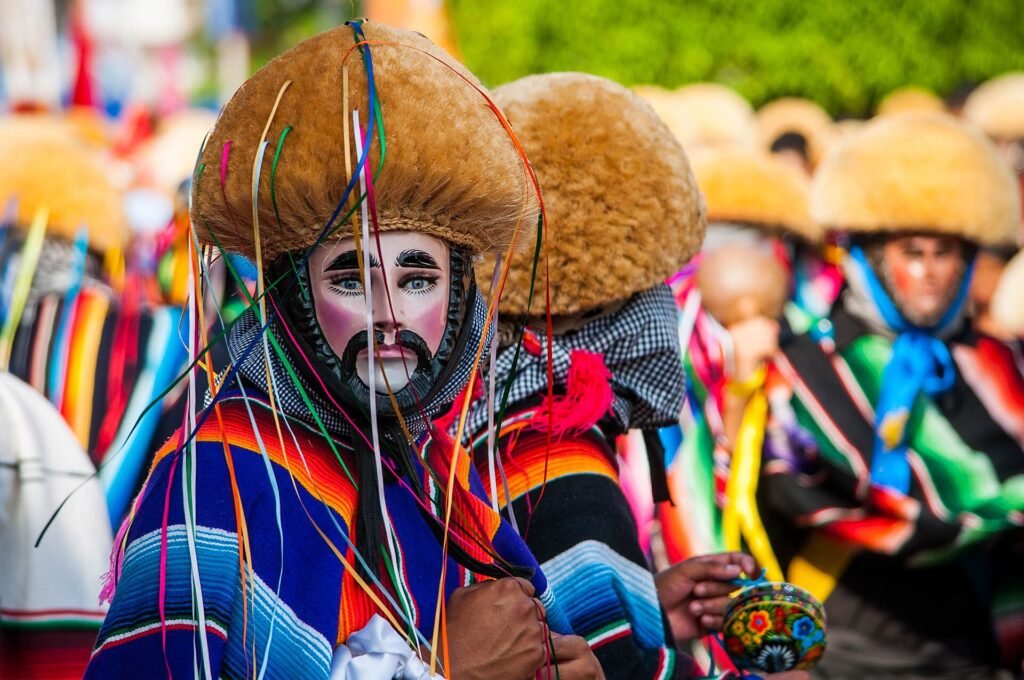
Street dancers in vibrant costumes honor the patron saints of Chiapa de Corzo each January, blending indigenous Maya ceremony with Catholic celebration in a festival that bridges centuries.
In UNESCO’s words
The traditional Great Feast takes place from 4 to 23 January every year in Chiapa de Corzo, Mexico. This celebration of music, dance, handicrafts, gastronomy, religious ceremonies and feasting takes place in honour of three Catholic saints: Saint Anthony Abbot, Our Lord of Esquipulas and, most importantly, Saint Sebastian. The dances of the Parachicos – the word refers both to the dancers and to the dance – are considered a communal offering to these saints. They start in the morning and conclude at night, as the dancers carry statues of saints throughout the city, visiting places of worship. Each dancer wears a carved wooden mask with headdress, serape, embroidered shawl and multicoloured ribbons, and plays ''chinchines'' (maracas). The dancers are led by the severely-masked Patron, who carries a guitar and whip, while playing a flute accompanied by one or two drummers. As they dance, he intones praises to which the Parachicos respond with cheers. The dance is transmitted and learned simultaneous with its performance, with young children taking part, imitating the adult dancers. The technique of mask-making is passed from generation to generation, including cutting of the wood, drying, carving and decorating. The dance of the Parachicos during the Great Feast embraces all spheres of local life, promoting mutual respect among communities, groups and individuals.
Official description, UNESCO Intangible Cultural Heritage List — Parachicos in the traditional January feast of Chiapa de Corzo
At a glance
Parachicos are traditional dancers who perform during the Great Feast held annually from 4 to 23 January in Chiapa de Corzo. The celebration honors three Catholic saints: Saint Anthony Abbot, Our Lord of Esquipulas, and Saint Sebastian. Dancers wear carved wooden masks with headdresses, serapes, embroidered shawls, and multicolored ribbons while playing chinchines (maracas). The dances, which run from morning to night, are considered a communal offering to the saints and involve carrying statues of saints throughout the city to visit places of worship.
Origins & history
The Parachico festival is thought to have developed from the meeting of indigenous and Spanish Catholic traditions. Like many religious observances across Latin America, it blends older Maya and pre-Hispanic practices with Catholic veneration and Spanish influence. At the heart of Chiapa de Corzo stands an ancient tree within the church where the festival concludes—a tree residents say predates the building itself and is said to represent the “tree of life” found in Maya and other American indigenous cosmologies, suggesting the site held ceremonial significance long before Catholic colonization.
The practice
Each Parachico dancer wears a carved wooden mask with headdress, serape, embroidered shawl, and multicolored ribbons while playing chinchines. A severely-masked Patron leads the dancers, carrying a guitar and whip while playing a flute, accompanied by one or two drummers. The Patron intones praises to which the Parachicos respond with cheers. Young children learn the dance by imitating adult dancers during performances. The mask-making technique—involving cutting, drying, carving, and decorating wood—passes from generation to generation.
Cultural significance
The Parachicos dance embraces all spheres of local life and promotes mutual respect among communities, groups, and individuals. The practice is transmitted and learned simultaneously with its performance, ensuring continuity across generations through direct participation and observation.
Key facts
- Country: Mexico
- Inscribed: 2010
- UNESCO list: Representative List of the Intangible Cultural Heritage of Humanity
- UNESCO reference: 00399
- UNESCO vocabulary: Festivals; Religious practice; Saints
- Map: Chiapa de Corzo — the locality named in UNESCO’s official description of this element
Where to experience it
Each January, Chiapa de Corzo hosts the Great Feast from 4 to 23, when Parachico dancers carry statues of saints through the city's streets and places of worship. Visitors can witness the elaborately masked dancers in their carved wooden masks, serapes and ribbons, playing chinchines as they perform their communal offering. The Patron leads the procession with guitar and whip, accompanied by drummers, while intoning praises to which the Parachicos respond with cheers. The celebration encompasses music, dance, handicrafts, gastronomy and religious ceremonies honouring Saint Anthony Abbot, Our Lord of Esquipulas and Saint Sebastian, drawing residents and visitors to experience this tradition that spans all spheres of local life.
Sources & resources
- UNESCO — official element page: Parachicos in the traditional January feast of Chiapa de Corzo
- UNESCO — open data record: Intangible Heritage List, reference 00399
- UNESCO — official photograph: Photograph of this element — Bob Schalkwijk — 2009 Coordinación Ejecutiva para la conmemoración del Bicentenario de la Independencia Nacional y del Centenario de la Revolución Mexicana del Estado de Chiapas
- Reference — Wikipedia (secondary): Parachico — consulted as a secondary reference, not as confirmation
- Cultural Heritage Online: Our archive and city guides

Find it on the map
See this place and what’s around it →📷 Become a Cultural Heritage Online photographer
Share your photos of places: they stay published under your name as the author. The more they're seen, the more you get noticed — and soon a contest will reward the most appreciated photos.
Log in or sign up free to add a photo