
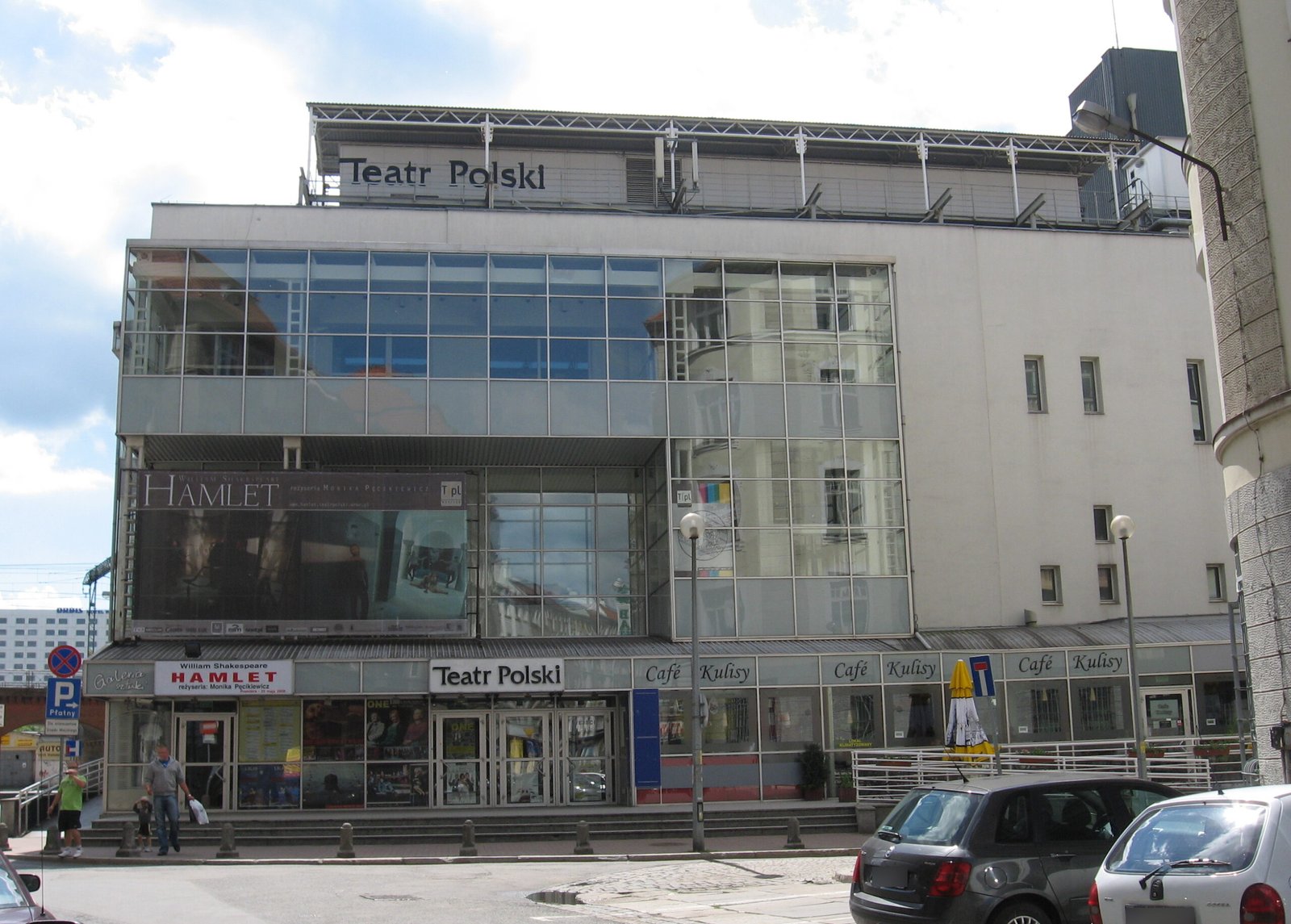
A landmark theatre complex showcasing three stages across historic and contemporary venues, from its 1909 main building designed by Berlin architect Walter Hentschel to its modern reconstruction after a devastating 1994 fire.
At a glance
The Polish Theatre operates across three distinct stages: the Jerzy Grzegorzewski Stage in the historic main building at 3 Zapolska Street, the Small Stage on Świdnicka Street, and the “Na Świebodzkim” Stage inside Świebodzki railway station. A functioning cultural institution since 1950, the theatre balances its classical architectural heritage with contemporary performance spaces.
History
Wrocław merchant Paul Auerbach commissioned the main building, completed in 1909 by Berlin architect Walter Hentschel. The structure was both functionally advanced and technically sophisticated for its era—by the early 1930s, with 1,736 seats, it was Wrocław’s largest stage, originally serving as the Schauspielhaus (German-language playhouse) and specializing in operetta.
World War Two inflicted partial damage on the building. Reconstruction began in 1950, culminating in the theatre’s reopening on February 20, 1950, with the premiere of A Thousand Brave Men, a socialist-realist drama by architect Jan Rojewski about workers rebuilding Poland’s war-damaged cities. The auditorium was destroyed by fire on the night of January 18, 1994. Witold Jackiewicz oversaw its reconstruction, and the theatre reopened on May 20, 1996, with Wroclaw Improvisations, directed by Andrzej Wajda.
What you see
The main 1909 building exemplifies early-twentieth-century theatre design, combining impressive scale with advanced technical systems. Its post-1996 reconstruction preserves the original architectural language while integrating modern performance capabilities. The three-stage configuration reflects both historical continuity and institutional expansion, with the Świebodzki railway station venue representing an imaginative adaptive use of existing infrastructure.
Cultural significance
The theatre marks a pivotal moment in Wrocław’s cultural recovery and reinvention after 1945, when Poland’s territorial shifts brought Polish populations into the formerly German city. The 1950 opening with ideologically charged Polish drama symbolized cultural reclamation. Andrzej Wajda’s 1996 directorial involvement underscored the institution’s restored prominence in Polish theatrical life.
Key facts
- Country: Poland
- City: Wrocław
- Main building completed: 1909
- Architect of main building: Walter Hentschel (Berlin)
- Original capacity: 1,736 seats
- Reopened after reconstruction: February 20, 1950; May 20, 1996
- Coordinates: 51.101226, 17.026352
Practical information & getting there
The main theatre is located at 3 Zapolska Street in central Wrocław. The Small Stage occupies 28 Świdnicka Street, while the “Na Świebodzkim” Stage operates from within Świebodzki railway station at 20c Orląt Lwowskich Square. For current performance schedules, admission fees, and opening hours, consult the theatre’s official website.
Sources & resources
Find it on the map
See this place and what’s around it →📷 Become a Cultural Heritage Online photographer
Share your photos of places: they stay published under your name as the author. The more they're seen, the more you get noticed — and soon a contest will reward the most appreciated photos.
Log in or sign up free to add a photoIs this page about you?
This page is read by travellers and heritage enthusiasts who find it on Google. Tell us how you are connected to this place and we will take it from there.