
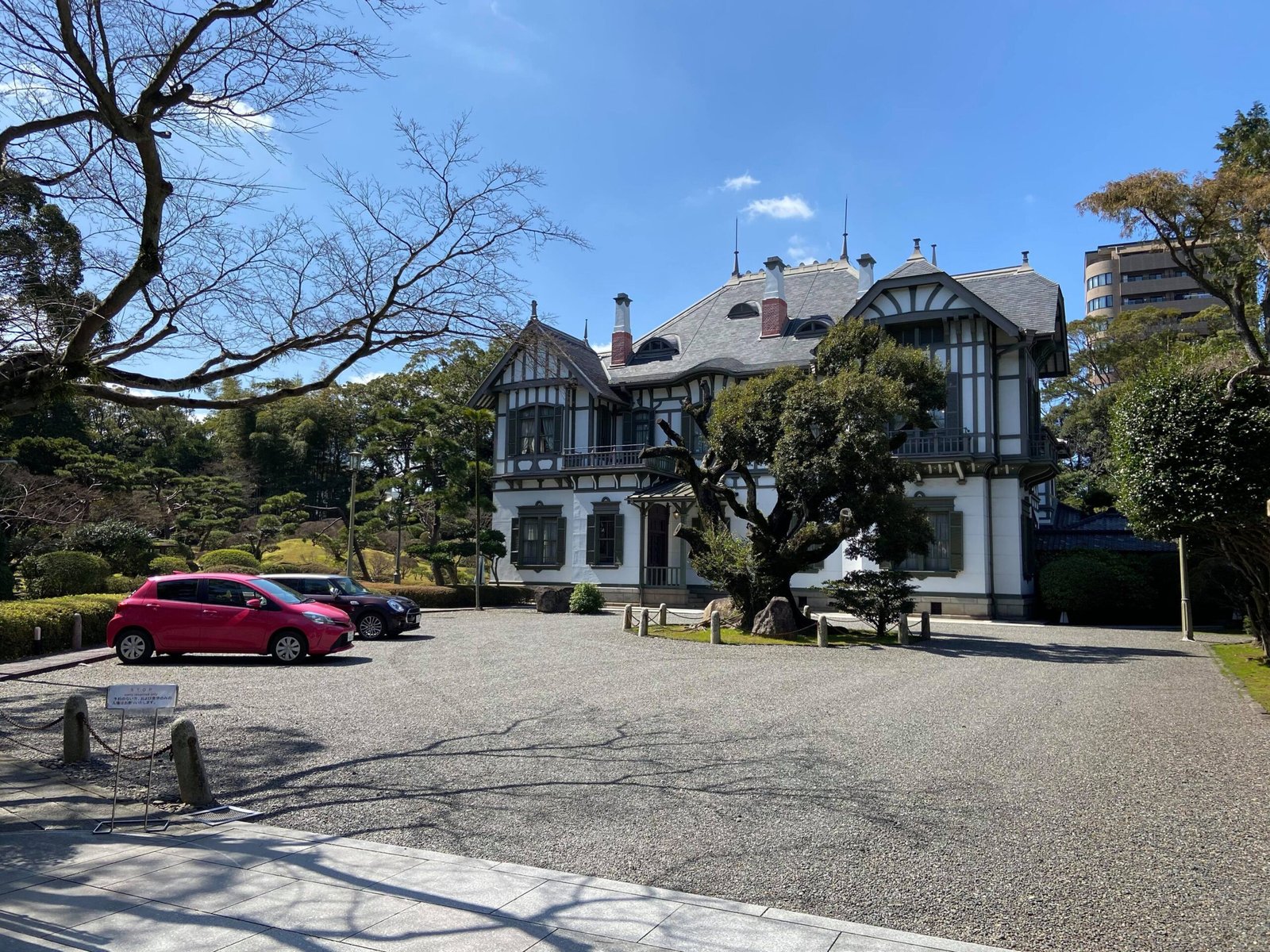
The only surviving private residence designed by Meiji architect Tatsuno Kingo, this grand mansion in Kitakyushu blends Japanese and Western aesthetics within its stately walls.
At a glance
A designated national cultural asset and former private residence, the West Japan Industrial Club opens to visitors twice yearly. The main Western-style house is accompanied by a traditional Japanese-style building, and the site now hosts a restaurant and concert performances.
History
Built originally for Matsumoto Kenjiro, a wealthy industrialist and founder of the nearby Kyushu Institute of Technology, the mansion represents the aspirations of Japan’s industrial elite during the early twentieth century. Designed by Tatsuno Kingo, one of Meiji Japan’s most accomplished architects, it remains his only surviving private house.
The building gained wider cultural recognition when it served as a filming location for the 2003 film Spy Sorge, which chronicles the life of Soviet intelligence agent Richard Sorge.
What you see
The residence exemplifies the period’s architectural hybridity. The main structure demonstrates Western design principles and materials, while a complementary Japanese-style house showcases traditional timber construction and spatial organization. This dual arrangement reflects the cultural negotiation characteristic of Japan’s modern transformation.
Cultural significance
As Tatsuno Kingo’s sole surviving private commission, the West Japan Industrial Club documents a pivotal moment in Japanese residential architecture. The building illustrates how industrial wealth shaped domestic space, and how Western architectural idioms were adapted within Japanese contexts during the Meiji and Taishō periods.
Key facts
- Country: Japan
- Location: Tobata-ku, Kitakyushu
- Coordinates: 33.88°N, 130.84°E
- Architect: Tatsuno Kingo
- Original owner: Matsumoto Kenjiro
- Status: National cultural asset
- Public access: Twice yearly
Practical information & getting there
The West Japan Industrial Club operates as a museum and cultural venue with limited public hours—visits are permitted twice per year. The site features a functioning restaurant and hosts musical performances. Check ahead for current opening dates and any special events. The location in Tobata ward is accessible by local Kitakyushu transportation.
Sources & resources
Find it on the map
See this place and what’s around it →📷 Become a Cultural Heritage Online photographer
Share your photos of places: they stay published under your name as the author. The more they're seen, the more you get noticed — and soon a contest will reward the most appreciated photos.
Log in or sign up free to add a photoIs this page about you?
This page is read by travellers and heritage enthusiasts who find it on Google. Tell us how you are connected to this place and we will take it from there.