
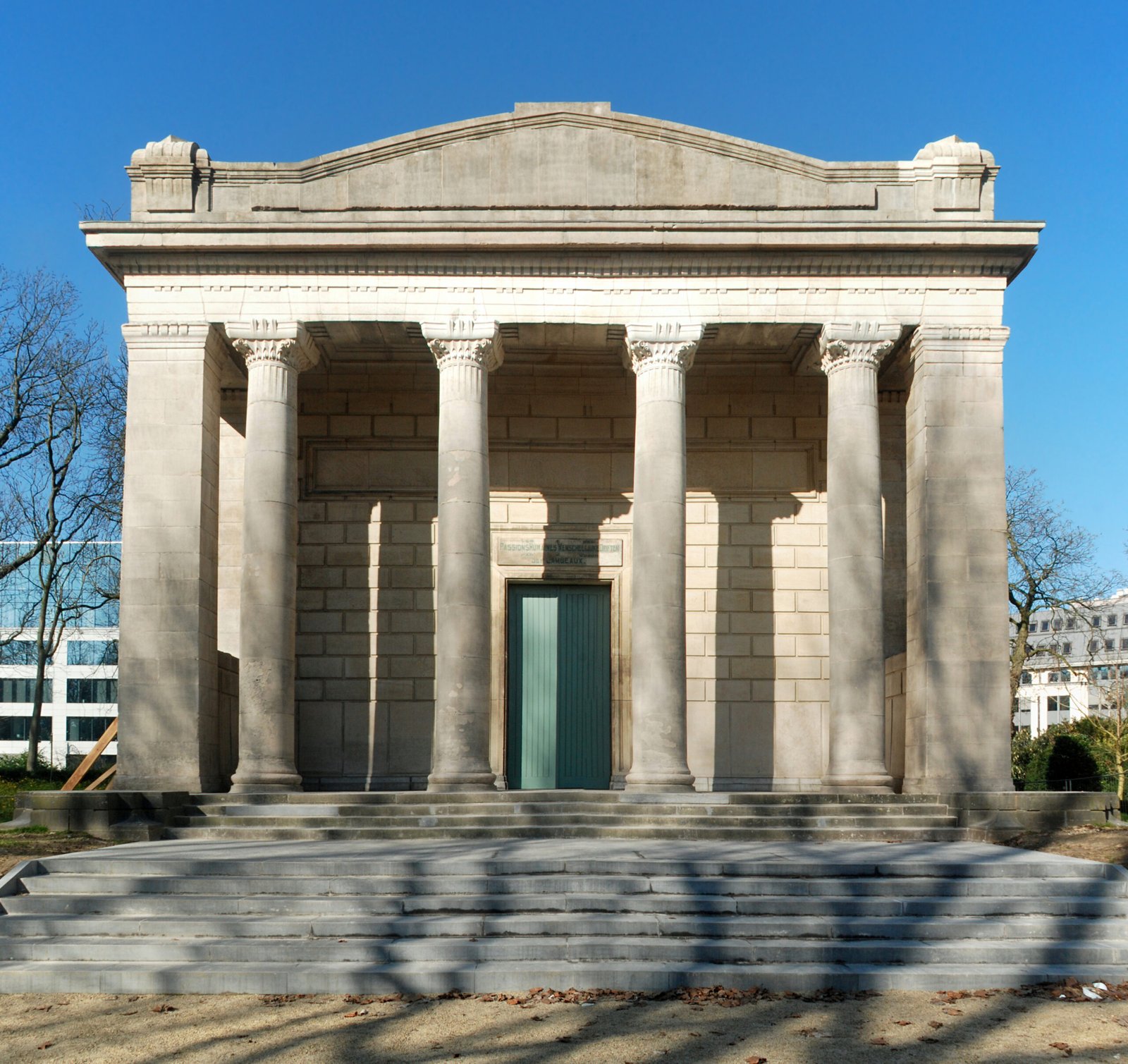
Victor Horta’s neoclassical temple in Brussels houses a monumental marble relief by Jef Lambeaux, marking the architect’s early steps toward Art Nouveau.
At a glance
A Greek temple-form pavilion in Parc du Cinquantenaire, designed to permanently display one of Belgium’s most significant sculptural works. The building exemplifies the tension between classical restraint and modern innovation in late 19th-century Belgian design.
History
Commissioned by the Belgian state, the Pavilion was built between 1891 and 1897 to showcase Jef Lambeaux’s monumental marble relief, The Human Passions. Designed by architect Victor Horta, it was conceived as a permanent home for this major work of Belgian sculpture.
Since completion, the building endured long closures and limited public access, with ongoing debates about artwork conservation and display. Following restoration work, it has reopened periodically to visitors since 2014 and remains under the care of the Royal Museums of Art and History (RMAH).
What you see
The pavilion adopts the form of a Greek temple, grounding its design in neoclassical principles. Yet despite this classical appearance, Horta embedded early modernist touches—the structure represents his first steps toward the Art Nouveau language that would define his mature work.
Inside, Lambeaux’s monumental marble relief remains the architectural and artistic focal point, the building serving wholly as its frame and protector.
Cultural significance
The pavilion stands as a landmark in Belgian architectural transition. Horta’s design bridges 19th-century academic tradition and early 20th-century innovation, while Lambeaux’s sculpture exemplifies Belgian Romantic sculptural ambition.
The building’s troubled conservation history reflects broader European debates about public art stewardship and the proper display of monumental works in changing cultural contexts.
Key facts
- Location: Parc du Cinquantenaire, Brussels, Belgium
- Coordinates: 50.8431°N, 4.3874°E
- Designed by: Victor Horta
- Built: 1891–1897
- Sculptor (relief): Jef Lambeaux
- Managed by: Royal Museums of Art and History (RMAH)
- Periodic public access: Since 2014
Practical information & getting there
The pavilion is situated within Parc du Cinquantenaire, one of Brussels’s principal public parks. It is managed by the RMAH and opens periodically; visitors should verify current opening hours and access arrangements before visiting. The park is well connected by public transport in central Brussels.
Sources & resources
Find it on the map
See this place and what’s around it →
📷 Become a Cultural Heritage Online photographer
Share your photos of places: they stay published under your name as the author. The more they're seen, the more you get noticed — and soon a contest will reward the most appreciated photos.
Log in or sign up free to add a photoIs this page about you?
This page is read by travellers and heritage enthusiasts who find it on Google. Tell us how you are connected to this place and we will take it from there.