
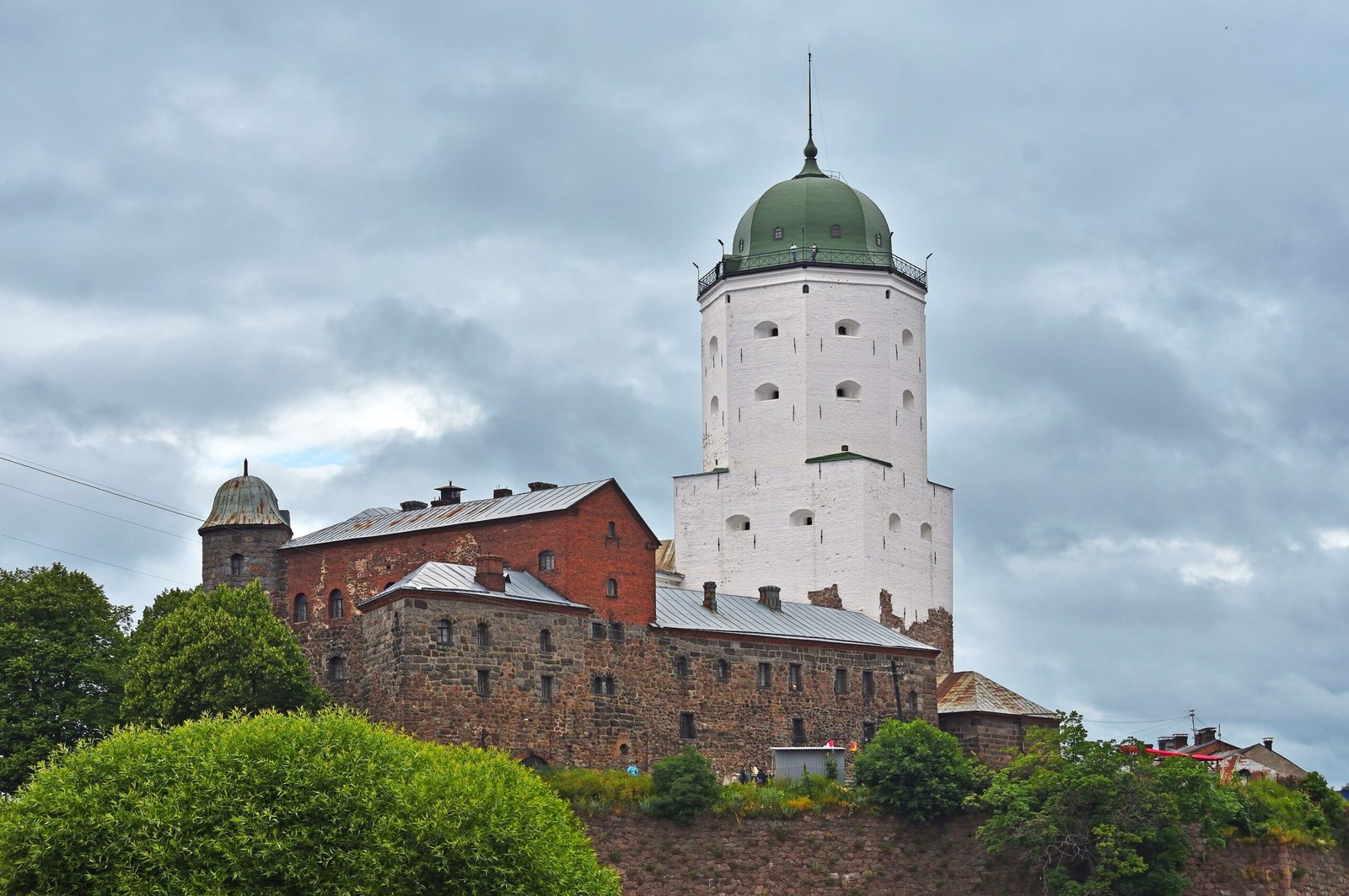
On a small islet where two bays meet, this Swedish-built fortress once guarded the eastern edge of a medieval kingdom, and still watches over the strait it was raised to defend.
At a glance
Vyborg Castle stands on an islet in a narrow strait connecting Zashchitnaya Bay to Vyborg Bay, on the Karelian Isthmus. Construction began in 1293 under Torkel Knutsson, Lord High Constable of Sweden, following the Third Swedish Crusade. It ranked among the three principal medieval castles of Finland, alongside Turku and Hämeenlinna. Today the site houses the Vyborg Regional Museum.
History
Excavations in the 1980s uncovered traces of an earlier Karelian fort beneath the Swedish structure, including a man-made sand breastwork and a bent sword dated to the 12th century. The Swedish fortress that followed became the linchpin of the crown’s presence in Karelia, second in strategic importance only to Stockholm. Its fief grew so powerful that governors, drawn from Sweden’s leading families, ruled it almost as an independent principality. Firearms are first recorded in Finland here, in 1429. The castle withstood repeated Russian sieges, most famously in 1495, when a sudden, unexplained explosion — remembered as the Viborg blast — reportedly scattered the besieging force on St. Andrew’s Day. Russia finally took the fortress in 1710. It returned to Finnish administration in 1812 within the Grand Duchy, was reshaped by major renovations in the 1890s, and served Russian imperial military housing until 1918. Border changes after the Second World War brought it under Soviet, then Russian, control in 1944.
What you see
The main castle occupies the islet’s highest ground, in its eastern corner. Its plan is irregular and four-cornered, built for defense rather than symmetry. Dominating the whole is the tower of St. Olav, three to four storeys depending on the section. Outer defensive works trace the shoreline around it, layering fortification upon fortification. Much of the present fabric reflects the 1890s restoration rather than the medieval original.
Cultural significance
Few structures embody the long Swedish-Novgorod and later Swedish-Russian frontier as directly as Vyborg Castle. It anchored a fief so autonomous its governors functioned as regional rulers, among them a future king, Karl Knutsson Bonde. The legendary 1495 blast lent the site an almost mythic status in Finnish and Swedish memory. Passing between Swedish, Russian, Finnish, and Soviet hands, the castle’s history mirrors the shifting borders of the whole region.
Key facts
- Location: Vyborg, Russia, on an islet in the Gulf of Finland
- Construction began: 1293, under Torkel Knutsson
- Predecessor: earlier Karelian fortress, excavated in the 1980s
- Main feature: the tower of St. Olav
- Present use: Vyborg Regional Museum
- Heritage status: listed cultural heritage site
Practical information & getting there
You reach the castle across a short causeway or bridge to its islet, within walking distance of central Vyborg. The site now functions as a museum, so opening arrangements follow standard visitor access rather than fortress rules. Wear sturdy shoes; the outer defensive works and shoreline paths are uneven in places. Vyborg itself is reachable by rail and road from St. Petersburg, making the castle a feasible day excursion.
Sources & resources
Find it on the map
See this place and what’s around it →📷 Become a Cultural Heritage Online photographer
Share your photos of places: they stay published under your name as the author. The more they're seen, the more you get noticed — and soon a contest will reward the most appreciated photos.
Log in or sign up free to add a photoIs this page about you?
This page is read by travellers and heritage enthusiasts who find it on Google. Tell us how you are connected to this place and we will take it from there.