
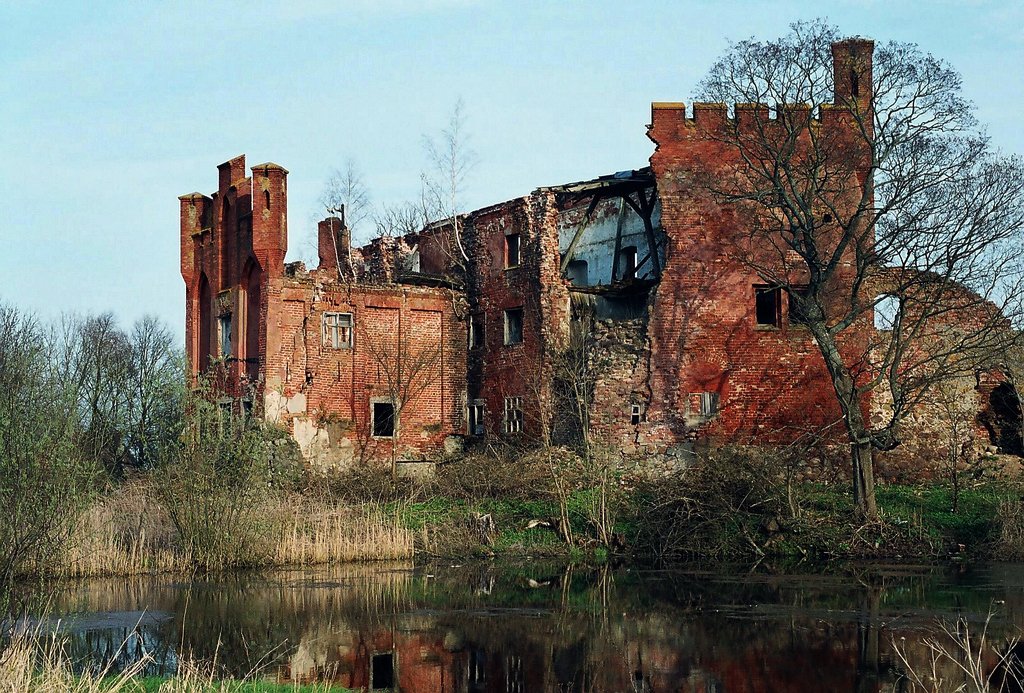
A Teutonic Order stronghold turned ducal seat, now a fire-scarred ruin on the site of an ancient Prussian fort near Kaliningrad.
At a glance
Schaaken Castle stands in Nekrasovo, once Liska-Schaaken in East Prussia, on flat land near the Baltic coast. Built from around 1270, it began as the Teutonic Knights’ outpost on an older Prussian trading site. Centuries of rebuilding followed, then war, then decades of slow collapse. Today only fragments remain, heritage-listed but exposed to the weather.
History
A fortress here is first noted in the Chronicle of the Teutonic Knights in 1258. The order’s own castle rose about 1270, on the earthwork of an old Prussian stronghold called Shoken, meaning grassland in Old Prussian. Its walled enclosure took an octagonal shape, tracing the earlier fort’s outline, with two outer baileys attached. Ownership belonged to the Bishop of Samland. The first structure was timber. From 1328 masons rebuilt it in stone. Secularisation of the Teutonic Order’s lands in 1525 turned the castle into a ducal residence. Fire destroyed much of it in 1606; partial rebuilding followed. Peter the Great lodged there three times. During the Seven Years’ War it served as Alexander Suvorov’s headquarters. By World War II the estate had become a family farm of 600 hectares. The Red Army seized it in January 1945. A kolkhoz followed, and for a time the castle housed a children’s home. Since 1975 it has stood as a ruin.
What you see
Little of the medieval fabric survives above ground, though the octagonal footprint still traces the old Prussian earthwork beneath it. In the early 19th century the residential building was reworked in a Romantic Gothic manner, gaining a new roof line and slim corner towers meant to evoke a storybook medieval past rather than restore an authentic one. The kitchen building, underground vaults, and the stone ring wall changed far less over that period, and their weight and plainness contrast with the picturesque towers above. Walk the perimeter and the layered history becomes legible in the masonry itself: rough early stonework, later brick patching, and 19th-century ornament sitting uneasily side by side. A 2012 fire added fresh scarring to walls already softened by decades of neglect.
Cultural significance
Schaaken Castle records nearly eight centuries of shifting rule in this corner of the former East Prussia, from Prussian earthwork to crusading order, ducal court to Soviet farm. Its guest list alone spans a Russian tsar and one of Russia’s most celebrated generals. German and Russian heritage associations have since worked together on stabilisation, floating ideas from a friendship centre to a museum of 13th-century architecture. A Kaliningrad architect who inspected the ruin in 2002 judged it salvageable. A small museum of medieval finds and a horse ring briefly gave the site new life before the 2012 fire set that progress back.
Key facts
- Location: Nekrasovo, Kaliningrad Oblast, Russia
- Founded: circa 1270, on an earlier Prussian fortification
- Original builders: Teutonic Knights, on behalf of the Bishop of Samland
- Rebuilt in stone from 1328; damaged by fire in 1606
- Remodelled in Romantic Gothic style, early 19th century
- Ruined since 1975; further fire damage in 2012
- Heritage-listed status confirmed
Practical information & getting there
The castle lies in Nekrasovo, a small settlement in Kaliningrad Oblast, reachable by road from the city of Kaliningrad. No fixed visiting hours or admission details are documented here, and conditions at a ruined, fire-affected site can change. Check current access and safety information locally before you plan a visit, and expect an open-air ruin rather than a fully restored monument.
Sources & resources
Find it on the map
See this place and what’s around it →📷 Become a Cultural Heritage Online photographer
Share your photos of places: they stay published under your name as the author. The more they're seen, the more you get noticed — and soon a contest will reward the most appreciated photos.
Log in or sign up free to add a photoIs this page about you?
This page is read by travellers and heritage enthusiasts who find it on Google. Tell us how you are connected to this place and we will take it from there.