

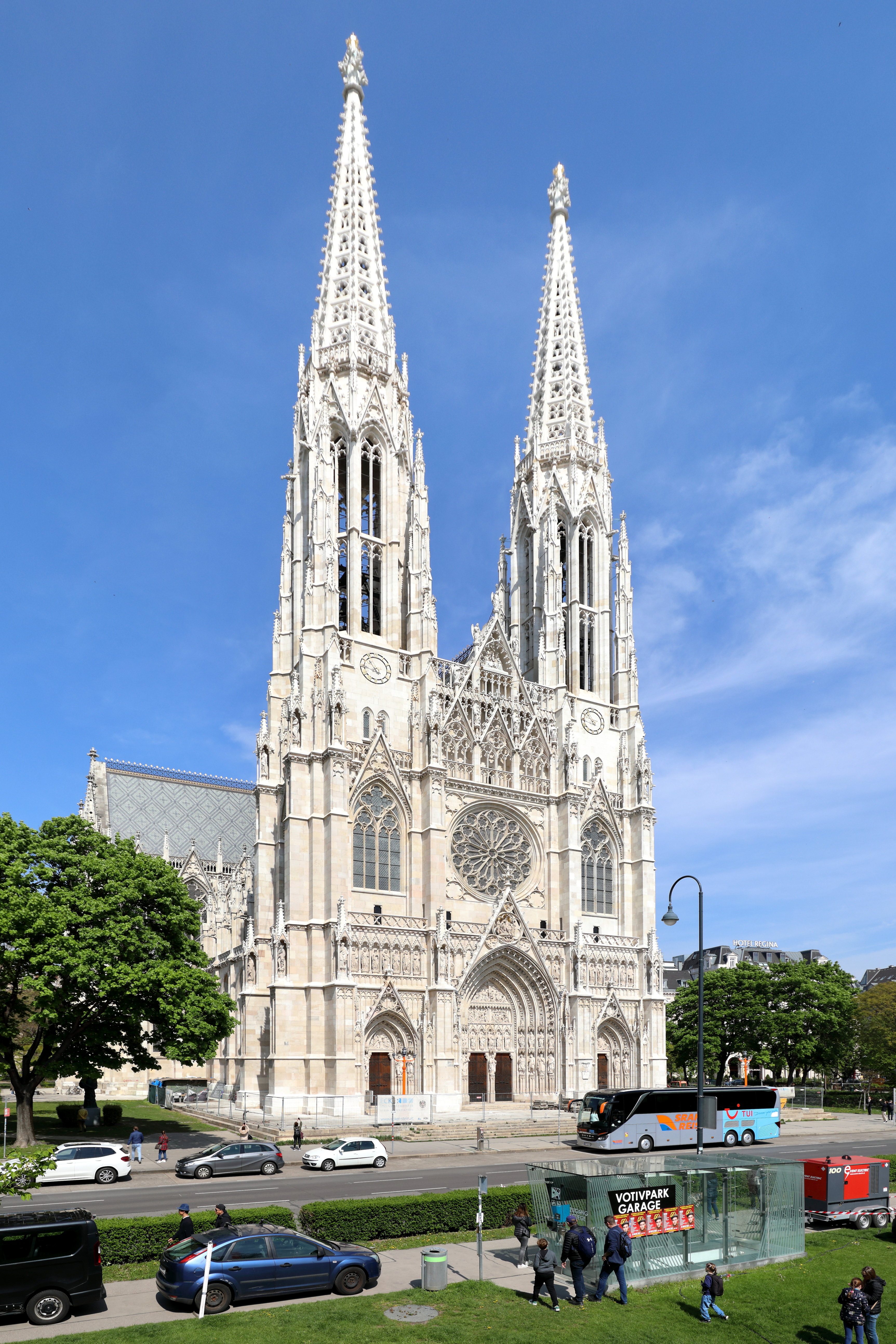
A soaring neo-Gothic church on Vienna’s Ringstraße, built to commemorate the miraculous survival of Emperor Franz Joseph from an assassination attempt.
At a glance
The Votivkirche is a monumental neo-Gothic church dominating the Vienna Ringstraße. Its twin spires and intricate facade reflect 19th-century imperial patronage and religious gratitude.
History
The church’s origins lie in an act of violence turned to divine purpose. Following the attempted assassination of Emperor Franz Joseph in 1853, Archduke Ferdinand Maximilian launched a campaign to build a church in thanksgiving for the Emperor’s survival.
Construction was funded through donations solicited across the Austro-Hungarian Empire. The completed church was dedicated in 1879, marking the silver anniversary of Emperor Franz Joseph and Empress Elisabeth.
What you see
The Votivkirche exemplifies neo-Gothic design with dramatic vertical emphasis. Twin spires rise prominently above the Ringstraße, while elaborate stone detailing and pointed arches characterize its facade and interior spaces.
Cultural significance
The church embodies both imperial power and public devotion. As a votive offering—a gift made in gratitude for answered prayer—it represents a unique moment when state, empire, and faith converged in 19th-century Vienna.
Key facts
- Country: Austria
- City: Alsergrund, Vienna
- Coordinates: 48.2153, 16.3586
- Style: Neo-Gothic
- Dedicated: 1879
Practical information & getting there
The Votivkirche is located on Vienna’s Ringstraße, the grand boulevard circling the inner city. The church is accessible by public transport; the nearby U-Bahn stations serve the district well.
Sources & resources
Find it on the map
See this place and what’s around it →📷 Become a Cultural Heritage Online photographer
Share your photos of places: they stay published under your name as the author. The more they're seen, the more you get noticed — and soon a contest will reward the most appreciated photos.
Log in or sign up free to add a photoIs this page about you?
This page is read by travellers and heritage enthusiasts who find it on Google. Tell us how you are connected to this place and we will take it from there.