

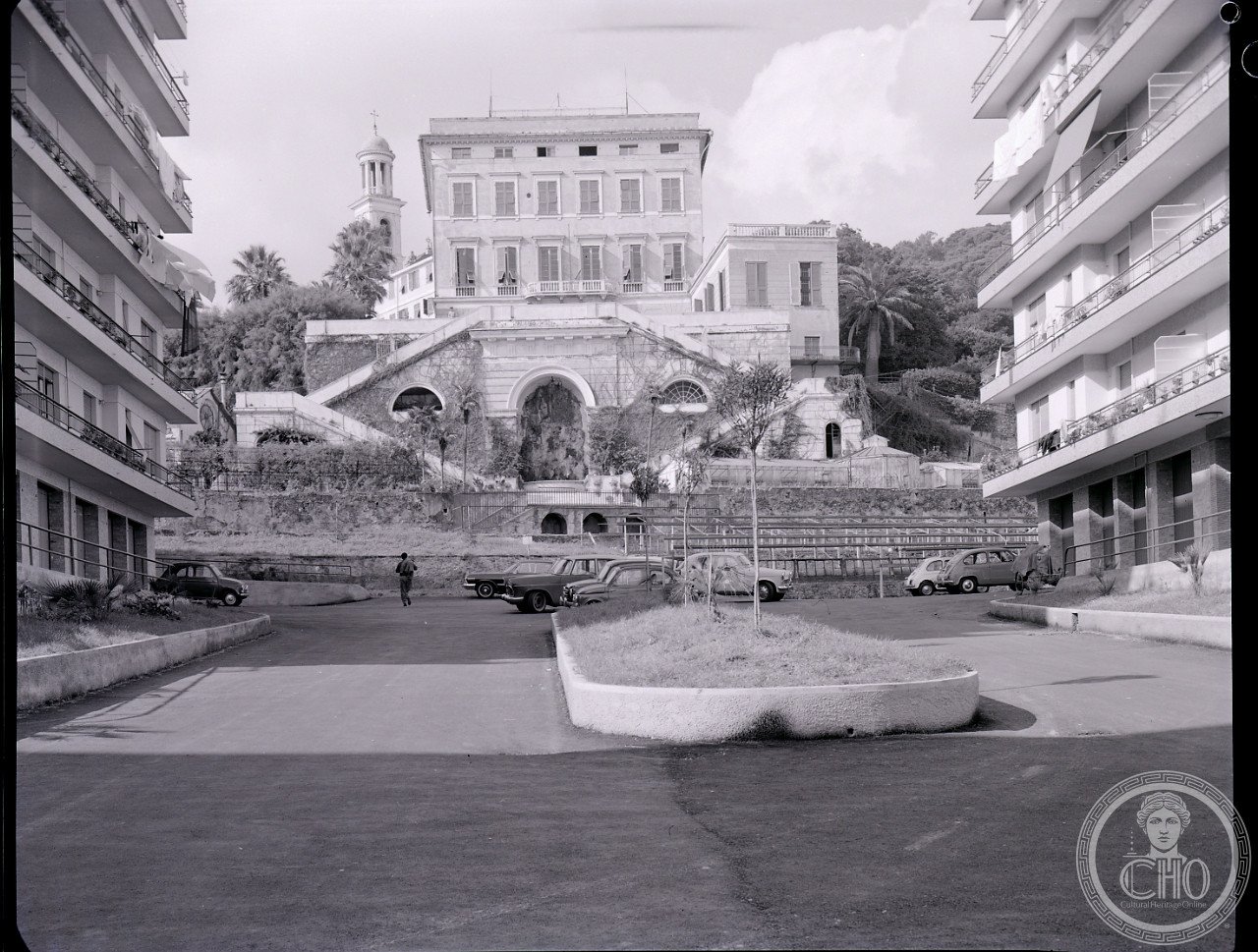
A neoclassical villa in Genoa’s western quarter, now home to the Ligurian Archeology Museum. Its ten-hectare park ranks among Europe’s finest historic gardens.
At a glance
Villa Durazzo Pallavicini stands in Pegli, a residential district near Genoa’s waterfront. The municipality has owned the property since its conversion into a museum. It houses the Ligurian Archeology Museum, featuring archaeological finds spanning from the Paleolithic era through the Roman period and beyond.
History
The complex traces its roots to an eighteenth-century mansion built by the Grimaldi family. In subsequent generations, the Durazzo and Pallavicini families—all interconnected through marriage—acquired and developed the property. The villa and park assumed their present form during the mid-nineteenth century.
The Ligurian Archeology Museum was inaugurated in 1936 but temporarily relocated during World War II. Collections moved to the abbey of Tiglieto for safekeeping. The museum reopened in 1953 with the scholarly collaboration of Luigi Bernabò Brea and fellow researcher Cardini.
What you see
The villa exemplifies neoclassical design typical of nineteenth-century Ligurian noble residences. Its park encompasses nearly ten hectares, including a botanical garden named for the noblewoman Clelia Durazzo. The landscape ranks among the major historic gardens in Europe.
Cultural significance
The museum preserves the material history of Liguria across millennia. Its core exhibition documents the peoples who inhabited the region from 100,000 years ago through the end of the Roman Empire, including climatic changes that shaped settlement patterns. Artifacts from the Riviera di Ponente caves—Balzi Rossi, Toirano, and Finalese—illustrate prehistoric life. Iron Age Ligurian warrior burials and the pre-Roman necropolis of Genoa itself provide insight into indigenous societies.
Broader collections include Roman-period Ligurian cities, Egyptian antiquities from the Albertis collection, and ancient Greek and Roman vases donated by Prince Oddone of Savoy. Together, these holdings survey the cultures that shaped the western Mediterranean.
Key facts
- Address: Via Ignazio Pallavicini, 13, 16155 Genova
- Coordinates: 44.4294205555596, 8.8172847032547
- Phone: 010 8531544
- Website: https://www.villadurazzopallavicini.it/
Practical information
The villa is open to the public as a museum. Check the official website for current hours, admission fees, and any restrictions.
Getting there
The entrance is located directly next to Genoa-Pegli railway station, making it easily accessible by train from central Genoa. Pegli lies in the western reaches of the city along the coast.
Sources & resources
Find it on the map
See this place and what’s around it →📷 Become a Cultural Heritage Online photographer
Share your photos of places: they stay published under your name as the author. The more they're seen, the more you get noticed — and soon a contest will reward the most appreciated photos.
Log in or sign up free to add a photoIs this page about you?
This page is read by travellers and heritage enthusiasts who find it on Google. Tell us how you are connected to this place and we will take it from there.