
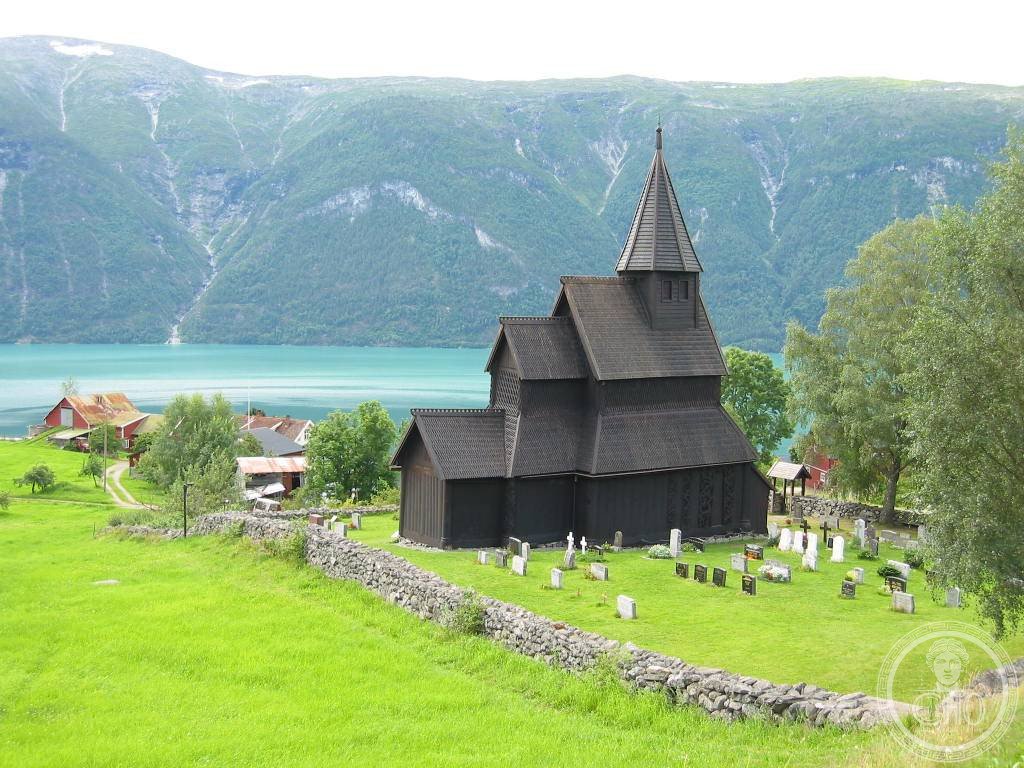
One of Norway’s oldest wooden churches, Urnes exemplifies the architectural and artistic fusion of Viking culture with medieval Christian tradition, its carved portals revealing a civilization in religious transition.
At a glance
This 12th-century stave church stands on the eastern shore of Lustrafjorden in Vestland, among the oldest of its kind in Norway. Its construction incorporates timber elements dating to the latter half of the 11th century. The basilica-plan interior features cylindrical columns and semi-circular arches characteristic of medieval Christian architecture.
History
Built during Norway’s transition from paganism to Christianity, Urnes Stave Church embodies this cultural watershed in its very fabric. The north portal displays the distinctive Urnes style, named for this church—a decorative tradition that draws from Norwegian mythology yet serves a Christian sanctuary. Fortidsminneforeningen, the Society for the Preservation of Norwegian Ancient Monuments, acquired the church in 1881. UNESCO designated it a World Heritage Site in 1979, recognizing its exceptional cultural and historical importance.
What you see
The church’s long-church basilica design reflects medieval European ecclesiastical planning. Inside, cylindrical wooden columns support semi-circular arches. The carved capitals and exterior ornamentation reveal sophisticated craftsmanship. The north portal’s Urnes-style carvings—intricate interlacing patterns and zoomorphic motifs—represent the visual vocabulary of a society absorbing Christian iconography while retaining its Norse artistic heritage.
Cultural significance
Urnes Stave Church stands as tangible evidence of Scandinavia’s religious transformation during the medieval period. Its artistic programme documents how Viking visual traditions were reinterpreted within a Christian context. The building itself—constructed almost entirely of wood—represents a construction method unique to Northern Europe and now largely vanished. Few stave churches survive; Urnes ranks among the most significant.
Key facts
- Location: Ornes, Luster Municipality, Vestland, Norway
- Built: 12th century (with 11th-century timber elements)
- Coordinates: 61.2981, 7.3226
- UNESCO World Heritage Site: designated 1979
- Owned by: Fortidsminneforeningen (since 1881)
Practical information & getting there
The church sits directly across Lustrafjorden from the village of Solvorn, approximately five kilometres east of Hafslo. You can reach Luster Municipality via the scenic Sognefjord region in western Norway. The church remains an active place of worship; visitors should respect services and opening hours, which vary seasonally.
Sources & resources
Find it on the map
See this place and what’s around it →Events here — now on & upcoming
- Norway's stave churches: the 2026 visiting season15 Apr 2026 — 14 Oct 2026See the event →
📷 Become a Cultural Heritage Online photographer
Share your photos of places: they stay published under your name as the author. The more they're seen, the more you get noticed — and soon a contest will reward the most appreciated photos.
Log in or sign up free to add a photoIs this page about you?
This page is read by travellers and heritage enthusiasts who find it on Google. Tell us how you are connected to this place and we will take it from there.