
.jpg)
When Tulsa was the Oil Capital of the World, it built a railroad terminal fit for the title. The 1931 Union Depot brought the same Art Deco ambition that shaped every Tulsa high-rise of the era to a building where fortunes arrived on the afternoon train.
At a glance
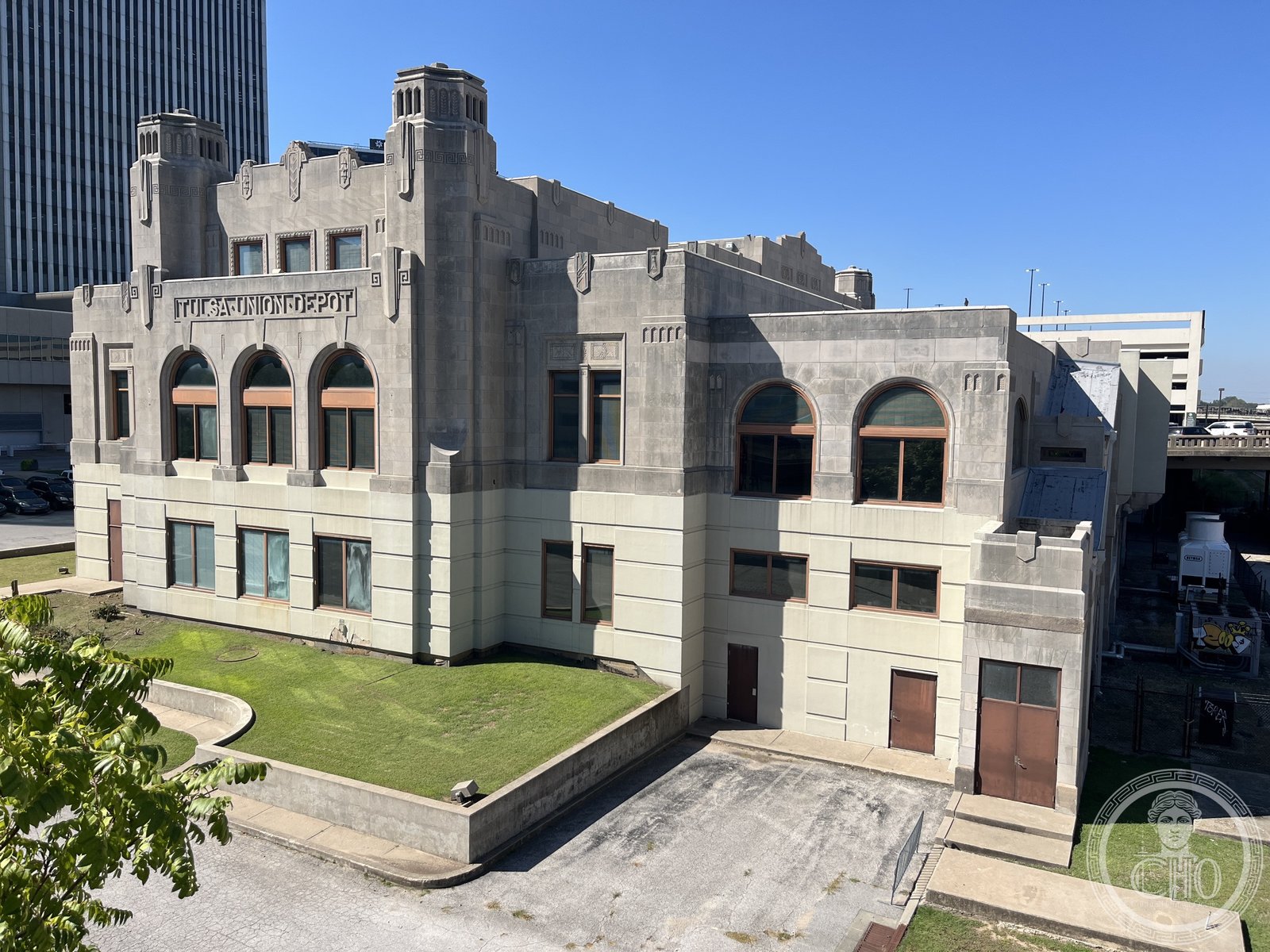
The Tulsa Union Depot on the northern edge of downtown is a buff-brick Art Deco building completed in 1931 at the height of the Oklahoma oil boom’s second wave. The depot served multiple railroad lines connecting Tulsa to Chicago, Kansas City, Dallas, and the Gulf Coast, functioning as the principal point of arrival for the petroleum engineers, oil traders, and investors who poured through the city during its golden decade. Now home to the Oklahoma Jazz Hall of Fame, the depot has been rehabilitated as a cultural institution while preserving the architectural character of its original construction. It is listed on the National Register of Historic Places.
Key facts
- Completed: 1931
- Style: Art Deco
- Status: National Register of Historic Places
- Current use: Oklahoma Jazz Hall of Fame
History
Tulsa in the 1920s was one of the most prosperous cities in the United States. The discovery of oil in the surrounding Green Country had transformed a modest Indian Territory town into a city of bank towers, luxury hotels, and Art Deco commercial buildings that rivalled those of cities many times its size. The “Oil Capital of the World” title was not an idle boast: in its peak years Tulsa was the operational headquarters of much of the American petroleum industry, and its wealth supported an extraordinary concentration of ambitious architecture that remains one of the largest intact Art Deco districts in the United States.
The Union Depot was completed in 1931 as a consolidation of the city’s multiple rail facilities into a single terminal. The timing was unfortunate: the Great Depression had already begun to contract the oil economy, and the terminal’s working life in its original configuration was compressed by the rapid decline of intercity passenger rail in the postwar years. By the mid-twentieth century, rail passenger traffic through Tulsa had declined sharply.
The depot survived the transition era that claimed many similar buildings across the country. Adaptive reuse came in the form of the Oklahoma Jazz Hall of Fame, which established its headquarters in the building. The Hall of Fame celebrates Oklahoma’s contribution to jazz and American popular music — a contribution as substantial in its domain as the state’s contribution to the petroleum industry. The reuse has preserved the depot’s principal spaces and facades while giving the building a sustained programme of events and visitors.
What you see
The Union Depot’s exterior is a restrained but accomplished Art Deco composition in buff brick with terra cotta ornament concentrated at the entrance canopy, the window surrounds, and the parapet. The horizontal massing is typical of 1930s railroad terminals, which needed to accommodate platform lengths and train operations rather than maximise the vertical drama of office towers. The principal facade reads as serious and civic — proportioned to assert importance without theatrical ornament.
The interior preserves the spatial character of its peak railroad period, with a principal waiting hall of modest grandeur whose terrazzo floors, bronze fixtures, and coffered ceiling details speak to the quality of construction Tulsa expected of its public buildings in 1931. The Oklahoma Jazz Hall of Fame has installed interpretive exhibitions in the public spaces that document the careers of Tulsa-connected musicians and the broader Oklahoma contribution to American jazz. The combination of period architecture and active cultural programming makes the depot one of the more engaging museum experiences in the region.
Practical information
- Access: Public museum; check Oklahoma Jazz Hall of Fame schedule for opening hours and events
- Admission: Variable; nominal admission for Hall of Fame exhibitions
- Photography: Exterior freely photographed from South Boston Avenue; interior photography subject to museum policy
- Time needed: 45–90 minutes including the Hall of Fame exhibition
Getting there
The Union Depot stands on South Boston Avenue at the northern edge of downtown Tulsa, within easy walking distance of the city’s Art Deco district. The Tulsa International Airport (TUL) is approximately 10 minutes north by car. Street parking is available, and the depot is well positioned for a self-guided walk through the downtown Art Deco corridor that includes the Philtower Building, the Mid-Continent Building, and the Boston Avenue Methodist Church — one of the finest Art Deco religious buildings in the United States.
Nearby
- Boston Avenue United Methodist Church (1929) — The defining Art Deco religious building of Tulsa and one of the most architecturally significant churches in the United States — its vertical Gothic-Deco tower visible from across the downtown.
- Philtower Building (1928) — The most prominent of Tulsa’s oil-era skyscrapers, an orange-brick Gothic-inflected Art Deco tower that defines the downtown skyline from the east side of Boston Avenue.
- Philbrook Museum of Art — The Mediterranean Revival villa of oil baron Waite Phillips (1927), bequeathed to the city as an art museum, 15 minutes south of downtown; one of the finest small art museums in the South Central United States.
Sources
- National Register of Historic Places nomination — Tulsa Union Depot, Tulsa, Oklahoma.
- Meggs, Bryon T. Tulsa Art Deco. Tulsa: Tulsa Foundation for Architecture, 2002 — comprehensive survey of Tulsa’s Art Deco architecture including the Union Depot.
- Oklahoma Jazz Hall of Fame — building and institutional history documentation.
- Wikimedia Commons — Tulsa Union Depot photograph (David Wilson, CC BY 2.0).
Find it on the map
See this place and what’s around it →📷 Become a Cultural Heritage Online photographer
Share your photos of places: they stay published under your name as the author. The more they're seen, the more you get noticed — and soon a contest will reward the most appreciated photos.
Log in or sign up free to add a photoIs this page about you?
This page is read by travellers and heritage enthusiasts who find it on Google. Tell us how you are connected to this place and we will take it from there.