
Sulle rive del fiume Yukon, dove un popolo indigeno pescava e cacciava da generazioni, la scoperta dell’oro nel 1896 scatenò una delle più grandi corse all’oro della storia. Tr’ondëk-Klondike racconta l’incontro — e lo sconvolgimento — fra la First Nation Tr’ondëk Hwëch’in e decine di migliaia di cercatori d’oro.
At a glance
Tr’ondëk-Klondike, in Canada’s Yukon, is a group of sites along the Yukon River that tell the story of the meeting between an Indigenous people, the Tr’ondëk Hwëch’in, and the wave of newcomers brought by the Klondike Gold Rush. From 1896, the discovery of gold drew tens of thousands of prospectors to the area around Dawson City, transforming the land and the life of the First Nation. The sites record both this dramatic encounter and the resilience and adaptation of the Tr’ondëk Hwëch’in. It was inscribed by UNESCO in 2023.
Key facts
- UNESCO: World Heritage since 2023 (Tr’ondëk-Klondike)
- Tr’ondëk Hwëch’in: the First Nation whose homeland this is
- Klondike Gold Rush: the great gold rush that began in 1896
- Dawson City: the boom town at the heart of the rush
- Encounter: records the meeting of Indigenous and newcomer worlds
- Resilience: the adaptation and survival of the First Nation
History
For generations the Tr’ondëk Hwëch’in lived along the Yukon and Klondike rivers, fishing the salmon runs and hunting across the land from seasonal camps. In August 1896 gold was found in a tributary of the Klondike, and word of the strike set off a stampede: within two years tens of thousands of prospectors had poured into the region, and Dawson City sprang up almost overnight.
The rush brought wealth and upheaval, displacing the Tr’ondëk Hwëch’in from key sites and disrupting their way of life, to which they adapted and which they have since worked to renew. The sites — Indigenous fishing camps, the boom town and the goldfields — together tell this story of encounter and resilience, recognised by UNESCO in 2023.
What you see
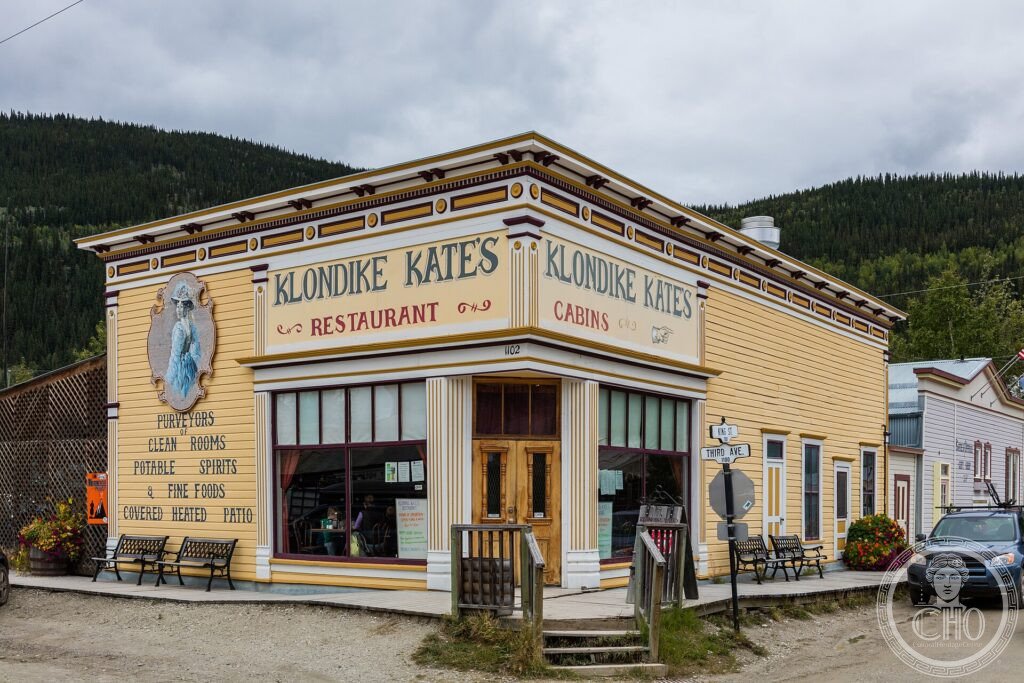
The sites include the preserved gold-rush streetscape of Dawson City, with its wooden false-front buildings and boardwalks, the dredged goldfields and creeks where the rush unfolded, and Tr’ondëk Hwëch’in places such as the fishing camp of Tr’ochëk across the river. Museums and the First Nation’s own cultural centre interpret both histories.
The wooden frontier town set against the wide Yukon, and the Indigenous places around it, bring the encounter to life.
Practical information
- Sites: in and around Dawson City and along the Yukon River
- Best time: summer; the far north has long, harsh winters
- Time needed: one to two days
- Note: remote; reached by long road or by air
Getting there
Tr’ondëk-Klondike centres on Dawson City, in the Yukon, Canada, about 530 km north of Whitehorse by the Klondike Highway; Dawson has a small airport. GPS: 64.06° N, 139.43° W.
Nearby
- Dawson City — the preserved gold-rush town
- Klondike goldfields — the creeks where the rush took place
- Tombstone Territorial Park — mountain wilderness to the north
Sources
- UNESCO World Heritage Centre — “Tr’ondëk-Klondike” (ref. 1564)
- Tr’ondëk Hwëch’in / Parks Canada — official bodies
- Encyclopaedia Britannica — Klondike Gold Rush
Find it on the map
See this place and what’s around it →📷 Become a Cultural Heritage Online photographer
Share your photos of places: they stay published under your name as the author. The more they're seen, the more you get noticed — and soon a contest will reward the most appreciated photos.
Log in or sign up free to add a photo