
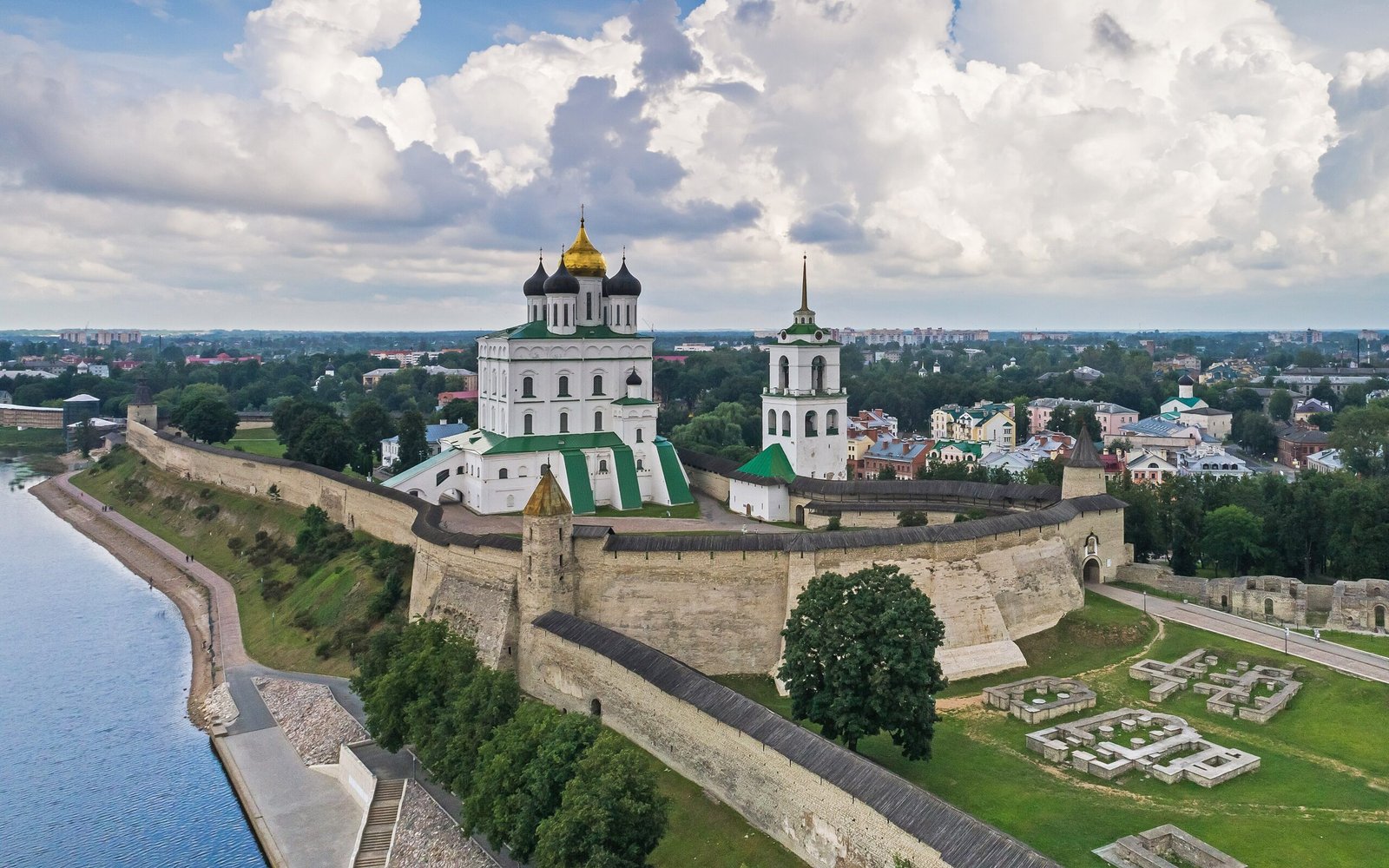
Rising above the Velikaya River inside the Pskov Krom, this white cathedral has anchored the city’s spiritual life through fire, war, and a millennium of rebuilding.
At a glance
The Trinity Cathedral stands within the Pskov Krom, the ancient fortress-kremlin on the Velikaya’s east bank. It has served as the mother church of the Pskov Eparchy since 1589. The present structure is the fourth or fifth on this site. It reaches 256 feet into the sky above the fortress walls.
History
Tradition credits the first wooden church here to Princess Olga in the tenth century. The claim is doubtful. Olga’s own conversion was personal; the wider Christianization of Rus did not begin until nearly two decades after her death, so a church from that later moment seems more probable. A stone cathedral followed in 1138, said to have been commissioned by Prince Vsevolod Mstislavich, who had died the year before construction. Fire and collapse forced repeated rebuilding. The Novgorodian First Chronicle records that Archbishop Aleksei of Novgorod blessed a new stone church on the original foundations in 1365; Master Kirill oversaw its completion in 1367, dying in the plague that swept the region in 1390. That medieval church survived until a fire gutted its interior in 1609. The building standing today was begun in 1691 — Wikidata records foundational work as early as 1682 — and was consecrated in 1699. Soviet rule brought further upheaval: in the 1920s the cathedral fell under the schismatic Living Church movement before Soviet authorities closed it in the 1930s and converted it into a museum. German occupation during the Second World War saw it reopened for worship, and it has remained an active church ever since.
What you see
The cathedral’s tall white mass dominates the Krom’s skyline, visible from across the river. Its height is unusual for the region. Inside, the interior reflects the 1609 restoration layered onto later baroque-era rebuilding, a church remade repeatedly rather than frozen at a single moment. The building holds the tombs of two of Pskov’s canonized princes: Vsevolod Mstislavich, known in sainthood as Gavriil, who died in 1138, and Dovmont, who died in 1299. Their presence ties the current structure directly back to the earliest stone churches on this ground, even though the walls around them are centuries younger.
Cultural significance
As the seat of the Pskov Eparchy since 1589, the cathedral has functioned as the region’s principal church for over four centuries. Its survival through Soviet closure, wartime reopening, and postwar continuity makes it a rare thread of unbroken religious life in a city otherwise reshaped by conflict. The burials of Vsevolod and Dovmont give the building a role beyond worship, linking it to Pskov’s medieval princely history and its local saints.
Key facts
- Location: Pskov Krom (Kremlin), east bank of the Velikaya River, Russia
- Current building: begun 1691 (foundations possibly from 1682), consecrated 1699
- Height: 256 feet
- Mother church of the Pskov Eparchy since 1589
- Contains tombs of Prince Vsevolod Mstislavich (Gavriil, d. 1138) and Prince Dovmont (d. 1299)
- Heritage-listed site
Practical information & getting there
The cathedral sits inside the Pskov Krom, the walled fortress complex at the heart of the historic city, easily reached on foot from central Pskov. You approach it across open ground within the kremlin walls, with the river visible beyond. As an active church, visiting hours follow services; check the official website before planning a trip.
Sources & resources
Find it on the map
See this place and what’s around it →📷 Become a Cultural Heritage Online photographer
Share your photos of places: they stay published under your name as the author. The more they're seen, the more you get noticed — and soon a contest will reward the most appreciated photos.
Log in or sign up free to add a photoIs this page about you?
This page is read by travellers and heritage enthusiasts who find it on Google. Tell us how you are connected to this place and we will take it from there.