
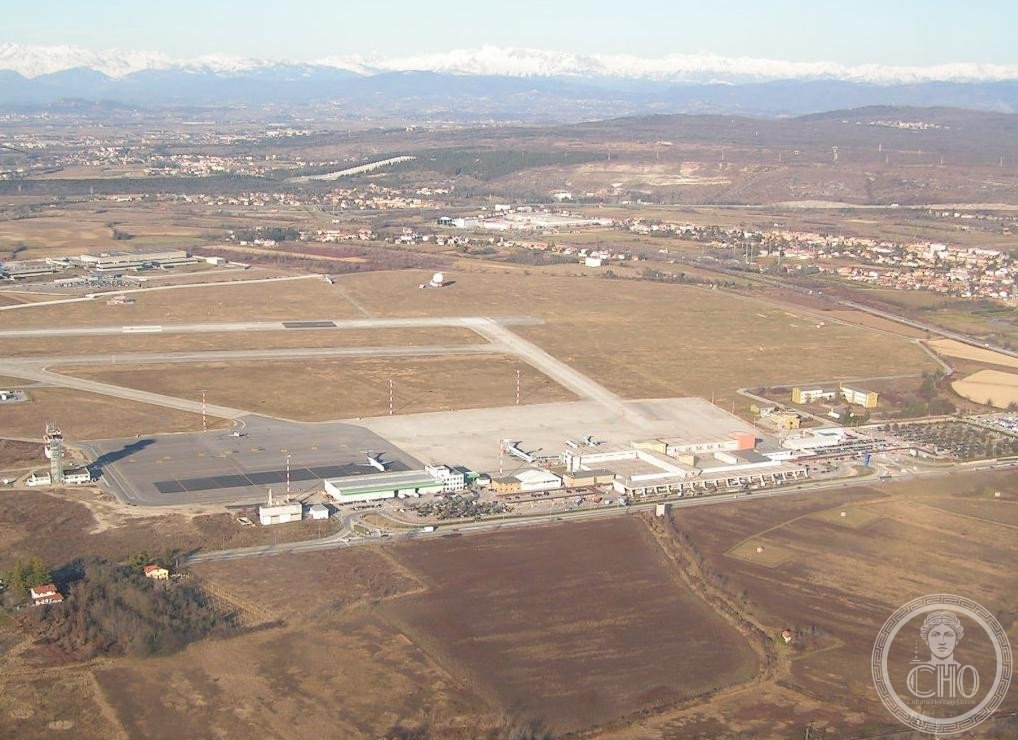
Built as a military airfield in 1935 and flying civil passengers since a Douglas DC-3 left for Rome on 2 December 1961, the airport of Ronchi dei Legionari is the only Italian airport where a train station, a bus terminal and a passenger terminal sit within one walk of each other.
At a glance
- Type
- Regional international airport, named after the explorer Pietro Savorgnan di Brazzà
- Origins
- April 1935, as a military airfield
- First civil flight
- 2 December 1961, Ronchi dei Legionari–Rome
- Runway
- 3,000 metres, extended to that length in 1978
- Traffic
- 1,651,703 passengers in 2025, the highest in its history
- Location
- Via Aquileia 46, Ronchi dei Legionari, province of Gorizia
Overview
Trieste Airport serves the whole of Friuli-Venezia Giulia from a plain midway between Trieste, Gorizia and Udine, a position chosen in the 1950s precisely because it belonged to no single city. It handled 1,651,703 passengers in 2025 across 27 routes, its best year ever and more than double the traffic of 2022.
What sets it apart is not its size. Since 2018 the terminal has been joined to a railway station on the Venice–Trieste line by a 425-metre elevated walkway over the state road, so a passenger can step off a train from Venice, Udine or Ljubljana and reach the check-in desks on foot. Few airports of this scale in Europe are wired into the rail network so directly.
History
Construction of the airfield began in April 1935, as a support base for the fighter training of the 4° Stormo Caccia stationed at Gorizia. The Second World War brought Allied bombing, and after it the British Royal Air Force occupied the field until 1947.
Civil ambitions arrived in the following decade. In 1954 the national transport plan recognised the strategic value of the site for the north-east; in 1956 the provinces of Trieste, Gorizia and Udine founded the Consorzio per l’Aeroporto Giuliano to give the region a modern airport. Scheduled civil service began on 2 December 1961, when a Douglas DC-3 of Società Aerea Mediterranea flew to Rome. The runway was still surfaced with metal matting, laid in 1962.
The infrastructure followed the traffic. The first structural lot — a first section of runway, a taxiway and a passenger terminal — was inaugurated in 1965. A charter of the German airline LTU arrived from Düsseldorf with a Fokker F27 in 1967, the first international flight; the first scheduled international line waited until Lufthansa began flying to Munich in 1987. The first jet touched down on 23 February 1968, a Caravelle of Sterling Airways, and an instrument landing system was installed the same year. The runway reached its present 3,000 metres in 1978, and a new control tower opened in 1981 and is still in service.
Ownership changed as the airport grew. In 1997 the company Aeroporto Friuli-Venezia Giulia S.p.A., 51 per cent Consorzio and 49 per cent Region, took over management; a new passenger terminal and a cargo building were completed in 1998 for a capacity of 1.5 million passengers a year. On 3 August 2007 the company obtained a forty-year concession and the airport was dedicated to Pietro Savorgnan di Brazzà. The Region became sole shareholder in 2010, and in November 2016 the airport took its current name. In 2019 the fund F2i acquired 55 per cent through 2i Aeroporti, leaving the Region with 45 per cent and placing Trieste in a network with Milan, Turin, Naples and the Sardinian airports.
What you see
The passenger terminal is a low, functional building of the late 1990s, extended and reorganised since. Traffic had passed 800,000 passengers in 2011 and the terminal alone could no longer answer the problem of reaching it. What repays attention is therefore the intermodal complex north of it, opened on 19 March 2018 after thirteen months of works that began with the laying of the first stone on 23 January 2017. It cost 17.2 million euro, of which 14.2 million public.
The walkway is the piece worth crossing on foot. It runs 425 metres above the SS14 della Venezia Giulia, linking the terminal to the railway stop, the bus station and the car parks. The station is named Trieste Airport, belongs to the national rail network and is served by Italian and Slovenian trains.
Cultural significance
The airport is the clearest surviving trace of a regional idea from the 1950s: that Trieste, Gorizia and Udine, cities with a long history of rivalry and a border running between them and Yugoslavia, could share one piece of infrastructure. The founding consortium named all three, and the site was picked so that none of them owned it.
Its later history reads as a compressed history of Italian aviation. The first jet in 1968, the first wide-body in 1976 with an Alitalia Boeing 747-200, the first intercontinental flight to Toronto in 1971, the first hijacking of a civil aircraft in Italy on 6 October 1972, the low-cost turn that began with Ryanair from London in 2001 and became a based fleet in April 2024.
Practical information
- Address: Via Aquileia 46, 34077 Ronchi dei Legionari (GO)
- By train: the Trieste Airport station sits on the Venice–Trieste line, with direct services to Trieste, Monfalcone, Udine, Venice and Ljubljana; the terminal is a 425-metre covered walk from the platforms
- Passenger traffic: 1,651,703 in 2025, 47 per cent international
- Busiest day on record: 19 October 2025, with 8,104 passengers
- Official site: triesteairport.it
Getting there
Regional and long-distance trains stop at Trieste Airport station; the walkway leads directly to the terminal without leaving cover. By road the airport lies on the SS14 between Monfalcone and Ronchi dei Legionari, close to the A4 motorway. Trieste is about 33 km to the south-east, Udine about 40 km to the north-west.
Sources
- Trieste Airport, official company history — triesteairport.it
- Trieste Airport, Polo Intermodale project pages and the photographic record of the first stone, 23 January 2017
- Rete Ferroviaria Italiana, Trieste Airport station — rfi.it
- Trenitalia, Trieste Airport stop and regional connections
- Trieste Airport press release on 2025 traffic (1,651,703 passengers), reported by ANSA, 13 January 2026
Find it on the map
See this place and what’s around it →Historical events at this place (1)
📷 Become a Cultural Heritage Online photographer
Share your photos of places: they stay published under your name as the author. The more they're seen, the more you get noticed — and soon a contest will reward the most appreciated photos.
Log in or sign up free to add a photoIs this page about you?
This page is read by travellers and heritage enthusiasts who find it on Google. Tell us how you are connected to this place and we will take it from there.