
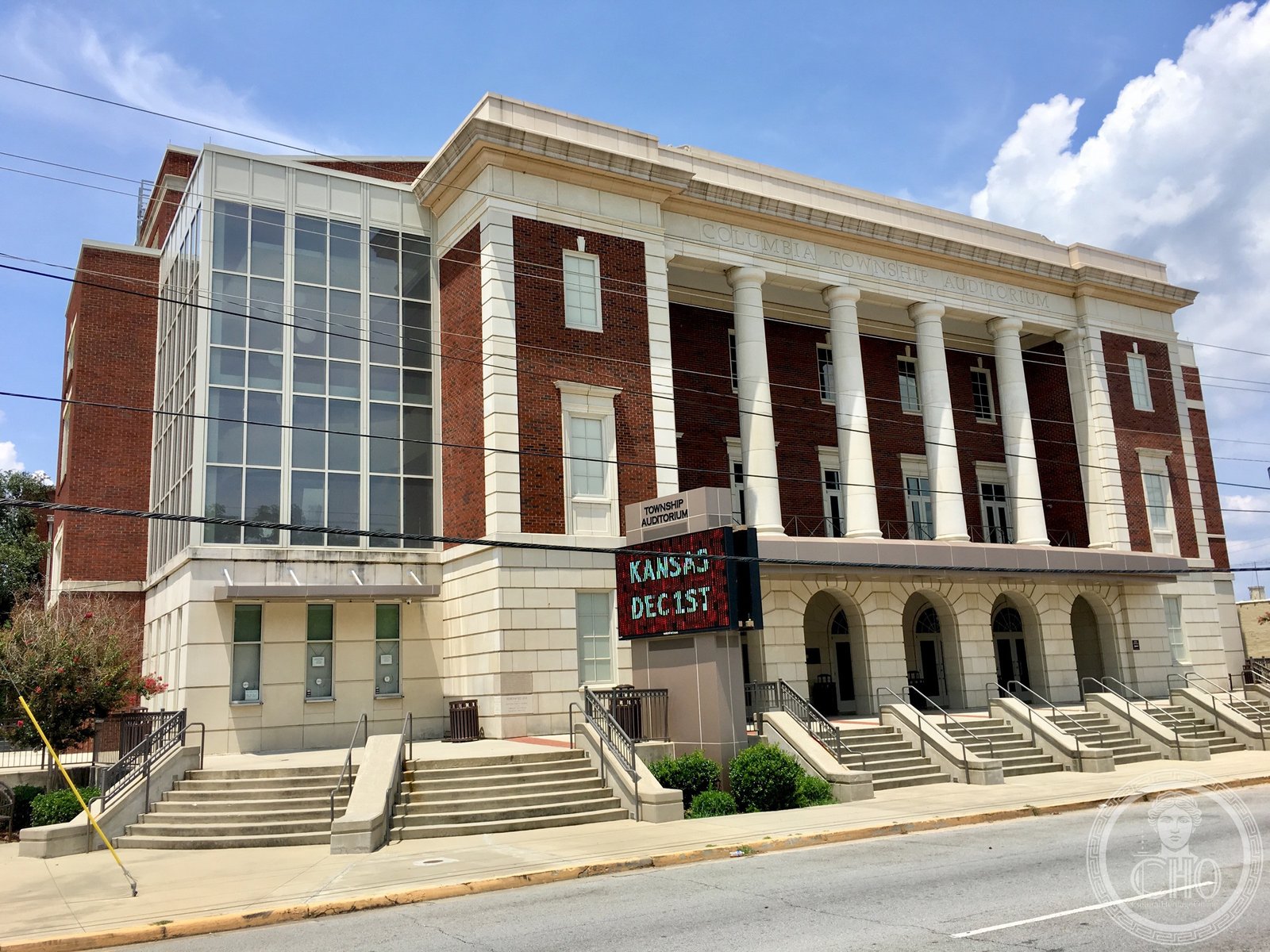
On Taylor Street in the heart of Columbia, the Township Auditorium has served as South Carolina’s capital city’s primary public gathering place since 1930 — an Art Deco civic monument that has hosted every kind of public event the twentieth century generated, from political conventions to rock concerts, in a building whose ambition matched the capital city’s own.
At a glance
The Township Auditorium at 1703 Taylor Street is the defining civic performing arts venue of Columbia, South Carolina, and one of the finest Art Deco public buildings surviving in the American South. Completed in 1930 and dedicated to Columbia’s history and public life, it was designed on a scale commensurate with the ambitions of a state capital — a building intended to host political conventions, graduation ceremonies, concerts, and theatrical productions that required the grandest venue the city could provide. Its exterior Art Deco facade, large main auditorium, and prominent civic presence have made it a central institution in Columbia’s cultural life for nearly a century. Restored in recent decades and still active, it continues to serve as one of Columbia’s primary venues for concerts, theatrical productions, and civic events.
Key facts
- Address: 1703 Taylor Street, Columbia, SC 29201.
- Completed: 1930.
- Style: Art Deco.
- Current use: Active performing arts and events venue.
- Designation: National Register of Historic Places.
History
Columbia in 1930 was a city defined by its role as South Carolina’s capital and the seat of the University of South Carolina, the state’s flagship public university. As the center of state government, Columbia had a particular need for a public assembly venue capable of hosting the full range of civic life — political gatherings, major concerts, theatrical productions, and the ceremonial events that a state capital generates. The Township Auditorium was built to meet that need, funded by the city as a monument to Columbia’s civic ambition and a practical resource for the community.
The 1930 building brought the Art Deco style — then at the height of its influence in American public architecture — to Columbia’s civic center. The design combined the era’s characteristic geometric ornament with the scale required for a major public assembly building, creating a structure that read as both contemporary and authoritative on Taylor Street. The auditorium immediately became the primary venue for the range of events that require a large stage and a large audience — a function it has continued to serve through all the transformations of the twentieth century and into the twenty-first.
The building’s history has mirrored the history of the American South: its audiences, performers, and uses have evolved with the social changes of the century. Columbia’s position as a state capital — home to Fort Jackson, the University of South Carolina, and the seat of state politics — has given the Township Auditorium a particularly varied history of use, from Democratic Party conventions to major concert tours. Its restoration and continued operation represent a community commitment to the civic role of public cultural infrastructure.
What you see
The Taylor Street facade presents the Township Auditorium’s civic ambitions in the Art Deco vocabulary of the 1930: a formal symmetrical composition with ornamental panels, a prominent central entrance element, and decorative detailing that establishes the building’s public importance without sacrificing the accessibility appropriate to a civic gathering place. The scale is confident — this is a building that was designed to be the largest and most important public venue in the city.
The main auditorium interior serves the full range of the building’s programming: the proscenium stage, the tiered seating, and the acoustic volume of the room are calibrated for the large public assembly that was its intended purpose. The decorative program of the interior reflects the Art Deco sensibility of the exterior, with ornamental plasterwork and lighting that give the room a sense of occasion appropriate to the events it hosts.
Practical information
- Events: Concerts, theatrical productions, civic events, graduation ceremonies; check the Township Auditorium website for schedule.
- Location: Taylor Street in the Five Points neighborhood and midtown Columbia; easily accessible from the University of South Carolina campus.
- Parking: Street parking and nearby lots available; the area is walkable from USC campus.
Getting there
Columbia is the capital of South Carolina, at the intersection of Interstates 20, 26, and 77 at the geographic center of the state. Columbia Metropolitan Airport (CAE) is 8 miles west. Amtrak’s Palmetto and Silver trains stop at Columbia on the New York–Miami corridor. The auditorium is on Taylor Street in midtown, about a mile from downtown Columbia and adjacent to the University of South Carolina campus.
Nearby
- South Carolina State House (1903) — the ornate Beaux-Arts state capitol building with its distinctive blue granite exterior and bronze stars marking cannon impacts from Sherman’s 1865 march; two blocks north of the Township Auditorium on Main Street.
- University of South Carolina campus — the historic USC campus and Horseshoe, one of the oldest university courtyards in the American South; the campus is immediately adjacent to the Township Auditorium.
- Columbia Museum of Art — the state’s primary general art museum, with collections emphasizing the Baroque and Renaissance alongside the decorative arts; in the downtown core.
- South Carolina State Museum — the four-story natural and cultural history museum of South Carolina, in a renovated textile mill complex; covers natural history, art, science, and the history of South Carolina from indigenous cultures to the present.
Sources
- National Register of Historic Places, Township Auditorium nomination.
- South Carolina State Historic Preservation Office records.
- Columbia Metropolitan Magazine — Township Auditorium history.
- The State newspaper archives — Columbia cultural history.
- South Carolina Historical Society documentation.
Find it on the map
See this place and what’s around it →Record researched and written by Luigi De Marchi for Cultural Heritage Online, 2026.
📷 Become a Cultural Heritage Online photographer
Share your photos of places: they stay published under your name as the author. The more they're seen, the more you get noticed — and soon a contest will reward the most appreciated photos.
Log in or sign up free to add a photoIs this page about you?
This page is read by travellers and heritage enthusiasts who find it on Google. Tell us how you are connected to this place and we will take it from there.