
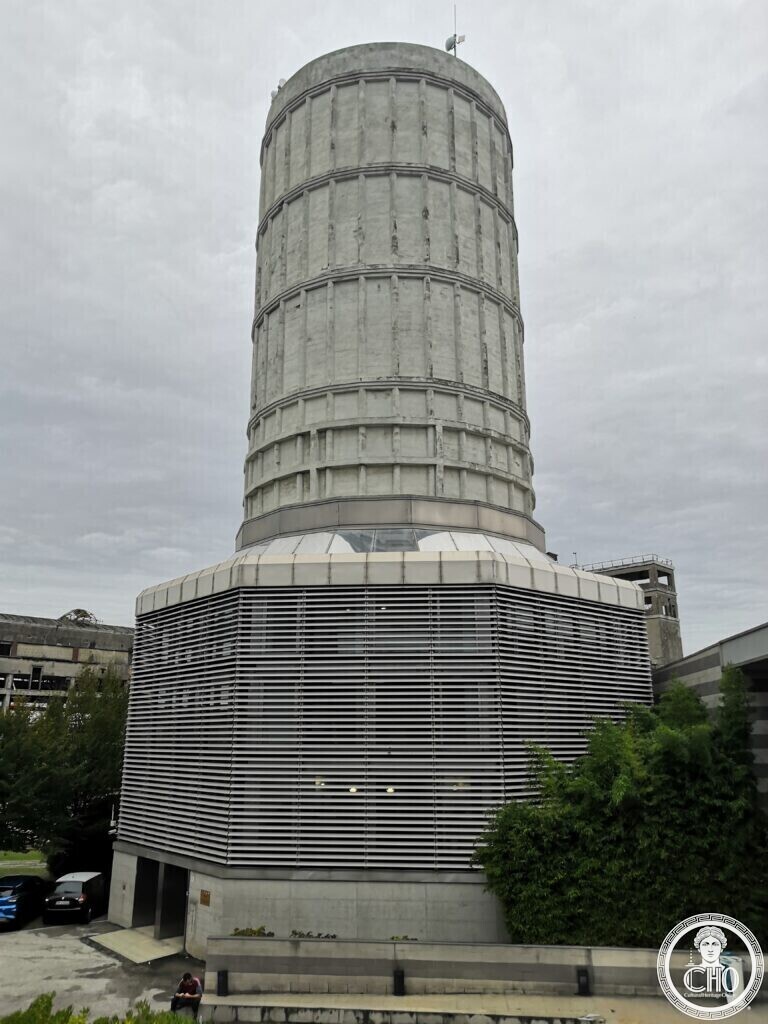
A reinforced-concrete cooling tower built in 1938 for the Vetrocoke chemical works at Porto Marghera, kept when the factories around it were demolished and turned into a centre for exhibitions and events.
At a glance
Torre Hammon stands inside VEGA, the science and technology park that has taken the place of the old industrial plots at the edge of Porto Marghera. It was built in 1938 to cool the water of the Vetrocoke works, a plant backed by Senator Giovanni Agnelli that produced nitrogen fertilisers and other materials for industry and agriculture. Around 800,000 cubic metres of water a year passed through it. Its form, a tall concrete shell narrowing towards the middle, followed a late nineteenth-century Franco-Dutch design; building it in reinforced concrete, rather than in the timber used for earlier cooling towers, was the novelty. Today it is known as the Venezia Heritage Tower.
Key facts
- Built: 1938, for the Vetrocoke works at Porto Marghera
- Function: cooling tower for the plant’s process water
- Structure: reinforced-concrete shell; the sources give a height of 54.22 m (the owners), 58 m and 60 m
- Recovery: begun in 1996 with the creation of the VEGA park; the interior fitted out on three floors and completed in 2018, with European regional development funds
- Today: the Venezia Heritage Tower, an exhibition and events space of about 3,000 square metres
- Address: Via delle Industrie 5, Marghera (Venice)
- GPS: 45.47252, 12.25267 · Open in Google Maps
History
Porto Marghera was laid out after the First World War as the industrial port of Venice, on the mainland facing the lagoon. In 1937 the Agnelli family set up Vetrocoke Azotati there, a plant for nitrogen fertilisers; a year later, as production grew, the cooling tower was added. Senator Giovanni Agnelli chaired Vetrocoke from 1924 to 1948.
When the chemical industry withdrew from this part of Marghera, the area became VEGA, the science and technology park, and the tower was one of the few structures kept. Its recovery began in 1996, on an idea of the architect Gianni Cibin developed by the entrepreneur Gianni Sottana, and was completed in 2018, when three floors were built inside the shell; the owners credit the architect Roberto Pescarollo of RPR Studio, Venice, with the restoration. The site belongs today to the Consorzio Multimodale Darsena.
What you see
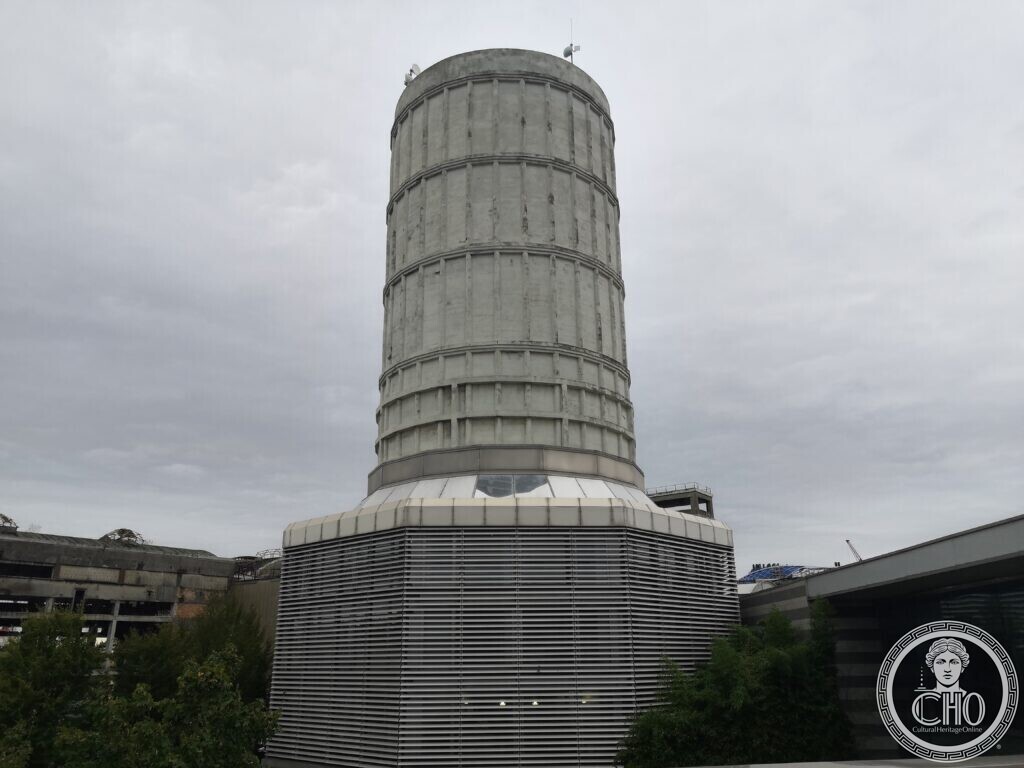
In Stefano Vigolo’s photographs of 2021 the tower rises as a pale concrete drum marked by horizontal rings and by the vertical joints of its casting. At the bottom it sits on a later octagonal base, wrapped in horizontal louvres and crowned by a glazed ring. Around it, on one side, are the stripped concrete frames of former industrial sheds; on the other, the glass fronts of the park’s new buildings.
Nearby
- VEGA, the Venice science and technology park — the park around the tower
- Porto Marghera station — a few hundred metres away
- Angiolo Mazzoni’s heating plant — another industrial building of the 1930s, at Venice’s railway station
Sources
- Venezia Heritage Tower, Progetto (veneziaheritagetower.com): 1938, Vetrocoke, Giovanni Agnelli’s presidency 1924-1948, the Franco-Dutch design, 54.22 m, Roberto Pescarollo, Consorzio Multimodale Darsena, about 3,000 square metres
- Il Sole 24 Ore, Il restyling di Marghera parte dal recupero dei pezzi storici: Vetrocoke Azotati founded in 1937 by the Agnelli family, 58 m, conversion begun in 1996 and completed in 2018, European regional development funds
- 1600 Venezia, Nel cuore di Porto Marghera, la storia della torre di raffreddamento: 800,000 cubic metres of water a year, reinforced concrete instead of timber, 60 m, Gianni Cibin and Gianni Sottana
- VEGA Parco Scientifico Tecnologico di Venezia, Torre Hammon: the address
Gallery
Find it on the map
See this place and what’s around it →
📷 Become a Cultural Heritage Online photographer
Share your photos of places: they stay published under your name as the author. The more they're seen, the more you get noticed — and soon a contest will reward the most appreciated photos.
Log in or sign up free to add a photoIs this page about you?
This page is read by travellers and heritage enthusiasts who find it on Google. Tell us how you are connected to this place and we will take it from there.