

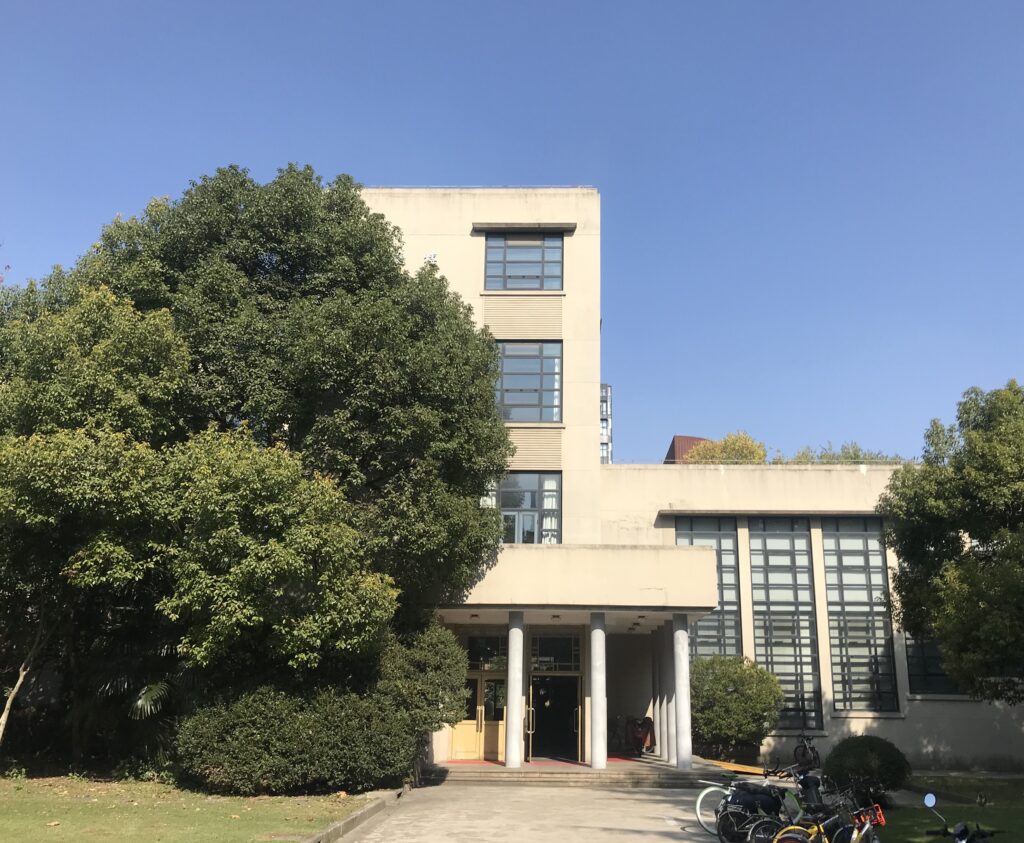
The College of Architecture and Urban Planning at Tongji University has taught architecture, planning and conservation since 1952. Its Wenyuan Building of 1953, on the Siping Road campus, is called by the university China's first modernist building.
At a glance
The College of Architecture and Urban Planning is one of the faculties of Tongji University, in Shanghai's Yangpu District. It grew out of the Department of Architecture formed in 1952, when departments from several Shanghai and Hangzhou schools were gathered into one. It took its present name in 1986. Its buildings stand on the Siping Road campus. The Wenyuan Building of 1953 is the one Chinese textbooks on modern architecture return to.
Key facts
- Department of Architecture formed in 1952
- Wenyuan Building completed in 1953
- Designed by two of the department's own teachers
- Named after the courtesy name of the astronomer Zu Chongzhi
- Listed in 2005 among Shanghai's outstanding historic buildings
- Five undergraduate programmes, including conservation
- 235 full-time faculty and 2,382 students
History
Tongji's architecture department took shape in 1952, in the national reorganisation of universities. The new department gathered Tongji's own civil engineering department, the architecture departments of St John's University and Hangzhou University, part of the faculty of the civil engineering departments of Fudan and Shanghai Jiao Tong, and staff of the state-run Hangzhou National College of Art. In 1986 it became the College of Architecture and Urban Planning.
The Wenyuan Building went up in 1953, designed by Huang Yulin and Ha Xiongwen, two teachers of the department. Xia Jianbai, then in charge of buildings on campus, named it after the courtesy name of the astronomer Zu Chongzhi. Bauhaus elements concentrate in that one building: a free plan, an asymmetric composition, plain flat façades, the flat roof, the division of the steel windows. Chinese motifs sit alongside them, in the ventilation grilles and on the stair handrails. The building took the Architectural Society of China's award for outstanding architectural creation and entered the fourth batch of Shanghai's outstanding historic buildings in 2005.
A protective renovation began in 2005. Steel windows gave way to aluminium frames and insulated glazing, walls were wrapped in insulation, the roof was planted with turf, and heat pumps and rainwater collection were added. The college calls the result the campus's first ecological conservation building. The school kept growing too. It holds China's first graduate programme in architecture, opened in 1954, and one of the country's first doctoral programmes, from 1981. Three departments now carry the teaching: architecture, urban planning and landscape studies.
What you see
The building is a working school, not a monument. Its plan is asymmetric. Stepped lecture theatres are stacked at the east and west ends, rows of smaller classrooms fill the middle, and four entrances break the perimeter. The shape outside follows the different rooms inside.
The marks of two traditions sit side by side. The flat roof, the plain wall surfaces and the even grid of windows are Bauhaus. The hook pattern in the ventilation grilles, the repeated character on the stair handrails, the stone platform at the entrance and the small cubes on the corner walls are Chinese. The building stands beside the central avenue of the Siping Road campus, among trees, with other teaching buildings of the college around it.
Practical information
- Address: 1239 Siping Road, Yangpu District, Shanghai 200092.
- Status: a working university college; studios and lecture rooms are not public space.
- Opening: there are no public visiting hours; the building is seen from the campus avenue.
- Enquiries: [email protected].
Getting there
The college stands on Tongji's Siping Road campus in Yangpu, in the north-east of Shanghai. The campus is reached from Siping Road itself.
Nearby
- Wujiaochang commercial district
- Fudan University
- Jiangwan Stadium
- Tongji University Museum
Sources
Find it on the map
See this place and what’s around it →📷 Become a Cultural Heritage Online photographer
Share your photos of places: they stay published under your name as the author. The more they're seen, the more you get noticed — and soon a contest will reward the most appreciated photos.
Log in or sign up free to add a photoIs this page about you?
This page is read by travellers and heritage enthusiasts who find it on Google. Tell us how you are connected to this place and we will take it from there.
This entry stays online and free either way — and a free account lets you add to it yourself.