

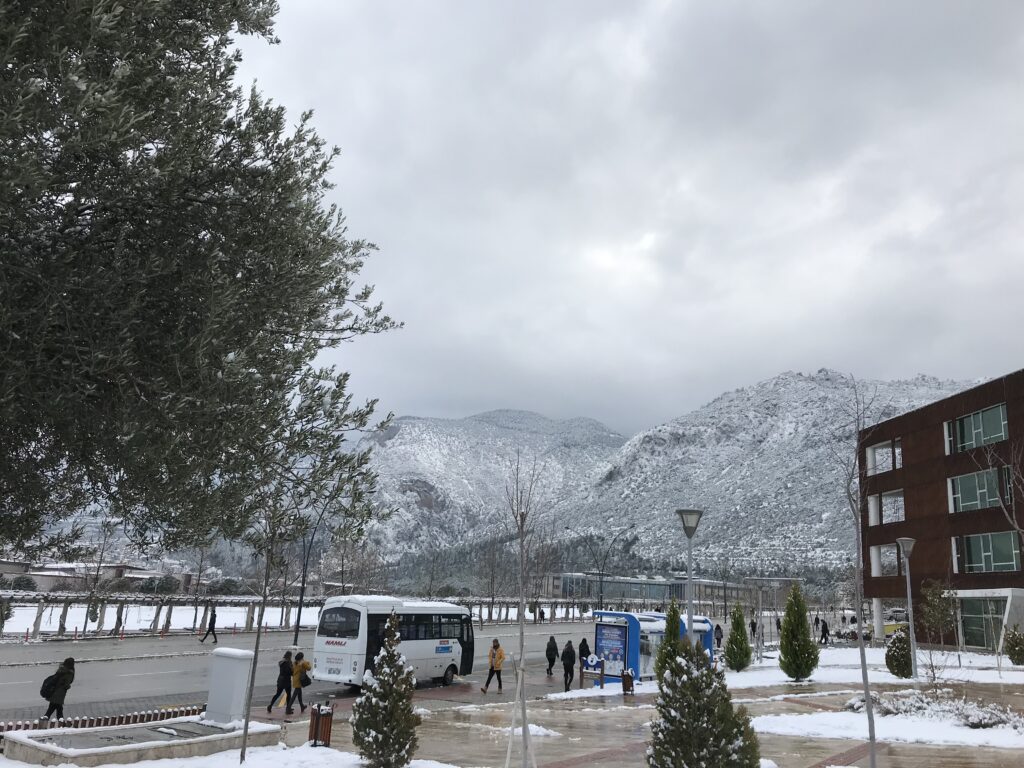
Pamukkale University was founded in Denizli in 1992 and works from the Kınıklı campus, where an institute of archaeology trains restorers and digs in the surrounding valleys.
At a glance
The university works from Kınıklı, in Denizli, and runs nineteen faculties and seventeen vocational schools. It was founded in 1992. Its Institute of Archaeology dates from 2015 and teaches archaeology, conservation and restoration of cultural assets, and textile archaeology. The institute digs in the region and publishes the journal Lycus.
Key facts
- Founded in 1992
- Nineteen faculties and seventeen vocational schools
- Institute of Archaeology set up in 2015
- Master's programmes in conservation and restoration of cultural assets
- Excavations at Laodikeia, Tripolis, Sillyon and Stratonikeia-Lagina
- Journal Lycus, first issue in 2020
- Pamukkale and Hierapolis on the UNESCO world heritage list
History
The Faculty of Engineering began in 1976 as the Denizli Academy of Architecture and Engineering, with departments of mechanical and civil engineering. A teachers' school that had opened in Denizli in 1957 became an education institute in 1976. Pamukkale University was established in 1992.
Kınıklı began as an overflow. The engineering faculty had run out of room, so about 1,000 acres of land were expropriated at Kınıklı and a new building went up. The civil engineering department moved into it in 1990, two years before the university opened.
The Institute of Archaeology came later. It was set up at the university on 16 February 2015, with master's programmes in archaeology, in conservation and restoration of cultural assets, and in textile archaeology, plus a doctorate in archaeology. In 2023 it had 74 students. Its staff dig at Laodikeia, Tripolis and Stratonikeia-Lagina, and the Sillyon excavation closed its 2020 season. The institute publishes Lycus, whose first issue appeared in 2020, and states that its task is to train archaeologists and restorers.
What you see
Kınıklı is a modern campus of teaching blocks and laboratories rather than an old foundation. The Institute of Archaeology sits in it, and its students learn on the excavations as much as in the classroom.
The university's subject matter lies outside the gates as well. Denizli holds the travertines and the Roman city of Hierapolis, which UNESCO lists as world cultural heritage, and the inns and caravanserais of the Silk Road that crossed the plateau. The town keeps its own architecture in its old houses, and about sixty thousand students live in the city.
Practical information
- Address: Kınıklı Mh. Üniversite Cd. No:11, 20160 Pamukkale, Denizli.
- Telephone: +90 258 296 20 00.
- A working university; the Institute of Archaeology publishes Lycus and reports on its excavations.
- The campus is at Kınıklı, a district of Denizli.
Getting there
Kınıklı is a district of Denizli, and the campus address is on Üniversite Caddesi. The travertines of Pamukkale and the Roman city of Hierapolis are in the same province.
Nearby
- Pamukkale travertines
- Hierapolis
- Laodicea on the Lycus
- Tripolis on the Meander
Sources
- https://www.pau.edu.tr/mf/en/sayfa/history-3
- https://www.pau.edu.tr/pau/en/kurumsal/history-2
- https://www.pau.edu.tr/pau/en
- https://www.pau.edu.tr/arkeolojienstitusu/en/sayfa/history-28
- https://www.pau.edu.tr/arkeolojienstitusu/en/sayfa/excavations
- https://www.pau.edu.tr/arkeolojienstitusu/en/sayfa/introduction-to-the-institute-of-archaeology
- https://www.pau.edu.tr/adayogrenci/en/sayfa/denizli-ve-pamukkale
Find it on the map
See this place and what’s around it →📷 Become a Cultural Heritage Online photographer
Share your photos of places: they stay published under your name as the author. The more they're seen, the more you get noticed — and soon a contest will reward the most appreciated photos.
Log in or sign up free to add a photoIs this page about you?
This page is read by travellers and heritage enthusiasts who find it on Google. Tell us how you are connected to this place and we will take it from there.
This entry stays online and free either way — and a free account lets you add to it yourself.