
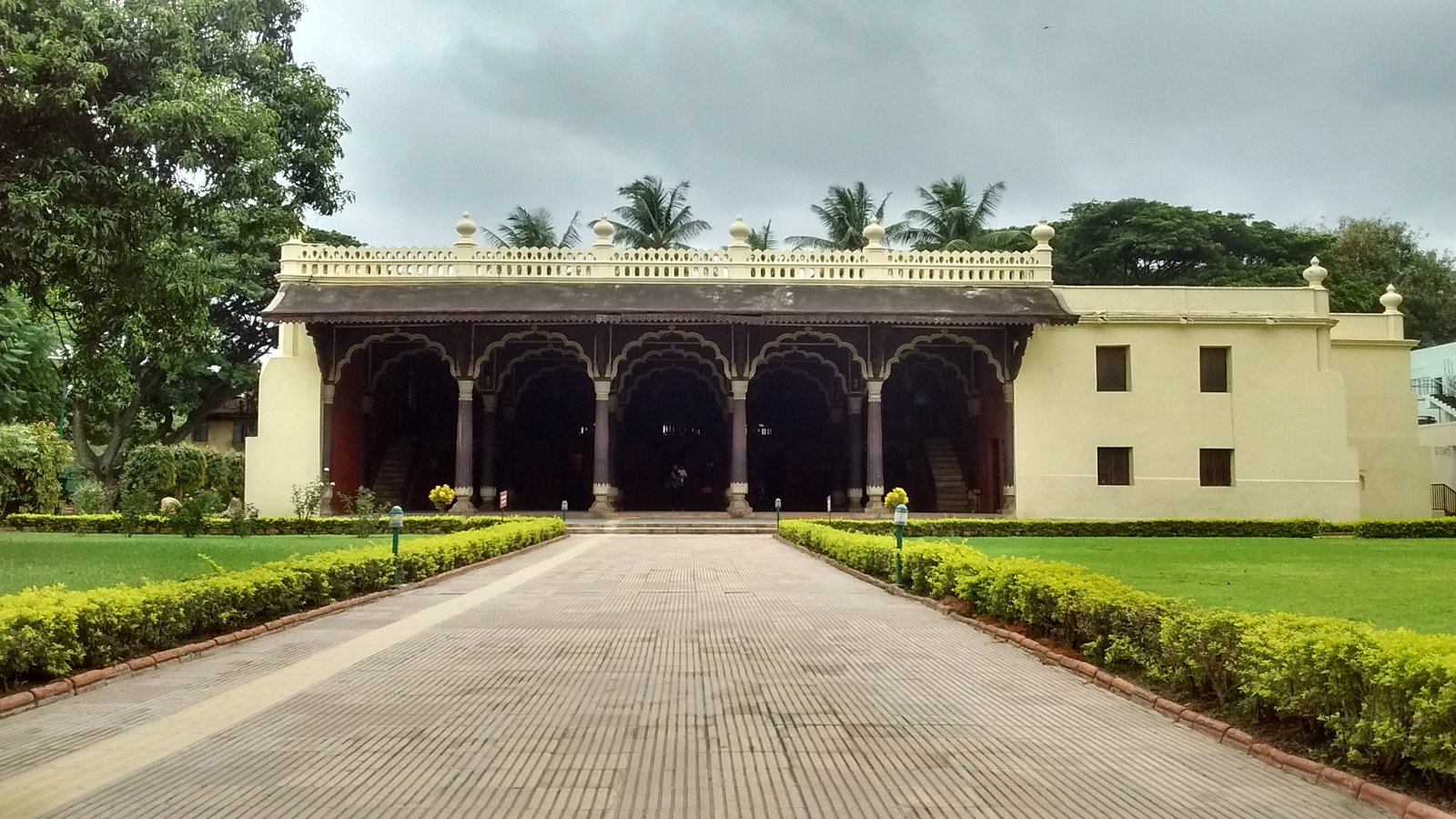
A teak-built Indo-Islamic residence that once served as the summer retreat of Mysore’s formidable ruler, now preserved as a museum within Old Bangalore.
At a glance
Tipu Sultan’s Summer Palace stands as a refined example of Indo-Islamic architecture, built entirely of teak and distinguished by ornate pillars, arches, and balconies. Constructed between 1781 and 1791 under the patronage of Hyder Ali and his son Tipu Sultan, the palace once functioned as both a royal residence and seat of governance. The Archaeological Survey of India now maintains the structure as a protected monument and visitor destination at the heart of Old Bangalore’s heritage quarter.
History
Hyder Ali initiated construction of the palace within Bangalore Fort in 1781, completing the initial phases during the reign of his son Tipu Sultan a decade later in 1791. Following Tipu Sultan’s death in the Fourth Anglo-Mysore War, the British colonial administration claimed the palace for its secretariat operations. The colonial government occupied the site until 1868, when it relocated to Attara Kacheri. Since then, Indian heritage authorities have preserved the structure for public access and historical study.
What you see
The palace showcases Indo-Islamic design through its teak construction and decorative vocabulary of pillars, arches, and deep balconies. The upper floor’s eastern and western balconies traditionally hosted Tipu Sultan’s durbar, or royal court. Four chambers on the first floor served as Zenana Quarters, reserved for royal women. Floral motifs adorn the walls throughout the residence, while a painting depicts the grand throne Tipu Sultan envisioned for himself—famously mounted with gold sheets and emerald stones. Tipu had sworn never to occupy this throne until he defeated the British entirely; following his death, the British dismantled and auctioned its valuable components.
Cultural significance
The palace embodies the architectural and political aspirations of the Mysore state under Tipu Sultan, one of South India’s most consequential rulers. Its design represents a distinctive regional interpretation of Indo-Islamic forms, adapted to palatial use. The structure witnessed the transition from pre-colonial to colonial governance, serving both as a symbol of Mysore’s independence and later as an instrument of British administration—a duality that marks many South Asian heritage sites of this era.
Key facts
- Country: India
- City: Bangalore
- Coordinates: 12.95949444°N, 77.57357222°E
- Construction: 1781–1791
- Built by: Hyder Ali and Tipu Sultan
- Material: Teak
- Current custodian: Archaeological Survey of India
Practical information & getting there
The palace is centrally located in Old Bangalore near Kalasipalya bus stand, accessible by public transport. Admission is ₹20 for Indian citizens and ₹200 for foreign visitors. The ground floor has been converted into a museum displaying Tipu Sultan’s achievements, period portraits, a replica of Tipu Sultan’s Tiger (the original resides in the Victoria and Albert Museum, London), royal garments, and historic silver vessels. The surrounding gardens are maintained by the Horticulture Department of the Government of Karnataka.
Sources & resources
Find it on the map
See this place and what’s around it →📷 Become a Cultural Heritage Online photographer
Share your photos of places: they stay published under your name as the author. The more they're seen, the more you get noticed — and soon a contest will reward the most appreciated photos.
Log in or sign up free to add a photoDo you manage this place?
This page is read by travellers and heritage enthusiasts who find it on Google. Keep it accurate — and make it work for you. Free for non-profit heritage institutions.