

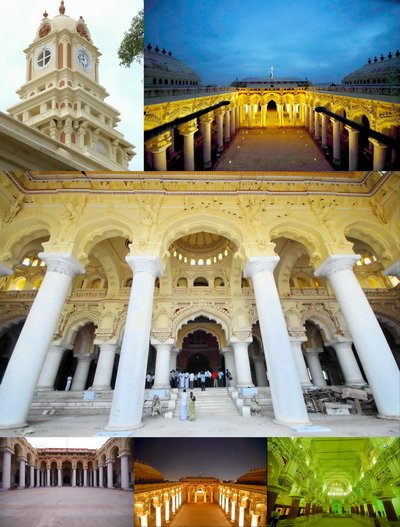
A monumental palace in central Madurai, built for the Nayak dynasty ruler Tirumala Nayaka in the early 17th century. Though reduced to a fraction of its original footprint, the surviving structure remains a testament to the architectural ambitions of South India’s medieval courts.
At a glance
Thirumalai Nayakkar Mahal stands 2 km southeast of the Meenakshi Amman Temple in Madurai’s historic center. Built between 1623 and 1636, it served as the royal residence of Tirumala Nayaka. Today the palace is protected as a national monument.
History
Tirumala Nayaka ruled Madurai from 1623 to 1659 during the height of the Madurai Nayak dynasty. He commissioned this palace as his primary dwelling, completing the structure in 1636. The original complex was four times larger than what survives today—a loss that speaks to centuries of architectural erosion and urban change in Madurai.
What you see
The remaining palace is the main residential block. Its scale and design reflect Nayak-period aesthetics, blending South Indian temple architecture with palatial grandeur. The surviving portion offers a partial vision of what was once a vast, multi-chambered royal complex.
Cultural significance
Thirumalai Nayakkar Mahal embodies the architectural confidence of the Madurai Nayaks, regional powers who flourished after the Vijayanagara Empire’s decline. The palace connects Madurai’s royal history to its sacred geography, positioned near one of South India’s most important temples. Its preservation reflects India’s commitment to maintaining medieval dynastic heritage.
Key facts
- Country: India
- City: Madurai, Tamil Nadu
- Built: 1623–1636
- Ruler: Tirumala Nayaka (r. 1623–1659)
- Coordinates: 9.9148°N, 78.1243°E
- Status: Protected national monument
Practical information & getting there
The palace is located in central Madurai, a short distance from the Meenakshi Amman Temple. Madurai is well connected by rail and road to Chennai and other major cities in Tamil Nadu. Visitors should check current opening hours and access conditions before traveling.
Sources & resources
Find it on the map
See this place and what’s around it →📷 Become a Cultural Heritage Online photographer
Share your photos of places: they stay published under your name as the author. The more they're seen, the more you get noticed — and soon a contest will reward the most appreciated photos.
Log in or sign up free to add a photoIs this page about you?
This page is read by travellers and heritage enthusiasts who find it on Google. Tell us how you are connected to this place and we will take it from there.