
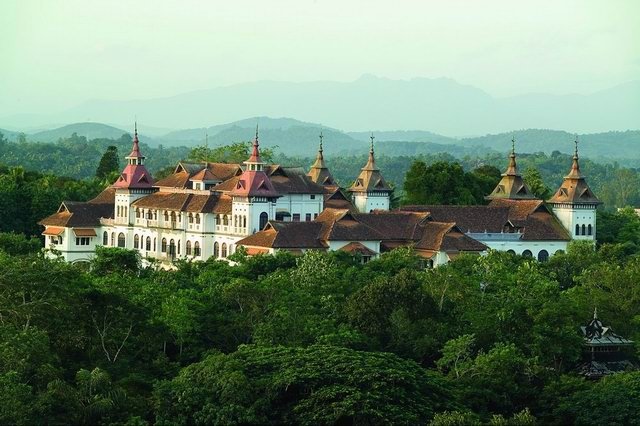
The official residence of the Travancore Royal Family, this early-twentieth-century palace showcases the grandeur of Kerala’s princely heritage with over 150 rooms and distinctive architectural achievement.
At a glance
Kowdiar Palace stands as the primary residence of the Travancore Royal Family in Kerala’s capital. Built by Maharaja Sri Chithira Thirunal and completed in 1934, the palace remains a private royal dwelling and is not open to public visitation.
History
Construction of the palace was undertaken by Maharaja Sri Chithira Thirunal, whose only sister, Karthika Thirunal Lakshmi Bayi, married G V Raja in 1934, the year the palace reached completion. Following India’s Constitutional Amendment of 1971, the royal family’s properties and estates were partitioned equally among the branches of two Travancore Queens, Sethu Lakshmi Bayi and Sethu Parvathi Bayi. Kowdiar Palace became the possession of the heirs of Sethu Parvathi Bayi, mother of the palace’s builder.
What you see
The palace is renowned for its architectural work and design excellence. The residence comprises over 150 rooms, reflecting the scale and complexity of a major royal establishment built to twentieth-century standards.
Cultural significance
Kowdiar Palace represents the architectural and cultural heritage of the Travancore dynasty during India’s final decades as a princely state. As the official seat of the royal family, it embodies the transition of Kerala’s aristocracy into the modern era.
Key facts
- Country: India
- Location: Thiruvananthapuram, Kerala
- Completed: 1934
- Builder: Maharaja Sri Chithira Thirunal
- Coordinates: 8.5239793, 76.9634343
- Access: Private residence; entry restricted
Practical information & getting there
Kowdiar Palace is a private royal residence and not accessible to the public. The palace may be viewed from outside the gates in Thiruvananthapuram. For information about the royal family’s history and heritage, contact local tourism authorities in Kerala’s capital.
Sources & resources
- Kowdiar Palace – Wikipedia
- Cultural Heritage Online
Find it on the map
See this place and what’s around it →📷 Become a Cultural Heritage Online photographer
Share your photos of places: they stay published under your name as the author. The more they're seen, the more you get noticed — and soon a contest will reward the most appreciated photos.
Log in or sign up free to add a photoIs this page about you?
This page is read by travellers and heritage enthusiasts who find it on Google. Tell us how you are connected to this place and we will take it from there.