
In a small mountain cemetery above Lake Garda lies a Soviet fighter whose name nobody wrote down. A local boy grew up hearing about him, and spent more than ten years trying to find out who he was — a search that ended up recovering hundreds of other names as well.
At a glance
San Zeno di Montagna sits at around 600–700 metres on the western flank of Monte Baldo, looking down on the eastern shore of Lake Garda. Its cemetery is the ordinary kind found in every Veneto village: a walled enclosure of loculi, a portico, gravel paths, family stones under cypresses. Among them is the burial of a Soviet partisan who was killed on this mountain in the autumn of 1944 and whose name was never recorded. He is the reason a native of the village, Massimo Eccli, went on to spend a decade in Russian, Italian, German and American archives reconstructing the story of the Soviet citizens who fought in the Italian Resistance.
Key facts
- What it is: the grave of an unidentified Soviet partisan in a municipal cemetery, still tended and commemorated
- Where: cemetery of San Zeno di Montagna, Via del Cimitero, Contrada Capra, province of Verona, Veneto
- The man: not named. The headstone records the absence itself — PARTIGIANO RUSSO IGNOTO, unknown Russian partisan — and no published account has ever given him a name
- When he was killed: 26 October 1944, the date cut into the stone (M. 26-10-1944) and the date carried by the Russian war-grave register
- Where he was killed: at Prà Bestemà, a contrada of the same municipality at 829 metres
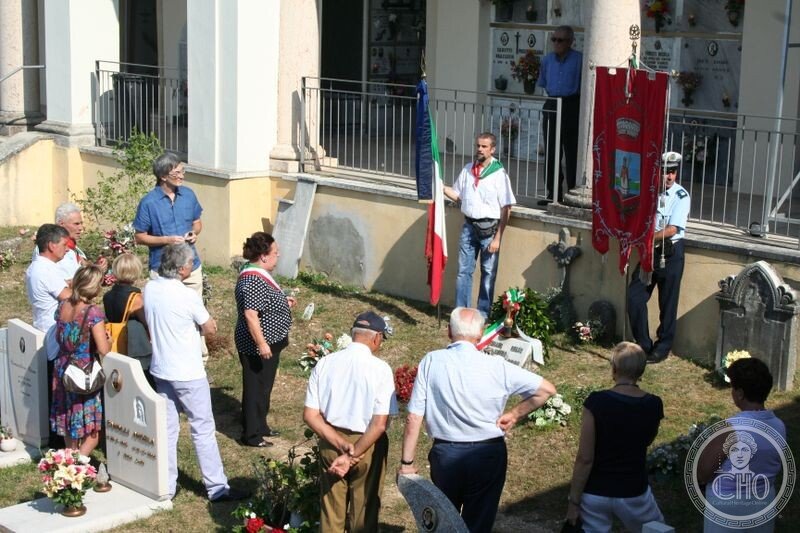
- Commemorated: by the municipality, with the town gonfalon; the ceremony photographed here was held on 12 August 2012
- Registered: in the war-grave register of the Russian Ministry of Defence as burial З39-50 — a single grave, one man buried, known: 0, unknown: 1. Kept, according to the same register, by the local Alpini veterans’ association
- Listed: the grave does not appear as such in the Italian national registers of Resistance memorials. The village war memorial (Monumento ai Caduti) is catalogued separately in Pietre della Memoria
History
More than five thousand Soviet citizens fought in the Italian Resistance between 1943 and 1945. Almost none of them had chosen to come. They were Red Army prisoners moved west as forced labour or pressed into German auxiliary units, who broke away and went up into the hills; several hundred were killed in Italy. Many were buried where they fell or in the nearest village churchyard, under a wooden marker and a nationality, because nobody present could read their papers or spell their names.
Monte Baldo was partisan country. The brigade that operated on this side of the mountain was the Avesani, one of the Verona formations; the village barber of San Zeno, Bortolo Schena, joined it in the summer of 1944 and later gave a filmed testimony about those months to the Verona Resistance archives. In the last week of October 1944 the Germans swept the mountain. The contrada of Prà Bestemà was burnt almost to the ground on 27 and 28 October, and some of its inhabitants were deported to Germany, because they had helped the partisans.
According to Massimo Eccli, the Soviet partisan buried in the cemetery was killed at Prà Bestemà during that operation, covering the withdrawal of the Avesani brigade. The date is 26 October 1944, and it is fixed by two independent records: it is the date cut into the headstone, M. 26-10-1944, and it is the date the Russian Ministry of Defence carries in its register of war graves abroad, where this burial is entered as created on 26 October 1944. It falls the day before the burning of the contrada, which is the order one would expect — the fighting first, the reprisal after.
What you see
Nothing monumental, and that is the point. The cemetery is a small walled enclosure on the road out of the village, with a portico along one side and a wall of loculi behind it, faced in pale stone and hung with photographs and flowers. The ground plots are set in grass and gravel; a stone cross stands among them. The Soviet grave is one of these, not a separate memorial: no plinth, no sculpture, no separate enclosure of the kind built for the Allied war cemeteries. It is marked by a low wedge of white stone set almost flat in the ground against the cemetery wall, carrying three lines and nothing else: PARTIGIANO RUSSO IGNOTO, and beneath them M. 26-10-1944. Unknown Russian partisan, died 26 October 1944. The stone states a nationality, a role and a day, and stops where the name would go.
What marks it out is what happens around it. In the photograph on this page the municipal gonfalon of San Zeno di Montagna has been carried into the cemetery and is being held by an officer of the local police; the Italian tricolour stands beside it; wreaths and a tricolour sash have been laid on the ground. Those who came that day included the mayor of the time, Graziella Finotti, wearing the tricolour sash of office, the deputy mayor Maurizio Peretti, Giovan Battista Trentini, and Bortolo Schena — the village barber who had gone up to the Avesani brigade in 1944, known locally as Nino Picena. Sixty-eight years after the fact, a village of fewer than fourteen hundred people still turns out for a man whose name it does not know.
The grave that started ten years of work
Massimo Eccli was born in this village and now teaches Italian in Moscow. As a child he was told by his grandfather about the unknown Russian soldier buried in the local cemetery. The story stayed with him, and as an adult he set out to find the man’s name.
He did not find it. What he found instead, working through the archives of the Russian Ministry of Defence and then Italian, German and American collections, was the scale of what had gone unrecorded: hundreds of Soviet citizens deported to Italy or escaped into the Resistance, whose names survived only in transliterations so mangled that the same man could appear three times under three spellings. That work became the book I partigiani sovietici in Italia (2018) and, with the publisher and historian Sandro Teti, I partigiani sovietici nella Resistenza italiana (2025), which carries a largely unpublished roll of names. It has been presented in Moscow as well as in Italy.
The archive he worked in has a record of this grave too. In the register of Soviet war burials abroad it is entry З39-50, province of Verona: one grave, one man, condition good, tended by the local Alpini. In the column for how many of the buried are identified it carries a nought, and in the column beside it a one. The bureaucracy counted him exactly, and that is all anyone has been able to do.
The grave at San Zeno is therefore two things at once. It is a war grave that a mountain village has looked after for eighty years, and it is the starting point of a piece of historical recovery that has given names back to men who had lost them — while the one who set it in motion still has none.
Practical information
- A municipal cemetery: open daily, free, ordinary opening hours. Behave as you would in any working cemetery.
- There is no sign or panel pointing the way to the Soviet grave, and it is easy to walk past: a low white stone lying almost flat against the cemetery wall, with three lines of lettering. If you cannot find it, ask at the town hall (Comune di San Zeno di Montagna) rather than wandering the rows.
- Our map point marks the cemetery, not the individual grave.
- Prà Bestemà, where the man was killed, is reachable on foot: the rebuilt contrada stands at 829 metres and is on the municipality’s signposted walking network.
Getting there
San Zeno di Montagna is about 40 km north-west of Verona and roughly 400 metres above the lakeside town of Garda, from which the road climbs in a series of hairpins. The nearest railway station is Verona Porta Nuova, with buses to Garda and a connecting local service up the mountain; most visitors drive. The cemetery is on Via del Cimitero, in Contrada Capra, a short distance from the village centre.
Nearby
- Prà Bestemà, the contrada burnt by the Germans on 27–28 October 1944, rebuilt and now a walking destination.
- The Monumento ai Caduti of San Zeno di Montagna, the village war memorial.
- Monte Baldo and its botanical trails, above the village.
- The German military cemetery of Costermano, 12 km south, where the other side of this war is buried.
Sources
- Account of the burial, the circumstances of the death and the 2012 commemoration supplied to Cultural Heritage Online by Massimo Eccli, August 2026, together with the photograph and the names of those present at the 2012 ceremony.
- OBD Memorial, Russian Ministry of Defence — burial record 262020193, war-grave number З39-50, San Zeno di Montagna, province of Verona: single burial created 26 October 1944, one man buried, none identified, kept by the local association of Alpini. The headstone inscription PARTIGIANO RUSSO IGNOTO / M. 26-10-1944 is read from the photograph attached to that record.
- M. Eccli, I partigiani sovietici in Italia, 2018; M. Eccli and S. Teti, I partigiani sovietici nella Resistenza italiana, Sandro Teti Editore, 2025 (ISBN 9788831492508).
- Comune di San Zeno di Montagna, Contrada Prà Bestemà — for the burning of the contrada on 27 and 28 October 1944 and the deportation of some of its inhabitants.
- Associazione Documenta, La Resistenza veronese raccontata da protagonisti e testimoni — filmed testimony of Bortolo Schena of San Zeno di Montagna, barber, who joined the Avesani brigade in the summer of 1944.
- Pietre della Memoria, Monumento ai Caduti di San Zeno di Montagna.
- Cemetery location from OpenStreetMap (Via del Cimitero, Contrada Capra).
Find it on the map
See this place and what’s around it →Record researched and written by Massimo Eccli for Cultural Heritage Online, 2026.
📷 Become a Cultural Heritage Online photographer
Share your photos of places: they stay published under your name as the author. The more they're seen, the more you get noticed — and soon a contest will reward the most appreciated photos.
Log in or sign up free to add a photoIs this page about you?
This page is read by travellers and heritage enthusiasts who find it on Google. Tell us how you are connected to this place and we will take it from there.