
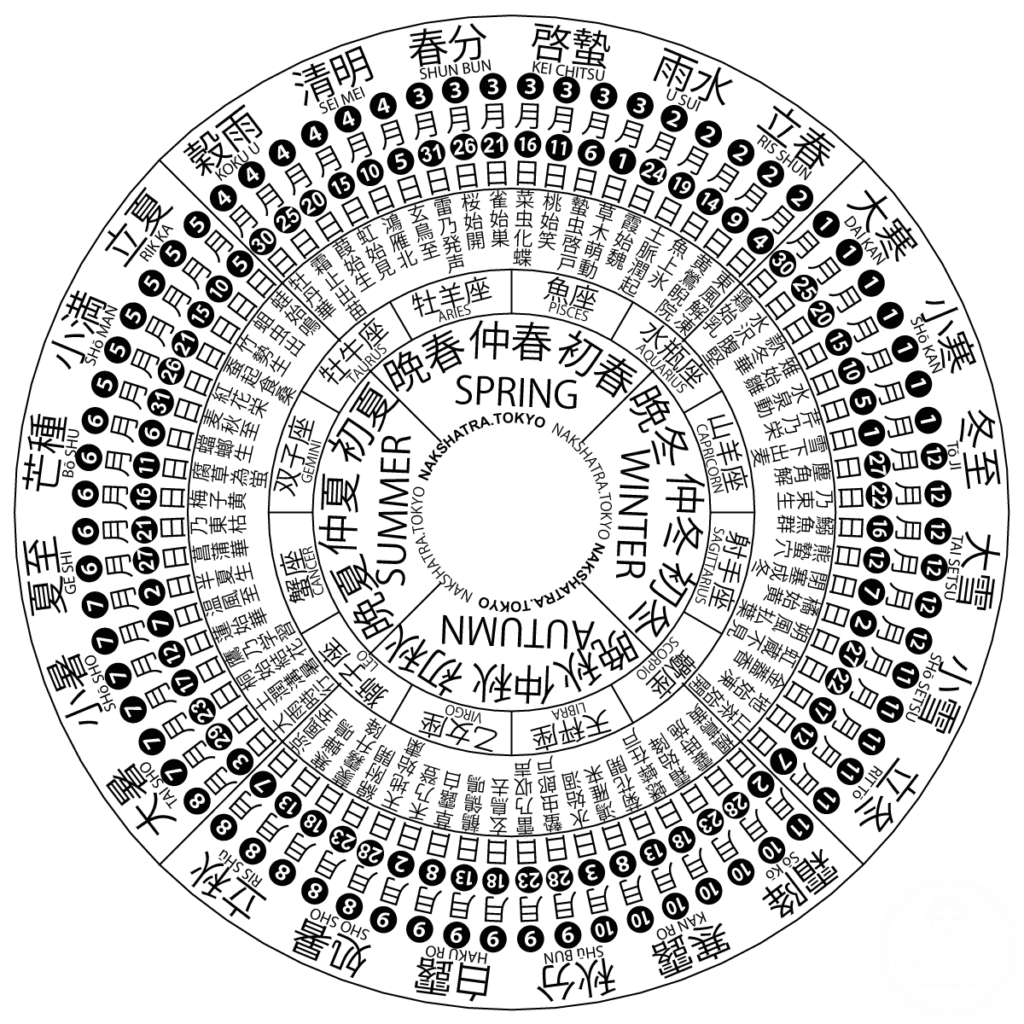
A system of twenty-four moments marking astronomical events and natural phenomena, used for millennia to synchronize lunar calendars with the seasons and guide agricultural practice across East Asia.
At a glance
The solar terms form the backbone of traditional timekeeping in China and neighbouring cultures. Each moment, spaced 15° apart along the ecliptic, corresponds to observable shifts in weather, plant behaviour, and animal activity. Farmers, families, and communities have relied on this knowledge system to plan planting, harvesting, and ritual life for over two thousand years.
Origins & history
According to the Book of Documents, the Duke of Zhou first determined the Winter Solstice by measuring the sun’s shadow on an ancient sundial called a tǔguī. Four seasonal terms were established, which evolved into eight before the Taichu Calendar of 104 BCE officially incorporated all twenty-four solar terms into the Chinese calendar. The system has remained largely unchanged since.
Solar terms originated in China, where they matched the seasonal changes of the North China Plain. Over centuries, the practice spread to Korea, Vietnam, and Japan, where communities adopted the same terminology and framework despite living in different climates.
The practice
The twenty-four terms divide the year into cycles marked by precise astronomical observation. Each term spans roughly 15 days, divided into three pentads—five-day periods, sometimes six—named after phenological events: the blooming of flowers, the arrival of insects, the behaviour of birds, the ripening of crops.
Practitioners and communities observe and record these shifts through direct attention to the natural world. The terms guide decisions about when to sow seeds, prune trees, prepare fields, and perform seasonal rituals. Knowledge is transmitted orally and through written calendars, farmer’s almanacs, and inherited practice.
Cultural significance
The solar terms represent a sophisticated merger of astronomical knowledge and ecological observation. Rather than abstract calendar mathematics, they embed practical wisdom about local climate and living things. This living knowledge system has sustained agricultural societies across East Asia and remains central to cultural identity and seasonal consciousness.
The terms are used not only to regulate planting and harvest but also to time traditional medicine, festivals, and family gatherings. They reflect a worldview in which human activity is coordinated with celestial and natural cycles.
Key facts
- Twenty-four moments spaced 15° apart along the ecliptic
- Each moment lasts approximately 15–16 days
- Divided into 72 pentads (five- or six-day periods) across the year
- Most pentads named after phenological phenomena
- UNESCO Intangible Cultural Heritage, 2016 (reference 00647)
- Shared across China, Korea, Vietnam, and Japan
Where to experience it
The solar terms are woven into daily life throughout China and East Asia. You encounter them in farmer’s markets, traditional calendars, agricultural almanacs, and seasonal festivals. In Beijing and rural communities across the heartland, families and farmers still consult the terms to plan work, prepare food, and mark the passage of the year.
Sources & resources
- Solar term — Wikipedia
- The Twenty-Four Solar Terms — UNESCO Intangible Cultural Heritage
- Cultural Heritage Online
Find it on the map
See this place and what’s around it →📷 Become a Cultural Heritage Online photographer
Share your photos of places: they stay published under your name as the author. The more they're seen, the more you get noticed — and soon a contest will reward the most appreciated photos.
Log in or sign up free to add a photo