
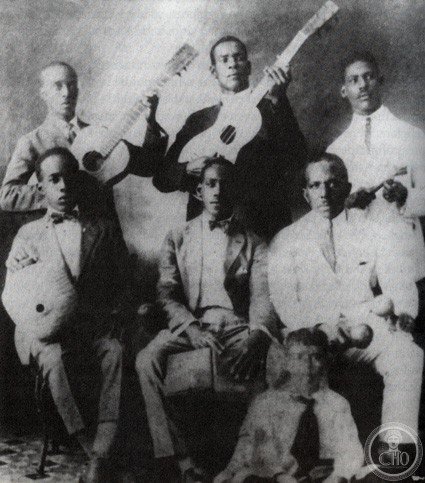
A syncretic music and dance born in the highlands of eastern Cuba in the late 19th century, blending Spanish vocal traditions and guitars with African rhythms, percussion, and call-and-response. Son became Cuba’s most influential genre and shaped Latin music worldwide.
At a glance
Cuban son is a living music rooted equally in Hispanic and Bantu traditions. The tres—a Spanish-derived guitar—carries the melody, while clave rhythm and percussion define the groove. Singers trade verses with bands in an intimate, conversation-like form that invites participation and improvisation.
Origins & history
Son emerged in the highlands of eastern Cuba during the late 19th century as a fusion of Spanish and African musical vocabularies. Around 1909 the practice reached Havana; the first recordings followed in 1917, sparking rapid expansion across the island.
Through the early 20th century, son ensembles evolved in size and instrumentation. Three- to five-member groups gave way to sextetos (sextets) by the 1920s; the addition of trumpet created septetos in the 1930s; and by the 1940s, larger conjuntos with congas and piano became standard.
From the 1930s onward, Cuban bands touring Europe and North America introduced son to global audiences, inspiring ballroom adaptations and hybrid genres from West African rumba to New York salsa. In Cuba itself, son continues to evolve into forms such as songo and timba.
The practice
A son performance centers on the tres—a small, bright-toned guitar with three double strings—paired with bongos, maracas, and other percussion. The clave rhythm underpins every phrase, a syncopated pulse that binds singer and band.
Vocally, son draws from Spanish lyrical metres and phrasing but channels them through Bantu call-and-response structures. A lead singer launches a phrase; the chorus answers, creating a dialogue that feels spontaneous even in formal arrangements.
Whether in a intimate gathering or a dance hall, son invites movement. The rhythm is felt in the feet and hips; the music builds from verses into instrumental breaks—especially notable during the descargas (jam sessions) that flourished in the 1950s—where musicians traded solos in real time.
Cultural significance
Son is the musical expression of Cuban creolidad—the blending of Spanish and African peoples into a shared cultural voice. It remains a cornerstone of Cuban identity and a gateway through which Cuban music reached and reshaped the world.
The practice demonstrates how musical traditions migrate, adapt, and thrive. Son’s influence flows through salsa, timba, and countless hybrid genres across the Americas and Africa, yet it endures in its original contexts as a vital, evolving form.
Key facts
- Origin: Late 19th century, eastern Cuban highlands
- Anchor heartland: Santiago de Cuba
- Primary instruments: Tres (Spanish guitar), bongos, maracas, clave
- Early format: Trios and quartets; sextetos became standard by the 1920s
- UNESCO Intangible Cultural Heritage (2019)
- Reference number: 02299
Where to experience it
Santiago de Cuba and the surrounding highlands remain the living center of son practice. The music thrives in informal gatherings, local venues, and festivals across the region, where it continues to evolve in both traditional and contemporary forms.
Sources & resources
- Son cubano — Wikipedia
- The Practice of Cuban Son — UNESCO Intangible Cultural Heritage
- Cultural Heritage Online
Find it on the map
See this place and what’s around it →📷 Become a Cultural Heritage Online photographer
Share your photos of places: they stay published under your name as the author. The more they're seen, the more you get noticed — and soon a contest will reward the most appreciated photos.
Log in or sign up free to add a photo