

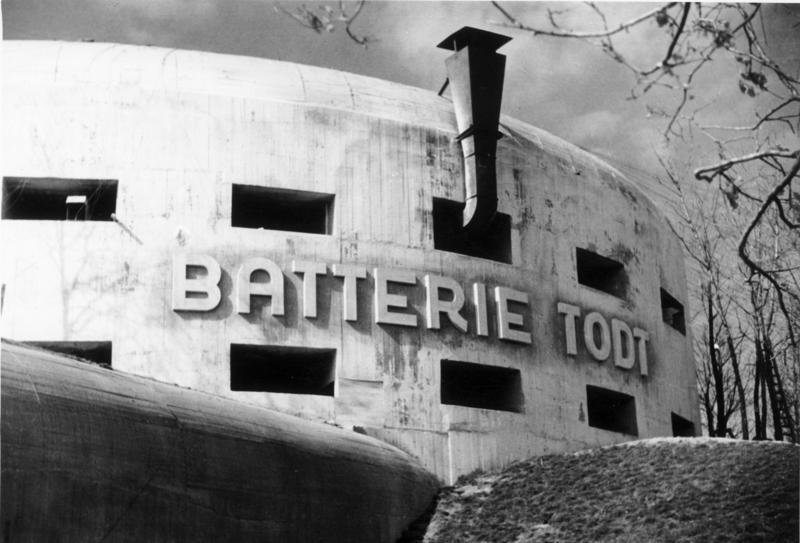
Four naval guns able to reach England from France, built to be the Atlantic Wall’s proof of German invincibility across the Channel. In two and a half years of firing at Dover it is not known to have sunk a single ship. It fell to Canadian infantry before lunch.
At a glance
Four casemates on the cliffs near Cap Gris Nez, each built around a Krupp 38 cm SK C/34 naval gun capable of reaching 55.7 km — far enough to fire across the narrowest point of the English Channel and hit Dover. Built by the Organisation Todt from the summer of 1940 with a workforce of 12,000–15,000, the battery fired its first round on 20 January 1942 and was formally inaugurated three weeks later, renamed for Fritz Todt after the engineer died in a plane crash the day before the ceremony.
It became one of the most photographed positions of the Atlantic Wall — a visible, close-range threat aimed directly at English soil. What the photographs from the German side do not show is a result: across the whole war, the battery’s guns are not credited with sinking a single ship, despite firing at Channel shipping and the port of Dover for years.
Key facts
- Built: from summer 1940, Organisation Todt, 12,000–15,000 workers (around 9,000 German)
- Structure: four reinforced-concrete casemates, walls and roof 3.5 m thick, each housing a Krupp 38 cm SK C/34 naval gun on a limited-traverse mount (120°)
- Range: 55.7 km — sufficient to strike Dover and Channel shipping from the French coast
- Garrison: roughly 390 Kriegsmarine personnel (Marineartillerieabteilung 242); with anti-aircraft crews and command staff, sources give figures up to about 600
- Operational: first shot 20 January 1942; renamed «Todt» and formally inaugurated 10 February 1942, with Admirals Raeder and Dönitz present
- 14 February 1942: fired in support of the «Channel Dash», covering the German battleships Scharnhorst and Gneisenau and the cruiser Prinz Eugen as they ran the Channel to German ports
- Toll on the English side: 3,059 shelling alerts, 216 civilian deaths and over 10,000 damaged properties around Dover — with no confirmed ship sunk by the battery
- Fell: Allied bombing 26 and 28 September 1944 (532 and 302 bombers), ground assault by the 9th Infantry Brigade, 3rd Canadian Infantry Division, on 29 September; garrison surrendered by mid-morning, white flags flying by 10:30
- Coordinates: 50.8442° N, 1.6000° E
How it was built
The Todt Battery was designed to be seen as much as to fire. Four separate casemates, rather than a single hardened position, spread the guns so no single Allied bomb could silence the battery at once, while the sheer visibility of four gun towers on the cliffs at Cap Gris Nez — the closest point of occupied France to England — served a propaganda purpose the Atlantic Wall rarely achieved elsewhere: the enemy coast was close enough to be an audience. The naval guns themselves, originally intended for a battleship refit, gave the position a reach few coastal batteries anywhere could match.
Fritz Todt, the engineer whose organisation built the position and much of the rest of the Atlantic Wall, died in a plane crash on 8 February 1942, two days before the battery’s inauguration. It was renamed in his honour on the spot, turning an already prominent installation into a memorial as well as a weapon.
Two and a half years of firing, and the morning it ended
For most of its operational life the battery did what coastal artillery does: it fired across the Channel at shipping and at Dover itself, and Dover fired back. The toll on the English side accumulated steadily — alerts running into the thousands, civilian deaths in the low hundreds, buildings damaged by the score — without ever converting into the kind of decisive naval kill the battery’s range promised. Its one moment of real strategic use was defensive rather than offensive: covering the Channel Dash of February 1942, when three German capital ships ran the length of the Channel under British guns and aircraft, largely successfully.
The end came fast. Two heavy Allied bombing raids on 26 and 28 September 1944 struck the position ahead of a ground assault by Canadian infantry on the 29th. By mid-morning the garrison had surrendered; white flags were flying before 10:30. A battery built to project invincibility across a stretch of open water fell to infantry in a single morning, after standing largely unchallenged on land for two and a half years.
Who tells it, and where the accounts diverge
A German wartime photograph of the battery, taken by an Organisation Todt war correspondent named Maier in 1942, survives with a caption that reads, in full confidence: the battery had «already become a term for the enemy: an invincible opponent». It is propaganda in the most literal sense — a claim of permanence made about a position whose actual combat record, cross-checked against Allied and French sources, shows no confirmed ship sunk in over two years of firing.
The gap between the caption and the record is not really about lying; both things can be true. A battery can fire thousands of rounds, damage a port, kill civilians, and still never sink the ship its range was built to threaten — and the same battery, called invincible in 1942, can surrender to a single infantry brigade in under a day in 1944 once air power and momentum, rather than naval gunnery, decide the question. The photograph’s confidence and the surrender two and a half years later describe the same weapon; only the war around it had changed.
What you see today
- The site operates as the Musée du Mur de l’Atlantique, with one of the original casemates (Turm I) open to visitors and displaying period equipment.
- A German railway gun, the 28 cm K5, is preserved and displayed on site, alongside the surviving casemate structures.
- The other three casemates and surrounding installations remain visible in the landscape around the museum.
Getting there
The Musée du Mur de l’Atlantique – Batterie Todt lies at Audinghen, on the D940 coast road between Calais and Boulogne-sur-Mer, close to Cap Gris Nez.
Nearby
- Cap Gris Nez itself, the closest point of the French coast to England, immediately west
- Blockhaus d’Éperlecques and La Coupole, the Atlantic Wall’s V-weapon sites, further south near Saint-Omer
Sources
- Wikipedia (English and French), Todt Battery / Batterie Todt — construction, armament, garrison, Channel Dash role, capture.
- Chemins de mémoire (cheminsdememoire.gouv.fr), Musée du Mur de l’Atlantique – Batterie Todt — official French government heritage listing.
- Bundesarchiv, photograph and caption, Bild 146-1973-036-01 (Maier, 1942), cross-checked as a primary example of contemporary German framing.
Find it on the map
See this place and what’s around it →📷 Become a Cultural Heritage Online photographer
Share your photos of places: they stay published under your name as the author. The more they're seen, the more you get noticed — and soon a contest will reward the most appreciated photos.
Log in or sign up free to add a photo