
Allied intelligence feared four 150 mm guns capable of shelling the invasion fleet off Sword Beach. What 150 British paratroopers found, after fighting through a minefield in the dark with two-thirds of their planned force missing, were four elderly 100 mm howitzers from the First World War.
At a glance
The battery at Merville, built by the Organisation Todt from August 1942 and completed just weeks before D-Day, sat inside a fortified compound 640 by 460 metres, ringed by double barbed wire, a 91-metre minefield and an anti-tank ditch. Its four reinforced-concrete casemates, walls 1.8 metres thick, were assumed by Allied planning staff to hold guns able to reach the invasion beaches directly. Destroying it before the landings became one of the most urgent objectives assigned to Britain’s airborne forces.
The 9th Parachute Battalion’s assault, in the hours before the first landing craft touched down, went wrong almost from the start — and succeeded anyway, against a threat that turned out to be smaller than anyone feared.
Key facts
- Built: casemates 1–2 from August 1942; casemates 3–4 completed by May 1944, Organisation Todt
- Structure: four casemates, walls 1.8 m thick, inside a 640 × 460 m fortified perimeter with double wire, a 91 m minefield and an anti-tank ditch
- Armament: four Czechoslovak-built Škoda leFH 14/19(t) howitzers, calibre 100 mm, First World War–era design, range about 8,400 m, plus one 20 mm gun
- Garrison: around 50 German troops
- Assault: 9th Parachute Battalion, 6th Airborne Division, under Lieutenant Colonel Terence Otway, night of 5–6 June 1944
- What went wrong: the preliminary air bombardment missed; of roughly 600 men and 3 gliders planned for the assault, only about 150 reached the rendezvous point, with a single machine gun and 20 Bangalore torpedoes between them; two of the three gliders missed their landing zone under anti-aircraft fire
- Result: the battery taken in close-quarters fighting with the force available; roughly 22 Germans killed and 22 captured, the garrison reduced from about 50 to 6 combat-effective men; British losses 65 of the 150 who attacked
- Aftermath: Germans reoccupied the position and returned two guns to action before British Commandos arrived on 7 June, without ever fully destroying it
- Coordinates: 49.2698° N, 0.1968° W
How it was built, and misjudged
The battery followed the Atlantic Wall’s standard grammar — thick concrete, a minefield, wire, an anti-tank ditch — built to make a direct assault as costly as possible. What made it exceptional was not the construction but the guesswork built on top of it. Allied photo-reconnaissance could see the casemates and the perimeter clearly enough, but not what was inside them, and planning staff assumed the worst: guns of 150 mm calibre, large enough to reach the fleet standing off Sword Beach and threaten the entire eastern flank of the invasion.
That assumption drove an assault plan disproportionate to what the battery actually held: heavy air bombardment, a full parachute battalion, glider-borne sappers with jeeps, anti-tank guns and mine-clearing equipment, all committed to destroying four guns that turned out to be First World War–era 100 mm howitzers with barely a third of the reach that had been feared.
The night the plan fell apart and worked anyway
Almost nothing went as planned. The RAF bombing run meant to crater the minefield and stun the garrison missed the position entirely. Of the roughly 600 men committed to the operation, dispersed by a scattered parachute drop in darkness, only about 150 reached the assembly point — without their mortars, most of their anti-tank guns, and most of their mine-clearing charges. Two of the three gliders carrying reinforcements and heavy equipment missed the landing zone under anti-aircraft fire; only one made it back to England.
Otway attacked regardless, with the 150 men and the 20 Bangalore torpedoes he had. They blew gaps in the wire, crossed the minefield, and took the casemates in hand-to-hand fighting. It cost 65 of the 150 attackers killed or wounded, against a garrison of about 50 reduced to six men still able to fight. The battery was silenced for the critical hours of the landing — not because the plan worked as designed, but because the men who executed it kept going once it had already failed.
Who tells it, and where the accounts diverge
The intelligence estimate and the battery’s actual armament are both well documented, and they do not agree: British planning treated Merville as a 150 mm threat capable of hitting the invasion fleet directly, while the four guns found inside, once the position fell, were 100 mm pieces already a generation old when the war began. The disproportion between the assault mounted and the threat that existed is not a matter of dispute between sources — English and French accounts of the battery agree on both figures independently.
What the disproportion does not do is make the assault pointless in hindsight. Planners could not know from aerial photographs what calibre sat behind 1.8 metres of concrete, and a battery of any calibre within range of the beaches had to be treated as the worse case until proven otherwise. The battle is remembered, accurately, as a case where the guns turned out to be smaller than feared — and just as accurately, as a case where nobody involved in the attack knew that until it was already over.
What you see today
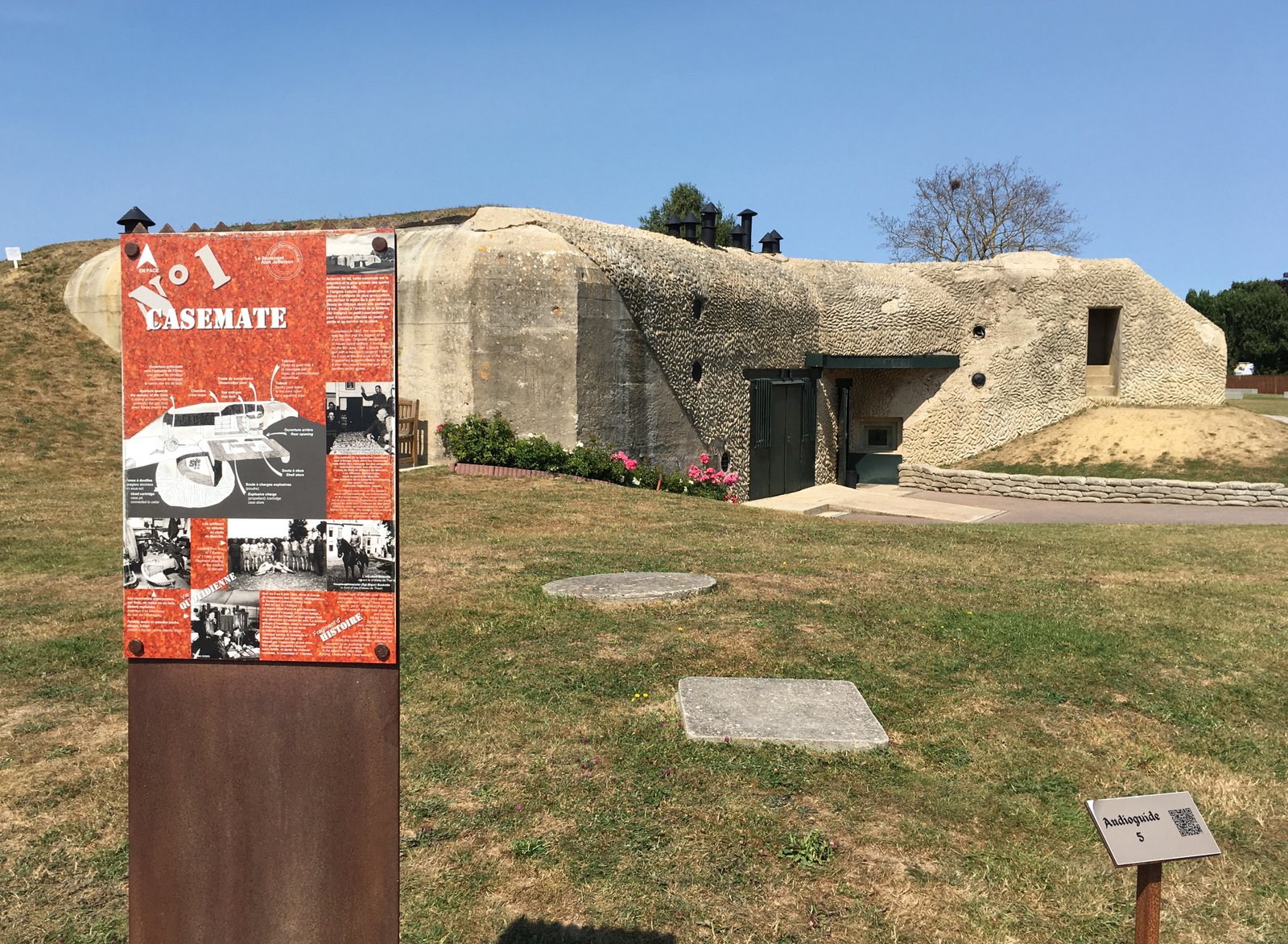
- Casemate No. 1, restored, houses the museum’s main exhibition on the battery and the 9th Parachute Battalion’s assault.
- The other three casemates remain on site, in varying states of preservation, within the original fortified perimeter.
- A Douglas C-47 Dakota, representative of the aircraft that dropped the paratroopers, is displayed on the grounds.
Getting there
The Merville Battery museum lies at Place du 9e Bataillon, Merville-Franceville-Plage, on the Normandy coast east of Ouistreham and Sword Beach.
Nearby
- Pegasus Bridge and the Pegasus Memorial Museum, a short distance south-west, another 6th Airborne Division objective of the same night
- Sword Beach, immediately south-west, the invasion sector the battery was believed to threaten
Sources
- Wikipedia (English and French), Merville Gun Battery and Battle of Merville Gun Battery — construction, armament, assault sequence, casualty figures, cross-checked between language versions.
- Base Mérimée/POP (Ministère de la Culture), notice PA14000026 — protection status, ownership by the Conservatoire du littoral.
- Batterie de Merville, official museum site — site orientation and preserved structures.
Find it on the map
See this place and what’s around it →📷 Become a Cultural Heritage Online photographer
Share your photos of places: they stay published under your name as the author. The more they're seen, the more you get noticed — and soon a contest will reward the most appreciated photos.
Log in or sign up free to add a photo