
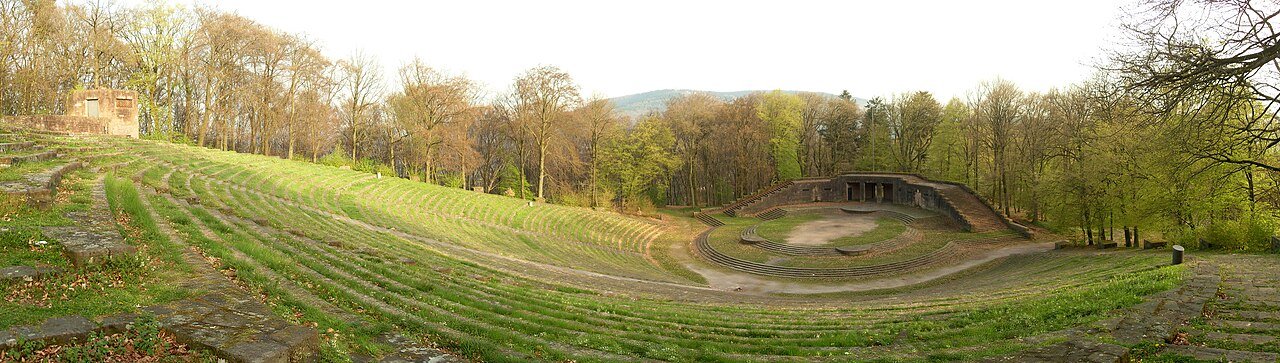
An amphitheatre built for a movement that its own propaganda minister buried within two years of opening it, on a hill the regime called sacred and ancient Germanic ground that archaeology never confirmed.
At a glance
Built in 1934–35 to designs by architect Hermann Alker, the Thingstätte was one of roughly forty open-air «Thing» theatres actually completed out of some four hundred planned nationwide, intended as ritual assembly spaces staging a new form of mass theatre. It opened on 22 June 1935 with Propaganda Minister Joseph Goebbels giving the address, calling it «National Socialism in stone» and the most beautiful of its kind — the only time the venue was ever full. By October 1935 Goebbels had banned the word «Thing» as backward, and by 1937 he had withdrawn support from the whole movement: the plays lacked drama, audiences stayed away, and the regime’s own interest had moved on.
The Heiligenberg carried older layers the regime folded into its own claim of sacred continuity: a Celtic hill settlement and ring wall, and the ruin of St Michael’s monastery, founded in 1023. The theatre itself is entirely a construction of 1934–35; the research since done on the Thingspiel movement states there is no evidence of a historical Germanic assembly site on this hill at all.
Key facts
- Construction: groundbreaking 30 May 1934, twelve months to build, nine months longer than planned; final cost around 600,000 Reichsmark against an initial estimate of 135,000, borne almost entirely by the city of Heidelberg.
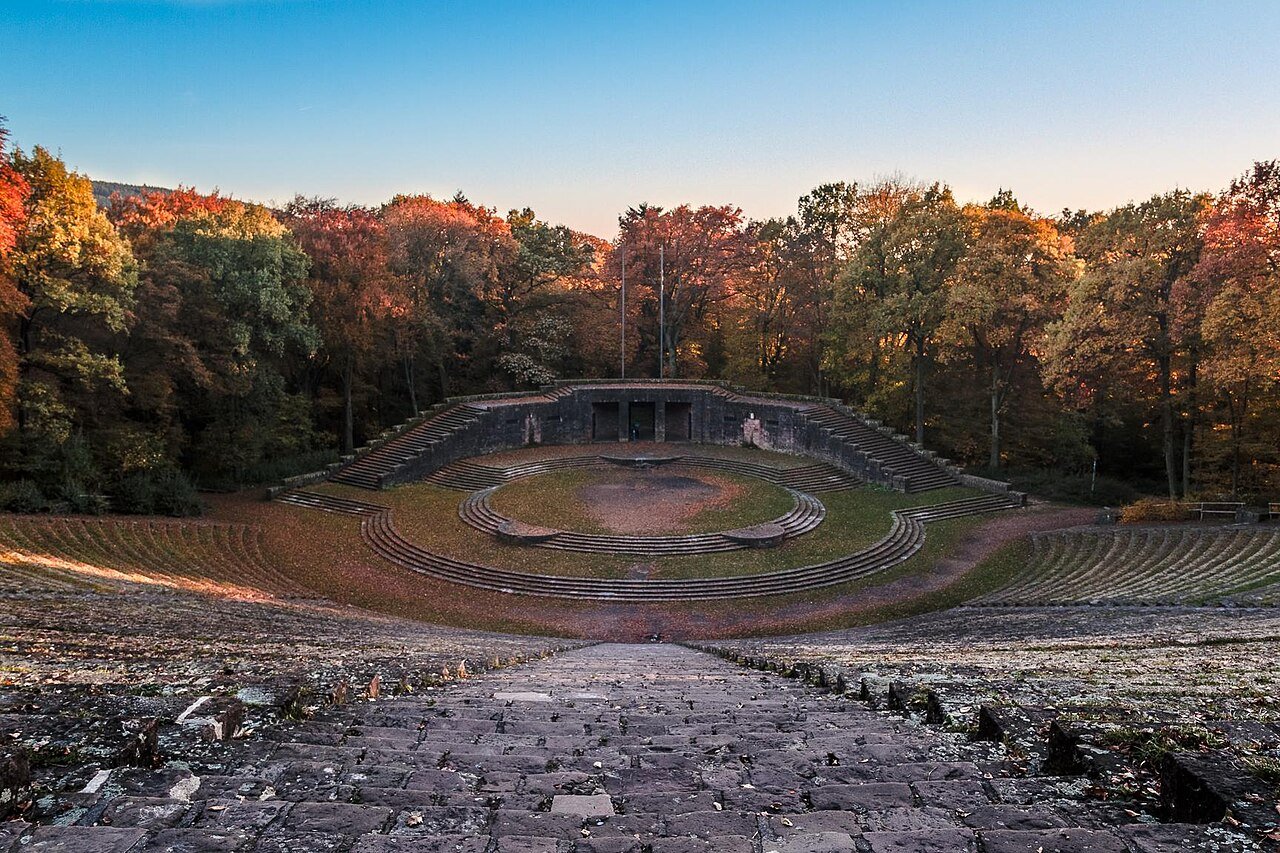
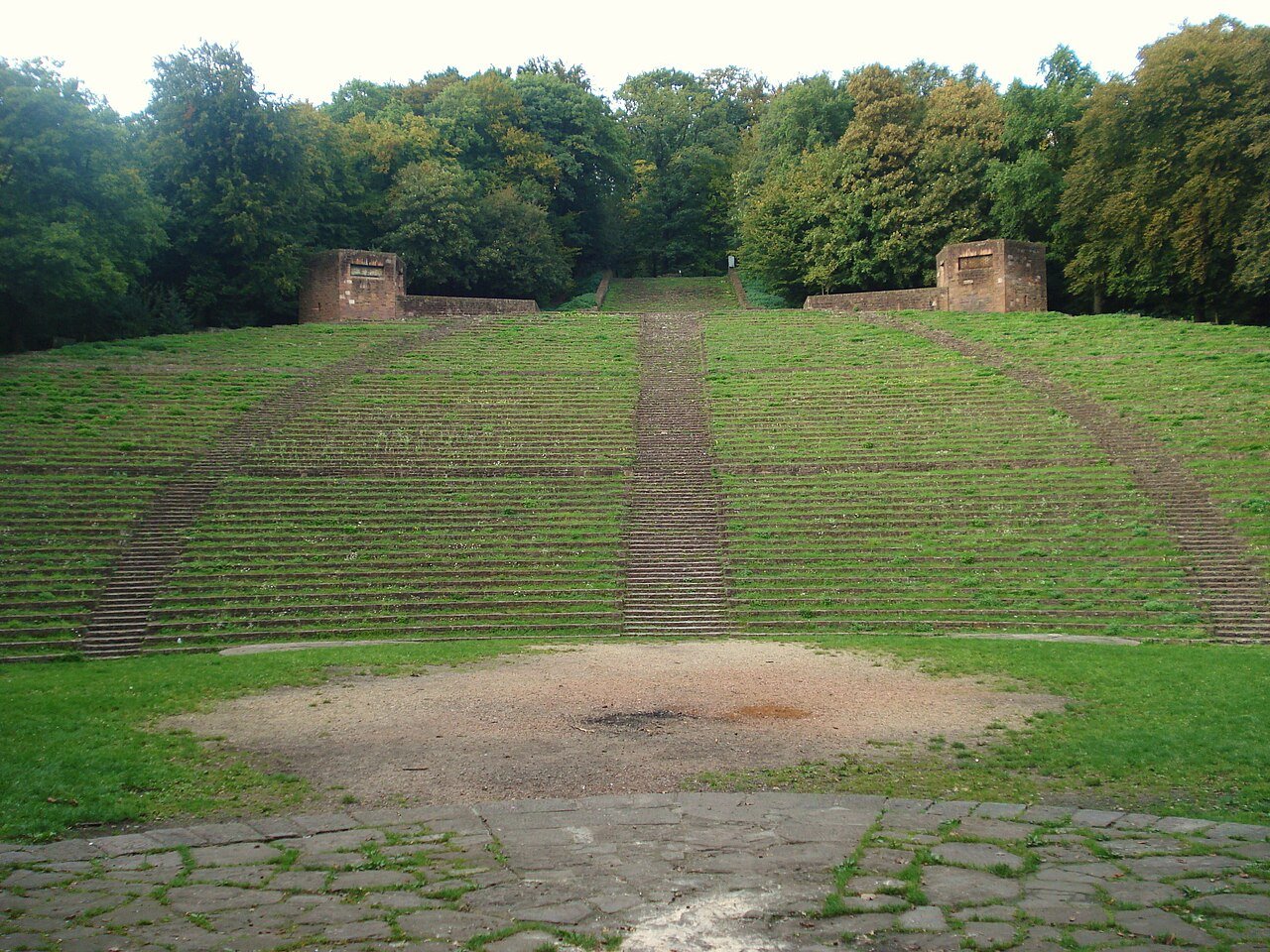
- Capacity: built for roughly 8,000 seated and up to 15,000 with standing room; the original design, scaled back during construction, had called for as many as 40,000. Fifty-six tiers of stone seating rise 25 metres around the stage.
- Workforce: over 1,200 Reichsarbeitsdienst men and Heidelberg students worked on site at peak, paid one Reichsmark a day — but the volunteer labour force was substantially a propaganda image; professional builders carried out most of the actual construction.
- The movement’s collapse: the word «Thing» itself was banned from official use by October 1935; Goebbels withdrew support in 1937, ending a movement that had run for barely three years from its first stone laid.
- What is actually ancient here: a Celtic hill settlement and ring-wall system dated to around 500 BCE, and the ruin of St Michael’s monastery, founded in 1023 as a daughter house of Lorsch Abbey and dissolved in the sixteenth century — both older by more than a millennium than anything the 1935 theatre claimed to continue.
- Coordinates: 49.4239° N, 8.7064° E.
Who tells it, and where the accounts diverge
The regime’s own words are the clearest refutation of its own claim. In June 1935 Goebbels called the Thingstätte the assembly-place of the age; by October of the same year his ministry had banned the very word that named the movement, and within two years he had ended it outright — the propaganda machine dismantling in months what it had consecrated in a single speech. The invented continuity followed the same pattern: the site was sold to visitors as an ancient Germanic sacred ground, but the modern research project dedicated to the Thing theatres states plainly that no historical Germanic assembly site ever stood here, and that the archaeology used to justify the claim in the 1930s was produced in haste. What the hill genuinely documents — a Celtic settlement, a medieval monastery — belongs to two entirely different pasts than the one the theatre claimed.
Postwar Heidelberg neither demolished the amphitheatre nor turned it into a memorial. American soldiers played basketball on its steps and held an Easter service there in 1947; it later hosted jazz concerts, then decades of an unofficial, increasingly large Walpurgisnacht gathering every 30 April. The city ended that gathering only in 2018, after a forest fire and a serious injury the previous year, citing safety — a 2017 risk assessment found seventeen of twenty-three hazard categories unacceptable — and citing safety alone, not history. Monument protection came only in 1989, forty-four years after the war ended.
Media
Video — DW Deutsch (Deutsche Welle), aerial drone view of the amphitheatre today.
What you see today
- The stone amphitheatre itself, intact, city-owned and freely accessible in forest on the Heiligenberg, used informally for hiking, jogging and picnics.
- Traces of the Celtic ring wall and the ruined St Michael’s monastery on the same hill, reached by marked paths.
- No formal events programme; the annual unofficial Walpurgisnacht gathering has been banned by the city since 2018 and remains banned in 2026, with the site barricaded and patrolled that one night each year.
Getting there
Free, year-round access via woodland paths from Heidelberg-Handschuhsheim, a 40–60 minute climb, or a shorter drive to a summit car park via Ziegelhausen. The terrain is unlit with steep stone steps; the site is closed to entry from 16:00 on 30 April to 06:00 on 1 May each year.
Sources
- City of Heidelberg (heidelberg.de) — the 2018 Walpurgisnacht ban, its 2026 renewal, the 2017 incident and risk assessment.
- Thingstätten.info, research and exhibition project on the German Thing theatres (Katharina Bosse) — construction cost, the «first 66» national programme, the absence of a genuine Germanic site here.
- Failed Architecture, «Hot Potato Heritage: Heidelberg’s Nazi Amphitheatre» — site selection, the October 1935 word-ban, postwar reuse, 1989 protection.
- Landeskunde Baden-Württemberg education portal (zum.de) — St Michael’s monastery and the Celtic-Roman cult site.
- Wikipedia, Heidelberg Thingstätte and Thingspiele, used as cross-check only.
Find it on the map
See this place and what’s around it →📷 Become a Cultural Heritage Online photographer
Share your photos of places: they stay published under your name as the author. The more they're seen, the more you get noticed — and soon a contest will reward the most appreciated photos.
Log in or sign up free to add a photoIs this page about you?
This page is read by travellers and heritage enthusiasts who find it on Google. Tell us how you are connected to this place and we will take it from there.