

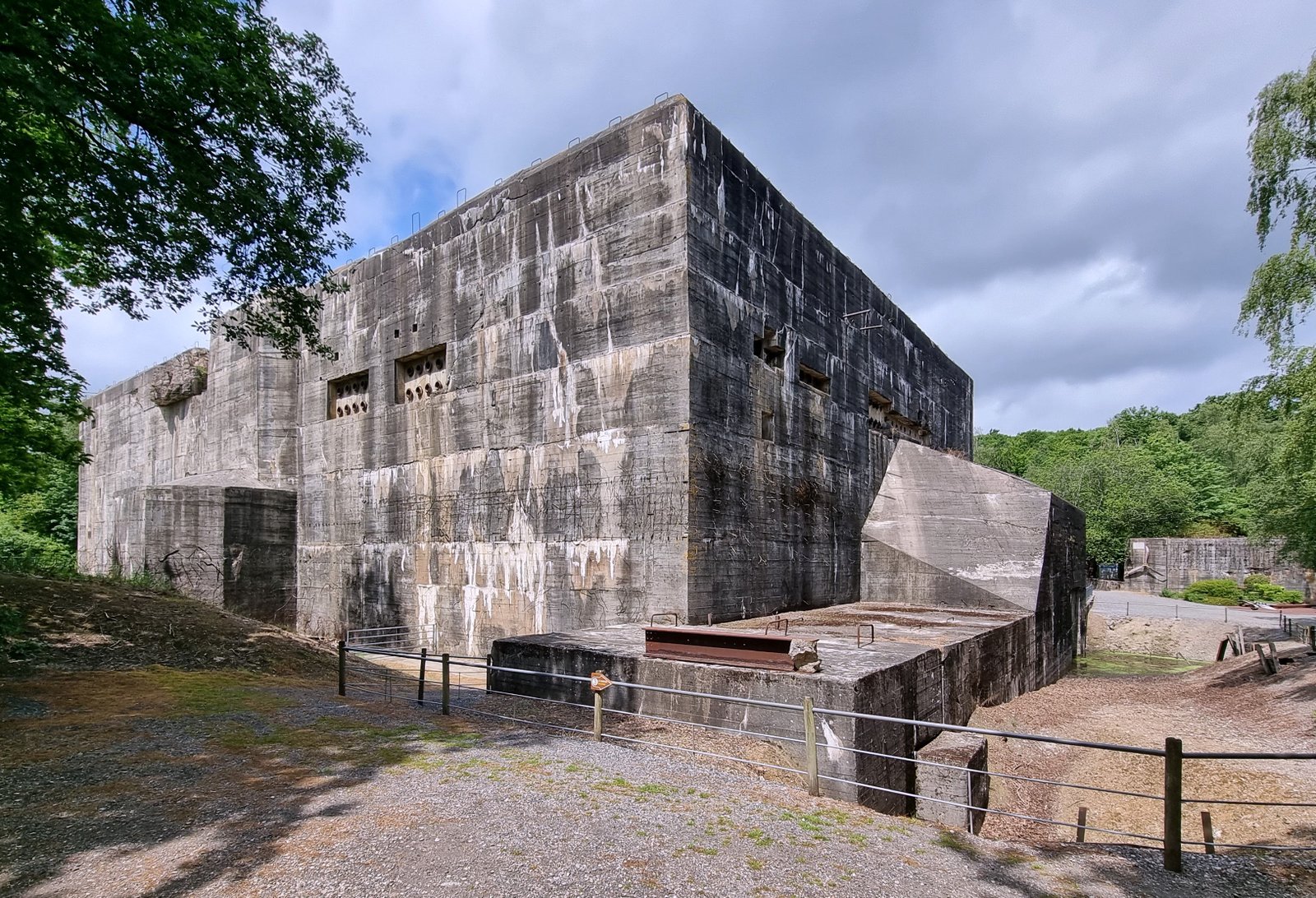
A bunker 92 metres wide and 28 metres tall, designed to fire up to 36 V-2 rockets a day at England, and abandoned little more than a third built. How many people were forced to build that third depends on which record you read.
At a glance
Under the code name «Kraftwerk Nord West», construction began at Éperlecques in late 1942 or early 1943: a reinforced-concrete complex meant to combine a V-2 storage and launch facility for up to 100 missiles, a liquid-oxygen production plant, and a protected railway station, behind walls up to 7 metres thick. It was the first of the two great V-2 bunkers the Germans built in the Pas-de-Calais, and the harder-hit of the two.
Two Allied bombing campaigns, eleven months apart, ended the project before it could fire a single rocket. What remains is roughly a third of what was planned — and an open question about exactly how many people were made to build even that much.
Key facts
- Built: from late 1942/early 1943, Organisation Todt, project associated with engineer Franz Xaver Dorsch
- Workforce: France’s own heritage register (base Mérimée) records around 2,000 workers on site; English-language historical accounts give a much larger figure — some 6,000 initially, rising past 35,000 workers cycled through over the site’s operational period, including German specialists, French forced conscripts (STO), and prisoners of war and political prisoners from Belgium, the Netherlands, Poland, Czechoslovakia, the Soviet Union and Spain, working 12-hour shifts around the clock
- Structure: 92 m wide, 28 m tall, walls up to 7 m thick, levels extending 6 m below ground; planned to use roughly 200,000 tonnes of concrete and 20,000 tonnes of steel
- Purpose: storage for over 100 V-2 rockets, a launch capacity of up to 36 missiles a day, a liquid-oxygen plant (five Heylandt compressors, about 10 tonnes of LOX per day each) and a protected rail terminus
- 27 August 1943: 187 USAAF B-17s dropped 368 bombs of 2,000 lb each, collapsing the site’s still-curing concrete into rubble
- 6 July 1944: an RAF raid of 314 Halifax, 210 Lancaster and 26 Mosquito aircraft breached the structure with a Tallboy earthquake bomb
- Outcome: abandoned March 1944, only about 35% complete; the V-2 launch programme moved to the newly designed La Coupole, 14.4 km to the north-north-west
- Coordinates: 50.8288° N, 2.1838° E
How it was built
Éperlecques was conceived before its designers had learned what Allied bombing could do to a site still under construction. Unlike La Coupole, which buried its production line inside a hillside, the Blockhaus rose largely above ground — a visible, enormous target from the moment its outline became clear from the air. The scale of the plan matched the ambition: not a single launch pad but a complete production chain, from liquid-oxygen manufacture to missile storage to a rail line protected under the same roof.
None of that scale is in serious dispute. What is disputed, without ever being resolved, is how many people it took to build even the unfinished third that survives. France’s own official heritage listing for the site records a workforce of roughly 2,000. Independent historical accounts, drawing on wartime and postwar research into the site’s forced-labour and prisoner-of-war contingents, put the true figure many times higher — into the tens of thousands cycled through over the site’s short working life.
Two raids, eleven months apart
The first blow came on 27 August 1943, when nearly 200 American B-17s dropped high-explosive bombs onto concrete that had not yet had time to cure; much of the structure collapsed under its own unset weight. Work continued regardless through the following months, patching and rebuilding, until a second raid on 6 July 1944 — this time British Lancasters and Halifaxes, one of them carrying the deep-penetration Tallboy bomb — breached the hardened structure directly. Within weeks the site was abandoned, its function already handed to the newer, better-protected complex at Wizernes.
Who tells it, and where the accounts diverge
The gap between 2,000 and 35,000 is not a rounding error. One figure comes from the French state’s own record of a site it now protects and presents to the public; the other comes from historians reconstructing, after the fact, how many forced labourers and prisoners actually passed through a construction project that never had reason to keep a public accounting of them at the time. Neither source is being dishonest — a heritage listing typically counts a site’s peak or average workforce, while historical reconstructions count everyone who was ever there, including men who died, were transferred, or were replaced within weeks. But the size of the gap matters: it is the difference between a labour force and something closer to a labour system, one large enough that no single official document was ever going to capture it in full.
The site’s own visitor-facing history, understandably built around its dramatic scale and its role in the V-weapon story, does not resolve this either way. What the concrete itself cannot say is how many of the hands that poured it were never free to leave.
What you see today
- The unfinished bunker structure, roughly a third of its planned scale, showing bomb damage from both the 1943 and 1944 raids including the Tallboy breach.
- A wooded site around the bunker, with displays on the V-weapon programme and the bombing campaign that stopped it.
Getting there
The Blockhaus lies at Éperlecques, north of Saint-Omer, Pas-de-Calais, close to the A26 motorway.
Nearby
- La Coupole, 14.4 km north-north-west, the successor V-2 complex the Éperlecques programme was transferred to
- Saint-Omer, the nearest town
Sources
- Wikipedia, Blockhaus d’Éperlecques — construction, workforce figures, bombing raids, outcome.
- Base Mérimée/POP (Ministère de la Culture), notice PA00108267 — official heritage listing and workforce figure, cross-checked against the higher figures in independent historical accounts.
Find it on the map
See this place and what’s around it →📷 Become a Cultural Heritage Online photographer
Share your photos of places: they stay published under your name as the author. The more they're seen, the more you get noticed — and soon a contest will reward the most appreciated photos.
Log in or sign up free to add a photo