
A confraternity of flagellants that became one of the richest institutions in Venice, a relic of the True Cross that produced a cycle of paintings now in the Accademia, and a marble courtyard screen that turned a side street into a threshold.
At a glance
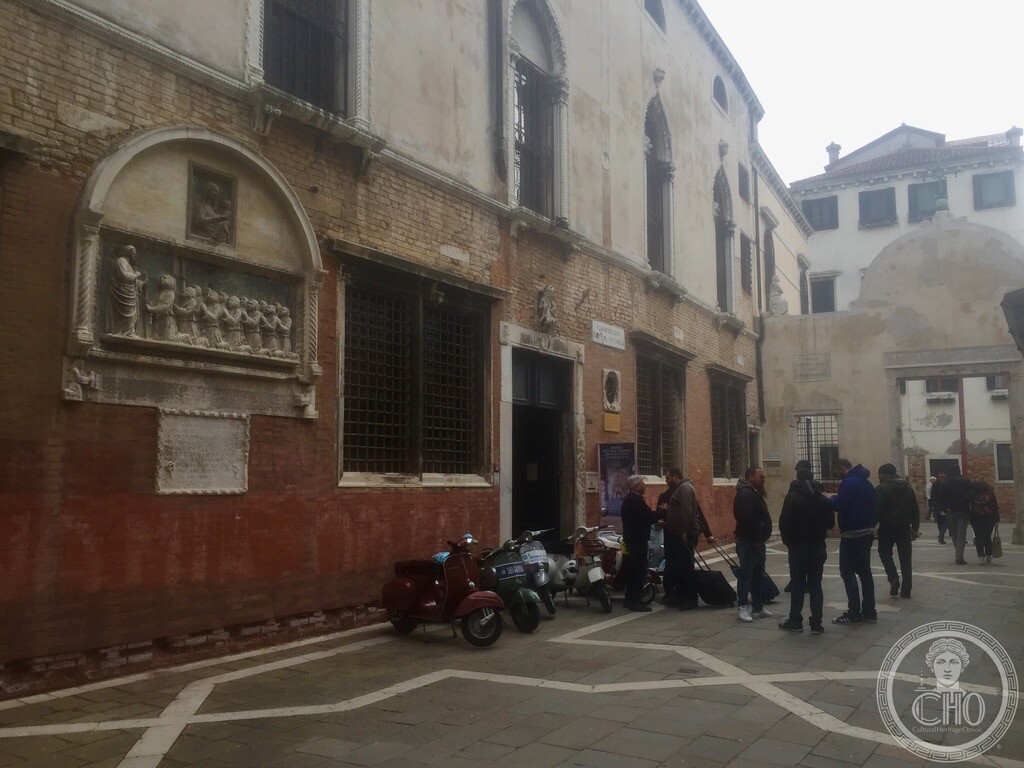
The Scuola Grande di San Giovanni Evangelista was founded in 1261 as a company of battuti – flagellants who walked the city in hooded robes. Those robes are what the relief beside its entrance shows: a double row of brothers kneeling before their patron saint, carved in marble and set into the wall of the campiello. Everything that followed came from a single object, a fragment of the True Cross given to the Scuola in 1369, which made it the destination of a civic cult and the client of Gentile Bellini and Vittore Carpaccio.
Key facts
- Founded: 1261, as a confraternity of disciplinati or flagellants
- Relic: a fragment of the True Cross, given in 1369 by Philippe de Mézières, chancellor of Cyprus and Jerusalem
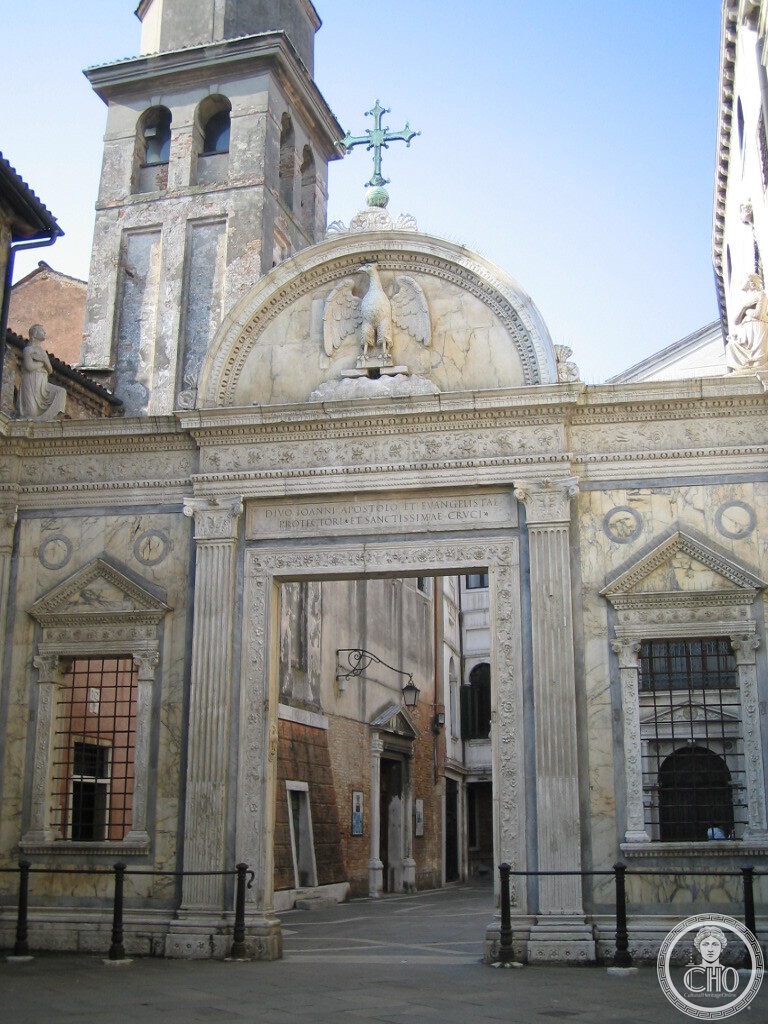
- Marble screen: Pietro Lombardo (c. 1435–1515), 1478–1481, closing the courtyard off the campiello
- Staircase: Mauro Codussi (c. 1440–1504), 1498
- Painting cycle: the Miracles of the True Cross, 1496–1501, by Gentile Bellini, Giovanni Mansueti, Vittore Carpaccio, Lazzaro Bastiani, Benedetto Diana and Perugino
- Where the paintings are now: the Gallerie dell’Accademia, since 1820; the Perugino is lost
- Today: an archconfraternity, reconstituted in 1929 and canonically erected in 1931
- GPS: 45.43830, 12.32620 · Open in Google Maps
History
Venice’s scuole were lay brotherhoods: mutual aid, funeral rights, charity, processions. This one began in 1261 among the flagellants, a movement that had swept up from central Italy the year before, and it settled in San Polo beside the church of San Giovanni Evangelista. For a century it was one confraternity among dozens.
What changed it was a gift. In 1369 Philippe de Mézières, chancellor of the crusader kingdoms of Cyprus and Jerusalem, handed the Scuola a fragment of the True Cross he had received from the Latin patriarch of Constantinople. The relic drew the city. It was carried in procession through the Piazza and along the canals, and it accumulated a reputation for miracles – which the Scuola then commissioned its painters to record. Between 1496 and 1501 Gentile Bellini, Carpaccio, Mansueti, Bastiani, Diana and Perugino produced the Miracles of the True Cross, a set of enormous canvases that are now among the most useful documents of what fifteenth-century Venice actually looked like. Napoleon’s suppression scattered the Scuola; since 1820 the surviving pictures have hung in the Accademia.
The building itself grew in the same decades. Pietro Lombardo closed the courtyard in 1478–1481 with a marble screen, and Mauro Codussi added the double staircase in 1498. The confraternity was refounded in 1929 and canonically re-erected two years later, and it holds the building still.
What you see
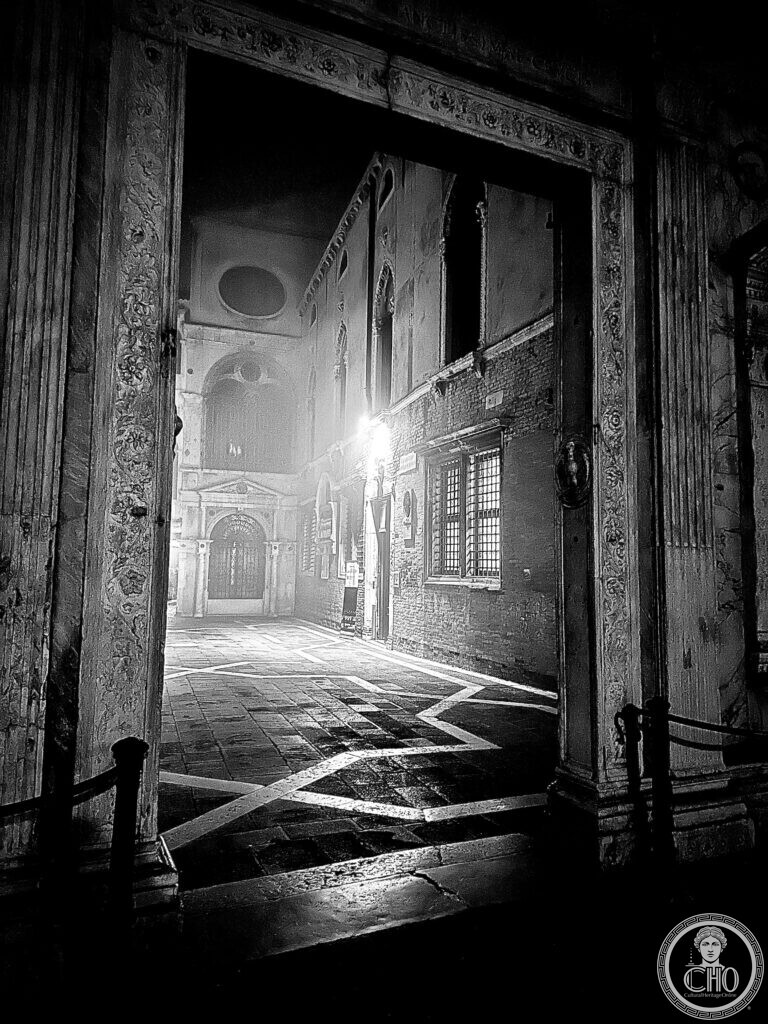
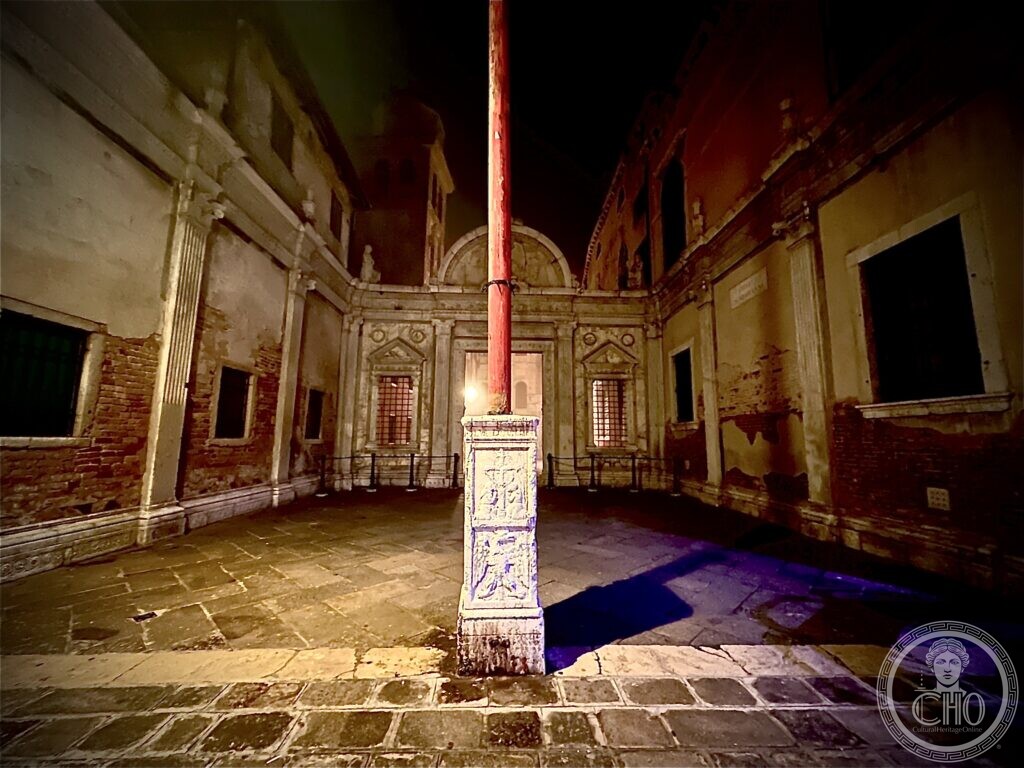
From the campiello, the first thing is Lombardo’s screen: a low marble wall with a round-arched opening, an eagle of Saint John above it, and carving fine enough to read as furniture rather than architecture. It does not enclose anything defensible. It marks a line between the public calle and the brotherhood’s ground, and it does so entirely by the change of material – from brick and plaster to white Istrian marble.
To the left of the entrance, set into a plain red wall under a shallow stone arch, is the relief. Saint John stands at the left in classical drapery; before him kneel two rows of brothers in the hooded cappa, arranged in near-identical repetition, faces hidden. Above, in a smaller framed panel, a Madonna and Child. The stone is grey with age and the panel below the relief is blank where an inscription has gone. It is the plainest thing on the street and the most direct: the confraternity portraying itself as it wished to be seen, anonymous and in rows.
Inside: the Salone Capitolare
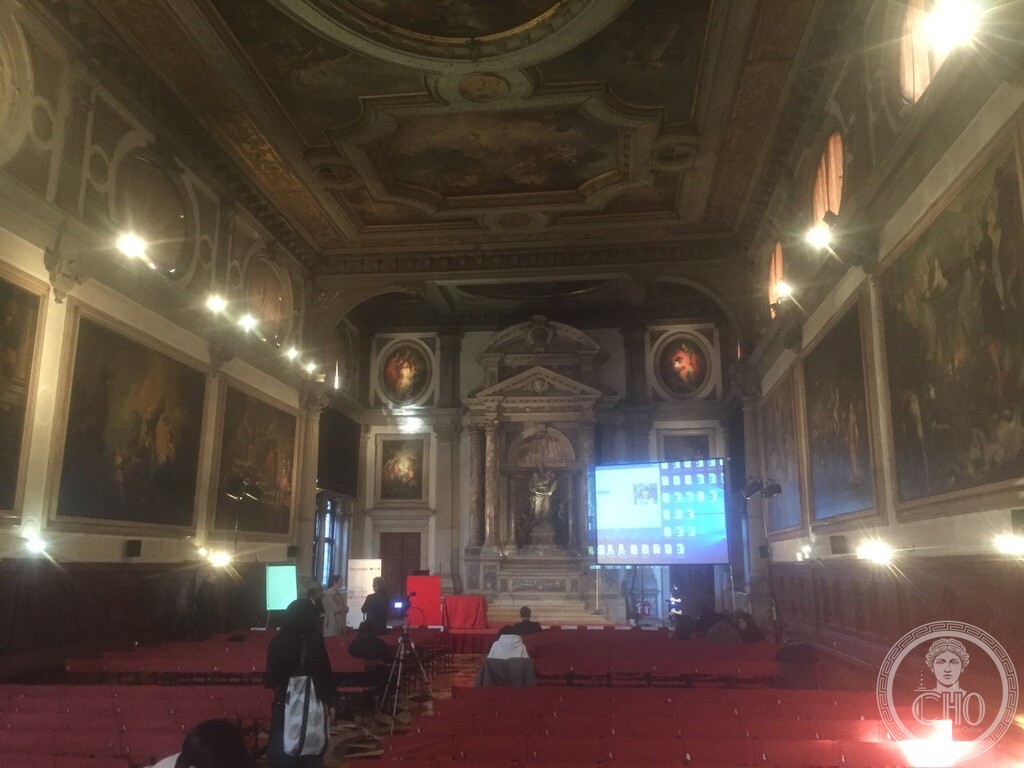
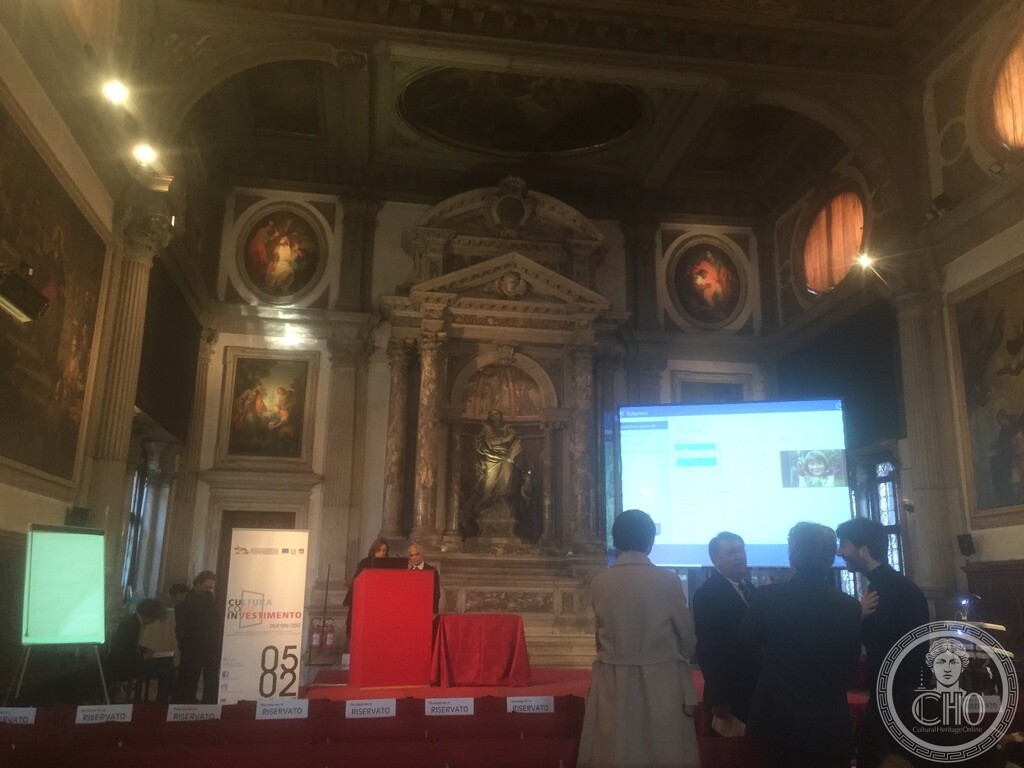
Beyond Mauro Codussi’s double-ramp staircase lies the monumental Chapter Hall (Salone Capitolare), remodelled in the 18th century by Giorgio Massari. At the head of the hall stands Massari’s classical altar aedicule with fluted marble columns framing the statue of Saint John the Evangelist with his gospel book and eagle attribute, beneath dramatic ceiling canvases and side paintings documenting the confraternity’s devotional life.
Practical information
- The screen and the facade relief are on a public campiello and can be seen at any hour, free of charge
- The interior — Codussi’s staircase, the Salone and the Oratorio della Croce — is used for concerts, exhibitions and guided visits; check the confraternity’s own calendar at scuolasangiovanni.it
- The Miracles of the True Cross are not here: they are in the Gallerie dell’Accademia, twelve minutes’ walk away
- Ten minutes outside; an hour if the building is open
Getting there
The Campiello de la Scuola is between the Frari and the Grand Canal, about five minutes’ walk from the San Tomà vaporetto stop and eight from the Ferrovia along the Rio Marìn.
Nearby
- The Basilica of Santa Maria Gloriosa dei Frari, five minutes south
- The Scuola Grande di San Rocco, with Tintoretto’s cycle, seven minutes south
- The bell tower of San Polo and its two lions, about seven minutes east
Sources
- Wikipedia (Italian), Scuola Grande di San Giovanni Evangelista: the 1261 foundation among the disciplinati, the 1369 donation of the relic by Philippe de Mézières, the Lombardo screen of 1478–1481, the Codussi staircase of 1498, the 1496–1501 cycle and its artists, the transfer to the Gallerie dell’Accademia in 1820, the lost Perugino, the relief to the left of the entrance showing the confratelli in prayer before their patron saint with a Madonna and Child above, and the reconstitution of the archconfraternity in 1929–1931
- Scuola Grande di San Giovanni Evangelista, official site — scuolasangiovanni.it, for the current programme of visits and events
- Location cross-checked against Wikimedia Commons geolocated photographs of the Scuola, which fall within six metres of the point recorded in the photograph
Gallery
Find it on the map
See this place and what’s around it →Record researched and written by Carla Szathvary for Cultural Heritage Online, 2026.
📷 Become a Cultural Heritage Online photographer
Share your photos of places: they stay published under your name as the author. The more they're seen, the more you get noticed — and soon a contest will reward the most appreciated photos.
Log in or sign up free to add a photoIs this page about you?
This page is read by travellers and heritage enthusiasts who find it on Google. Tell us how you are connected to this place and we will take it from there.