
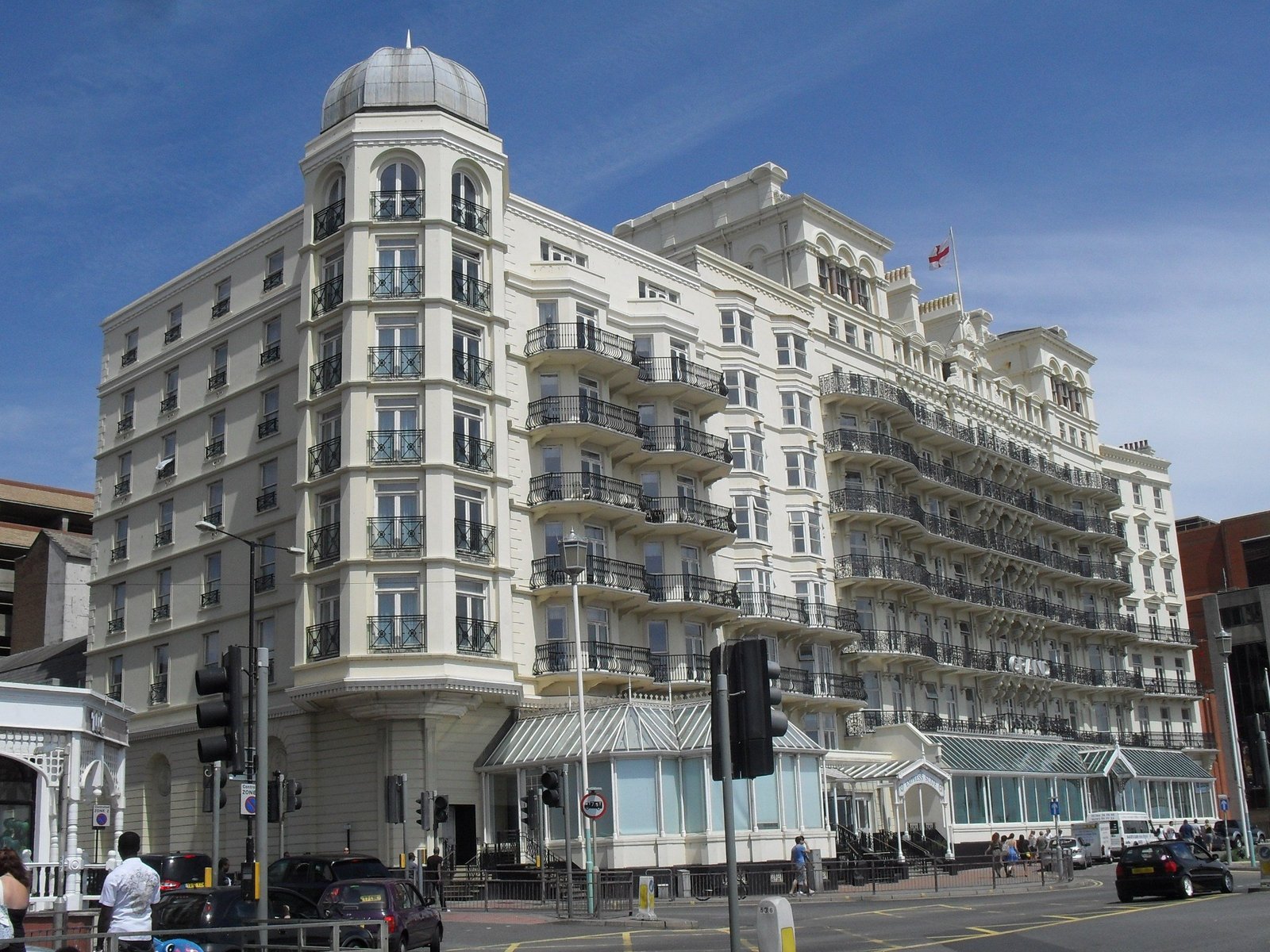
A white Italianate palace on Brighton’s seafront, the Grand opened in 1864 as the largest and most advanced hotel the south coast had seen, and has stood at the centre of English public life ever since.
At a glance
The Grand Brighton commands the seafront from King’s Road, its white stuccoed front rising above the promenade like a stack of wedding-cake tiers. John Whichcord Jr. (1823–1885) designed it for a new kind of traveller: the mid-Victorian visitor who arrived by railway and expected a metropolitan hotel at the seaside. When it opened in 1864 it was the largest hotel in Brighton and reputedly the tallest building in the town. Guests found running water, gas lighting and a hydraulic passenger lift, the “ascending omnibus”, reputedly the first installed in the United Kingdom outside London. It still trades as a working hotel. More than a century and a half on, it remains one of the defining monuments of the English seaside grand-hotel age.
Key facts
- Opened: July 1864, to designs by architect John Whichcord Jr. (1823–1885)
- Style: Italianate, a white stuccoed facade in the Victorian seaside manner
- Builder: Glentons of Blackheath, for the developer Lewis Glenton
- Engineering: one of the first British hotels with a hydraulic passenger lift, the “ascending omnibus”, reputedly the first lift installed in the UK outside London
- Listing: Grade II listed (Historic England), designated 20 August 1971
- History: target of the Provisional IRA bombing of 12 October 1984; rebuilt and reopened in 1986
- Today: an operating hotel at 97–99 King’s Road, on the Brighton seafront
History
Brighton had been a fashionable resort since the Prince Regent raised his Royal Pavilion, but the arrival of the railway in 1841 changed its scale. Visitors poured in from London, and the town needed lodging to match. The Grand was Whichcord’s answer. Built between 1862 and 1864 by Glentons of Blackheath, it opened in July 1864 as by far the largest hotel Brighton had seen, with more than two hundred rooms and comforts few provincial buildings could offer. It was reputedly the tallest structure in the town. The seaside holiday had become a serious industry, and the architecture said so.
The hotel absorbed the changing century. It survived a wartime landmine on the seafront and successive refurbishments, but it is remembered above all for a single night. In the early hours of 12 October 1984, during the Conservative Party Conference, a bomb planted weeks earlier by Patrick Magee for the Provisional IRA exploded in an upper-floor room. Five people were killed, among them the Member of Parliament Sir Anthony Berry, and more than thirty were injured; Margaret Tebbit, wife of the cabinet minister Norman Tebbit, was left permanently disabled. Prime Minister Margaret Thatcher, the intended target, was working in her first-floor suite and was unhurt. It remains one of the gravest attacks on a British government in modern times.
The blast tore away part of the seaward front. Rather than demolish, the owners rebuilt the damaged elevations to match the original, and the Grand reopened on 28 August 1986. The repair is now almost invisible from King’s Road, where the facade reads as one continuous Victorian composition. The hotel has stood on this spot for more than 160 years.
What you see
From the promenade the Grand presents a long white front, its render kept brilliant against the grey Channel light. The composition is Italianate: tier upon tier of round-arched and square-headed windows, each floor banded by a projecting cornice, with cast-iron balconies running across the principal storeys. A rusticated base grounds the wall; above it the elevation rises to a heavy crowning cornice. It is built to be read from a distance. The beach and the piers are its audience.
The scale is deliberate. Whichcord stacked the rooms high so that as many as possible could claim a sea view, and the balconies exist to sell it, a place to stand above the traffic and take the air. Look closely and the render hides its own history: the section rebuilt after 1984 was reinstated to match its neighbours so exactly that the join is hard to find. The whiteness, the symmetry and the faint theatricality all belong to the confident decades when the English seaside grand hotel was invented.
Practical information
- Status: a working hotel, not a museum; the lobby, bar and seafront terrace are open to non-residents
- Location: 97–99 King’s Road, directly on the Brighton seafront
- Best viewpoint: the promenade or the beach opposite, where the whole facade is visible
- Time needed: 10–15 minutes for the exterior; longer for afternoon tea or a drink
Getting there
Brighton’s mainline railway station sits about fifteen minutes’ walk from the seafront, and trains from London Victoria reach it in roughly one hour. The hotel faces the water on King’s Road. The Palace Pier lies a few minutes east on foot, the i360 tower a similar distance west. Seafront parking is limited and metered.
Nearby
- Brighton Palace Pier — the surviving Victorian pleasure pier, a short walk east
- Royal Pavilion — George IV’s Indo-Saracenic seaside palace, a little inland
- Brighton i360 — the slender observation tower on the site of the old West Pier, to the west
Sources
- Wikipedia — Grand Brighton Hotel: https://en.wikipedia.org/wiki/Grand_Brighton_Hotel
- Wikipedia — Brighton hotel bombing: https://en.wikipedia.org/wiki/Brighton_hotel_bombing
- Historic England — The Grand Hotel, list entry 1381654: https://historicengland.org.uk/listing/the-list/list-entry/1381654
- Regency Society — A Grand Hotel for Brighton: https://regencysociety.org/heritage/cityscape/hotels/a-grand-hotel-for-brighton
- Wikidata — Q5594619: https://www.wikidata.org/wiki/Q5594619
Find it on the map
See this place and what’s around it →📷 Become a Cultural Heritage Online photographer
Share your photos of places: they stay published under your name as the author. The more they're seen, the more you get noticed — and soon a contest will reward the most appreciated photos.
Log in or sign up free to add a photoIs this page about you?
This page is read by travellers and heritage enthusiasts who find it on Google. Tell us how you are connected to this place and we will take it from there.