
Bangkok, Thailand · reign of Rama VI · Government building
At a glance
The seat of the Prime Minister of Thailand is a Venetian Gothic palace. The Thai government’s own account says the building was modelled on the Ca’ d’Oro, the fifteenth-century house on the Grand Canal in Venice, and the resemblance is not a matter of atmosphere: the upper floor carries the same continuous screen of pointed, interlaced tracery. It was built as a private house called Ban Norasingha, in a city eight thousand kilometres from the lagoon, and it was one of the works produced in Siam by the Italian architects, engineers and artists whom Rama V and Rama VI brought into government service.
Key facts
- Built as: Ban Norasingha, a private residence
- Now: Thai Khu Fah Building (ตึกไทยคู่ฟ้า), the main building of Government House and the office of the Prime Minister
- Two storeys, on a site of roughly 4,500 square metres
- Style: Venetian Gothic, modelled on the Ca’ d’Oro in Venice
- Exterior: washed stone, with stucco lotus patterns
- Interior: stucco, gilding and painting, the work of Thai craftsmen
- 1989: Outstanding Architectural Award from the Association of Siamese Architects under Royal Patronage
- State rooms: the Golden Dome Room, the Ivory Room, the Purple Room, the Green Room
- Named by the Siam Society among the Bangkok buildings that are the work of Italians, with the Ananta Samakhom Throne Hall and Baan Phitsanulok
- Italians in the service of Siam: from 1868 to 1930, many trained at the Accademia Albertina in Turin
- Coordinates: 13.763030, 100.512017
What you see
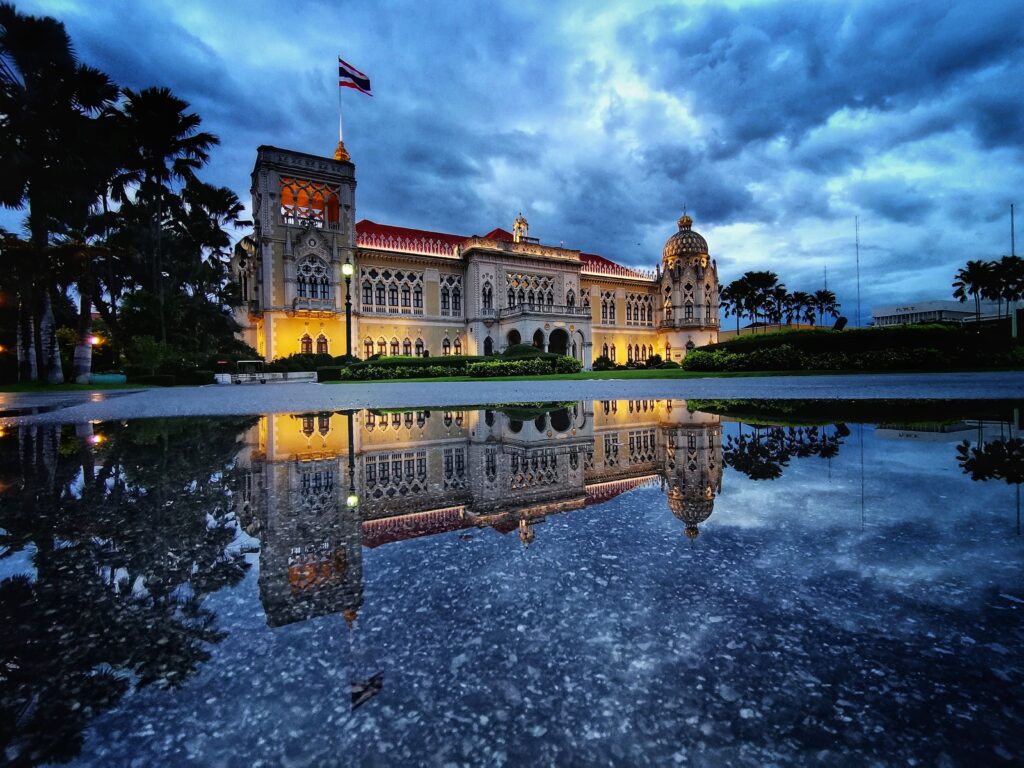
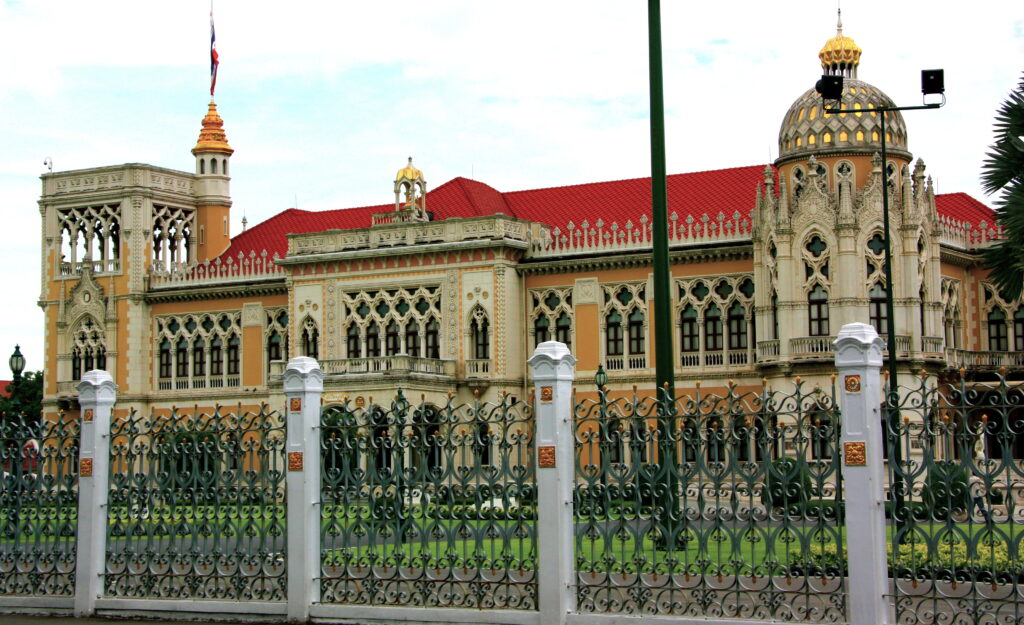
From the road the building is long and low, in ochre and cream under a red tiled roof, behind green railings with gilded panels. The upper floor is a continuous arcade of pointed arches with interlaced tracery and quatrefoils, run end to end like a screen rather than punched as windows — the Ca’ d’Oro device, transplanted. At the left end a square tower carries an open loggia and a gilded spire with the Thai flag above it. At the right, a dome sheathed in gold sits on a drum of tall traceried openings, and finials in the shape of Thai flame ornaments rise between them. That dome is where the Venetian model stops and something else begins.
At dusk, with the lamps on and rainwater standing on the forecourt, the whole elevation doubles in the reflection and the tracery reads twice. It is the view the building was composed for, and it makes the point better than any argument: a Venetian palace front, in Bangkok, with a Thai roofline, doing the work of a national government.
Government House today

Practical information
- This is the working seat of the Thai government and is not generally open to visitors. It is seen from Phitsanulok Road, through the railings.
Do you know more?
On this page we have published what can be seen and what we were able to verify. About who designed Ban Norasingha, the year it was built, and how it passed from a private residence to the seat of government we could not find a reliable source. If you know something — a name, a date, the architect, the family who lived there, an old photograph, a document, a book that mentions it — write to Sofia, who looks after these pages.
Write to Sofia
or send a message on WhatsApp
Please start your message with the title of this page, so it reaches the right file. Every contribution is checked against independent sources before it goes on the page, and we always say where a piece of information came from.
Sources
- E-Museum of the Royal Thai Government, page on the Thai Khu Fah Building: the building’s origin as Baan Norasingh; its two storeys on roughly 4,500 square metres; the Venetian Gothic style and the Ca’ d’Oro as its model; the washed stone exterior with stucco lotus patterns; the interior stucco, gilding and painting by Thai craftsmen; the 1989 Outstanding Architectural Award from the Association of Siamese Architects under Royal Patronage; the state rooms and the building’s present use as the office of the Prime Minister
- The Siam Society under Royal Patronage: diplomatic relations between Siam and Italy established in 1868; Rama V and Rama VI engaging Italian experts; Government House named, with the Ananta Samakhom Throne Hall and Baan Phitsanulok, among the buildings that are their work
- Ministry of Foreign Affairs and International Cooperation of Italy: Italian architects, engineers and artists at work in Siam from 1868 to 1930, many of them from Turin and specifically from the Accademia Albertina
- OpenStreetMap: coordinates of the Thai-Khu-Fah Building
Record researched and written by Luigi De Marchi for Cultural Heritage Online, 2026.
Find it on the map
See this place and what’s around it →📷 Become a Cultural Heritage Online photographer
Share your photos of places: they stay published under your name as the author. The more they're seen, the more you get noticed — and soon a contest will reward the most appreciated photos.
Log in or sign up free to add a photoIs this page about you?
This page is read by travellers and heritage enthusiasts who find it on Google. Tell us how you are connected to this place and we will take it from there.