

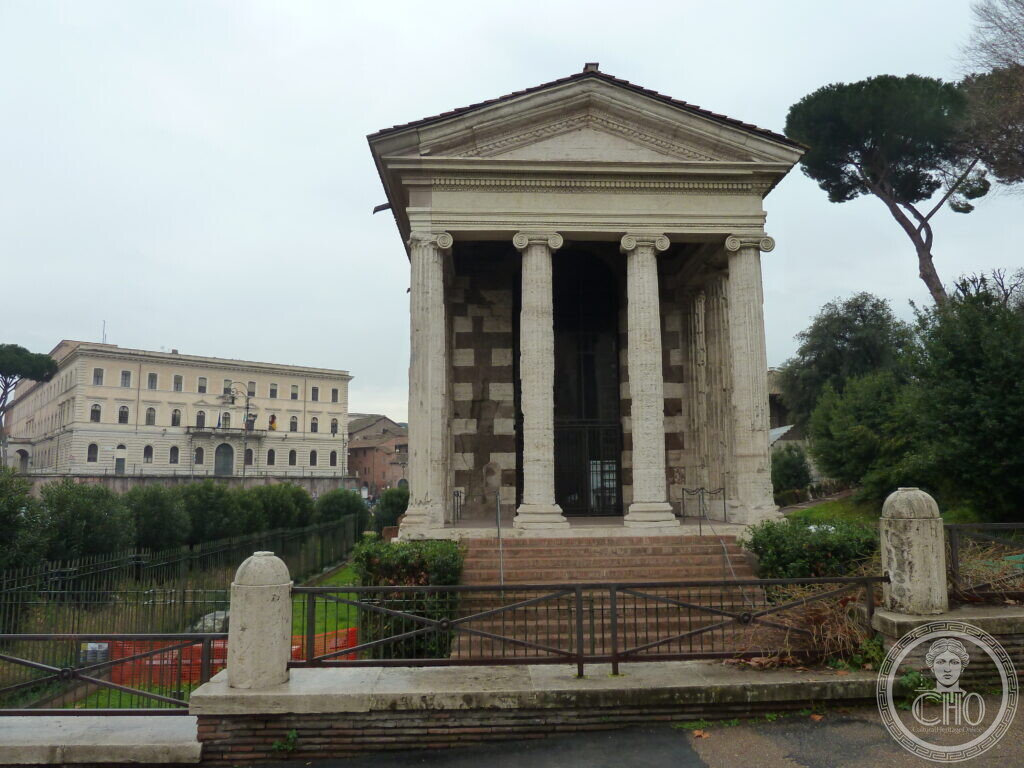
A rectangular Roman temple dedicated to Portunus, god of the river harbour, standing beside the former port of the Tiber in the Forum Boarium. Its unusually complete state and the traces of its later life as a church make it one of the best-preserved monuments of ancient Rome.
At a glance
In piazza della Bocca della Verità, close to the Tiber and the ancient harbour known as the Portus Tiberinus, stands a temple whose current form dates to the first century BCE. The Soprintendenza Speciale di Roma calls it one of the best-conserved monuments of ancient Rome, and Turismo Roma describes it, together with the nearby Temple of Hercules Victor, as a precious testimony to the architecture of the period.
Key facts
- Where: Via di Ponte Rotto, piazza della Bocca della Verità, Roma
- What: Monument
- When: 80–70 BCE for the present building; earlier phase late 4th to early 3rd century BCE
- GPS: 41.8892, 12.4809 · Open in Google Maps
History
The temple is dedicated to Portunus, a divinity connected with river ports. According to Turismo Roma, it stood near the Portus Tiberinus, the first commercial port on the Tiber, in the area of the Forum Boarium, the cattle market. The present building is dated by the Soprintendenza Speciale di Roma to between 80 and 70 BCE; it replaced an earlier temple placed between the end of the 4th and the beginning of the 3rd century BCE. Romano Impero records that excavations in 1947 brought to light that earlier phase and that the temple stood inside a sacred enclosure.
In the 9th century the building was converted into a Christian church. The Soprintendenza states that under Pope John VII it was dedicated to the Virgin Mary with the name Santa Maria in Secundicerio, entrusted to the care of Stefano Stefaneschi, judge and secundicerius of the papal court. By 1492 that name disappears and Santa Maria Egiziaca appears in its place. The church title remained until 1916, when, according to Turismo Roma, the church was deconsecrated and the ancient temple restored. The Soprintendenza adds that during the works of the 1920s, directed by Antonio Munoz, a cycle of early medieval frescoes came to light.
What you see
The photograph shows the front of the temple behind a metal fence: four Ionic columns support a pediment above a high podium reached by steps. Turismo Roma describes the podium as clad in travertine slabs, with four Ionic columns on the front and, on the sides, two travertine columns and five engaged columns in Aniene tufa against the cella walls. The Soprintendenza notes that the pronaos columns and those at the corners of the cella are in travertine, the others in Aniene tufa. Inside, the cella preserves Byzantine-era frescoes with stories from the life of Mary, a surviving trace of the building’s centuries as the church of Santa Maria Egiziaca.
Do you know more about this place?
If you know a date, a name, a document, a plaque or a photograph that tells its story, write to Sofia through the contact page. What arrives with a source goes into this page, with your name as the contributor.
Nearby
- Temple of Hercules Victor – Virtual Tour 360° — the first marble building in Rome, a short walk from the Temple of Portunus
- Temple of Portunus – Virtual Tour 360° — 360° view of the same monument
- Boarium Forum – Virtual Tour 360° — the ancient cattle market that once surrounded the temple
- Ponte Emilio (Ponte Rotto), Rome — the ancient bridge by the Tiber, connected in antiquity to the temple area
Sources
- Turismo Roma, Tempio di Portuno: location, dedication, dating, materials and later church history
- Soprintendenza Speciale Archeologia Belle Arti e Paesaggio di Roma, Tempio di Portunus: dating, construction details and the medieval dedication
- Romano Impero, Tempio di Portuno o Fortuna Virile: Portunalia festival, earlier phases and 1947 excavations
- Ministero della Cultura, Tempio di Portunus al Foro Boario: conversion to a church and restoration
- Stefano Vigolo, photographs and notes to the editorial staff (2026): identification of the subject and the photograph. Not a published source
Find it on the map
See this place and what’s around it →📷 Become a Cultural Heritage Online photographer
Share your photos of places: they stay published under your name as the author. The more they're seen, the more you get noticed — and soon a contest will reward the most appreciated photos.
Log in or sign up free to add a photoIs this page about you?
This page is read by travellers and heritage enthusiasts who find it on Google. Tell us how you are connected to this place and we will take it from there.
This entry stays online and free either way — and a free account lets you add to it yourself.