
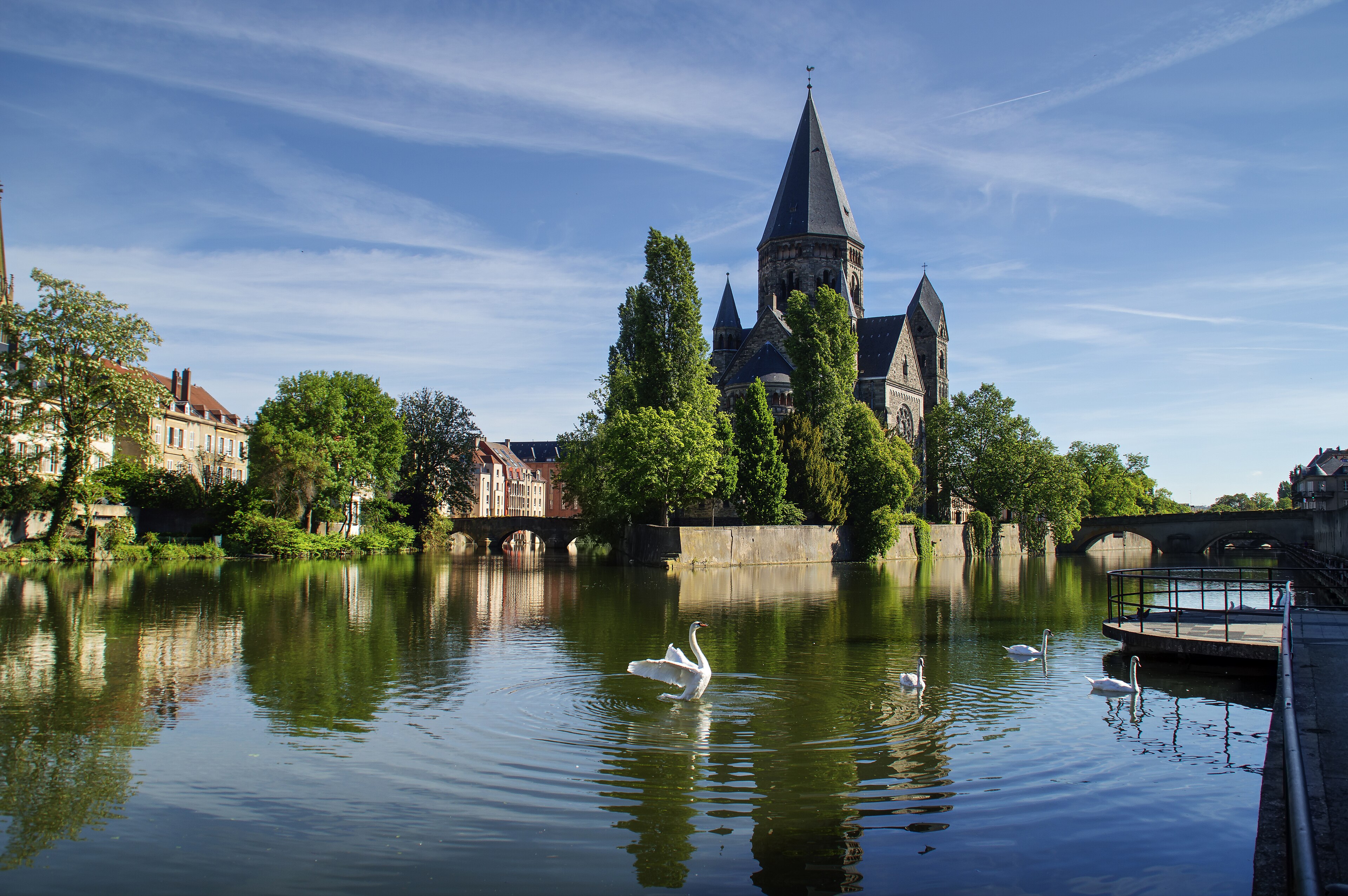
A Protestant church of striking Romanesque Revival design, built in Metz during the German imperial period and inaugurated in the presence of Wilhelm II.
At a glance
Temple Neuf is a Protestant church in central Metz, situated on the southwestern edge of Île du Petit-Saulcy, surrounded by the Moselle river. Its prominent position on place de la Comédie, adjacent to the Opéra-Théâtre, makes it a landmark of the city’s cultural quarter.
History
The first stone was laid on 25 November 1901, when Metz remained part of the German Empire following the Franco-Prussian War. Architect Conrad Wahn designed the church; Glod oversaw its construction. The building was inaugurated as the Neue evangelische Kirche on 14 May 1904 in the presence of German Emperor Wilhelm II and his wife Augusta Victoria of Schleswig-Holstein—a ceremony underscoring Metz’s status within the German Reich at the turn of the century.
What you see
Temple Neuf exemplifies Romanesque Revival architecture, a style that drew on medieval forms yet spoke to modern civic aspirations. The church’s massing and decorative vocabulary reflect early 20th-century interpretations of Romanesque tradition.
Cultural significance
The church embodies a pivotal moment in Metz’s history, built at the height of German administration and inaugurated under imperial patronage. Its designation as a French monument historique in 1930—two decades after Metz’s return to France following World War I—marks its recognition as part of the city’s architectural heritage.
Key facts
- Country: France
- City: Metz
- Architect: Conrad Wahn
- First stone laid: 25 November 1901
- Inaugurated: 14 May 1904
- Style: Romanesque Revival
- Monument historique since: 1930
- Coordinates: 49.1206, 6.1719
Practical information & getting there
Temple Neuf is located on place de la Comédie in the heart of Metz, next to the Opéra-Théâtre. The site sits at the center of Jardin d’Amour, easily accessed from the city center. For current opening hours and services, consult local tourism resources.
Sources & resources
Find it on the map
See this place and what’s around it →📷 Become a Cultural Heritage Online photographer
Share your photos of places: they stay published under your name as the author. The more they're seen, the more you get noticed — and soon a contest will reward the most appreciated photos.
Log in or sign up free to add a photoIs this page about you?
This page is read by travellers and heritage enthusiasts who find it on Google. Tell us how you are connected to this place and we will take it from there.