

The city promised Saint Anthony a church if it was not turned into a battlefield. It was not, and the church was begun — then the money ran out, and it was finished only when the state agreed to pay, on condition that it hold the bones of the dead.
At a glance
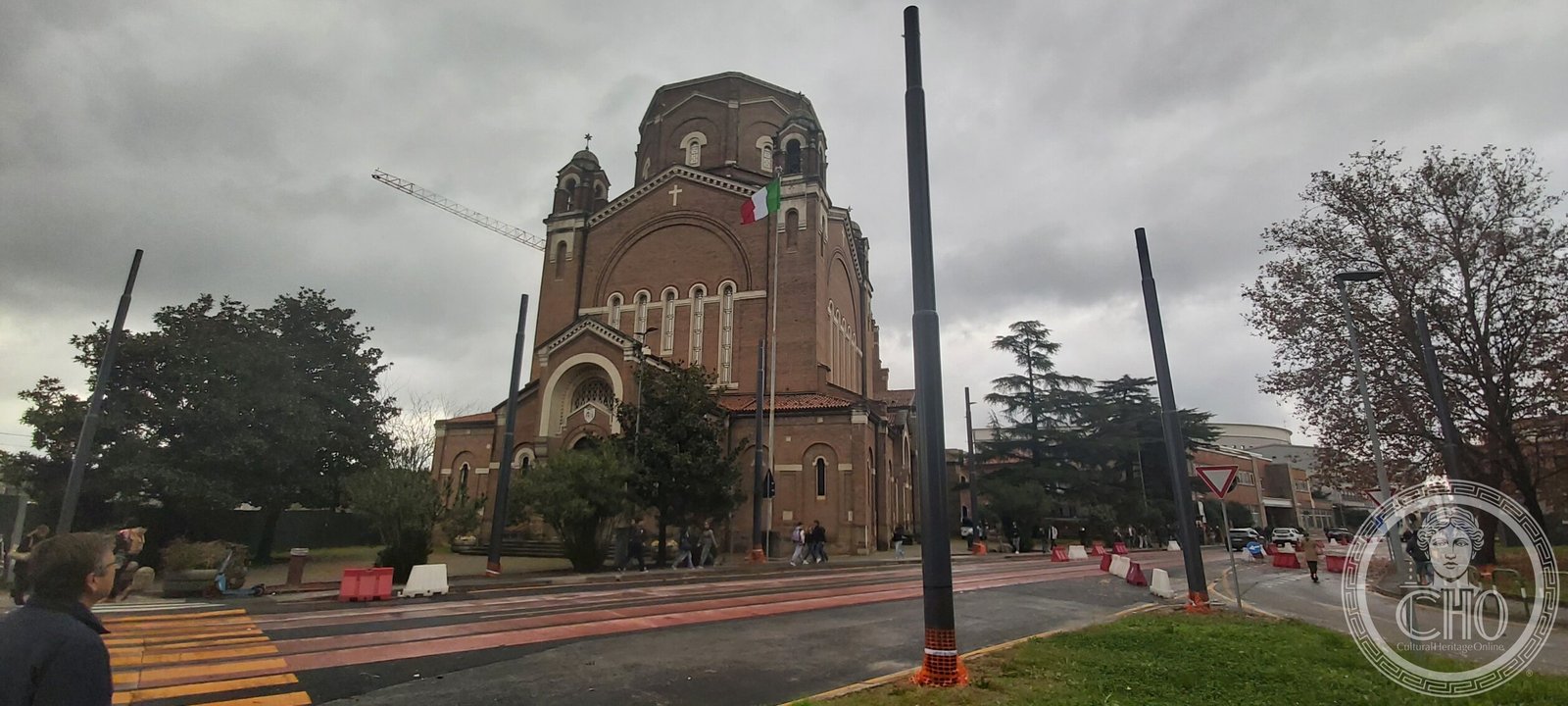
A large brick church in the neo-Romanesque manner near Padua’s railway station: red brick with white marble, an octagonal tiburio over the crossing, bell towers at the corners. It was vowed during the First World War, begun on 9 May 1920 to a design by Antonio Zanivan, left half-built for want of money, and completed in the 1930s once the state stepped in — on the condition that it become the ossuary of the province’s war dead. 5,401 of them lie inside.
Key facts
- Architect: Antonio Zanivan
- First stone: 9 May 1920
- Completed: 1934
- Ossuary: 5,401 fallen of the province of Padua, brought in on 20 June 1934
- Style: neo-Romanesque — red brick with white marble, octagonal tiburio, corner bell towers
- War damage: 30 December 1943, two bombs on the left flank
- Reopened: 19 March 1949
- Address: Via Niccolò Tommaseo, Padua — also called Tempio Antoniano della Pace e dei Caduti in Guerra
History
During the First World War, with the front on the Piave and Padua within reach of the guns, the city made a vow to Saint Anthony — urged on by the periodical Il Santo dei Miracoli — promising a votive temple in his honour if it were spared becoming a battlefield. It was spared. The first stone was laid on 9 May 1920.
Then the vow ran into the 1920s. With the memory of the war fading and money short, the building stopped half-finished; the parish wanted something more modest, and sports and recreation buildings besides. Zanivan’s design had been enormous — a church with a bell tower a hundred metres high, ending in a statue of the angel of peace — and that tower was never built.
What finished the church was a bargain. The diocese asked the state for help; the state agreed, on condition that the temple serve as an ossuary, gathering the soldiers buried in cemeteries across Padua and its province into one place. The ossuary sacrarium was built, and on 20 June 1934 the remains of 5,401 men were carried in. A church begun as a thanksgiving was completed as a tomb.
On 30 December 1943 two bombs struck it. The left side of the church came down, with the sacristy and the altar of the Madonna. It was rebuilt after the war and reopened for worship on 19 March 1949.
What you see
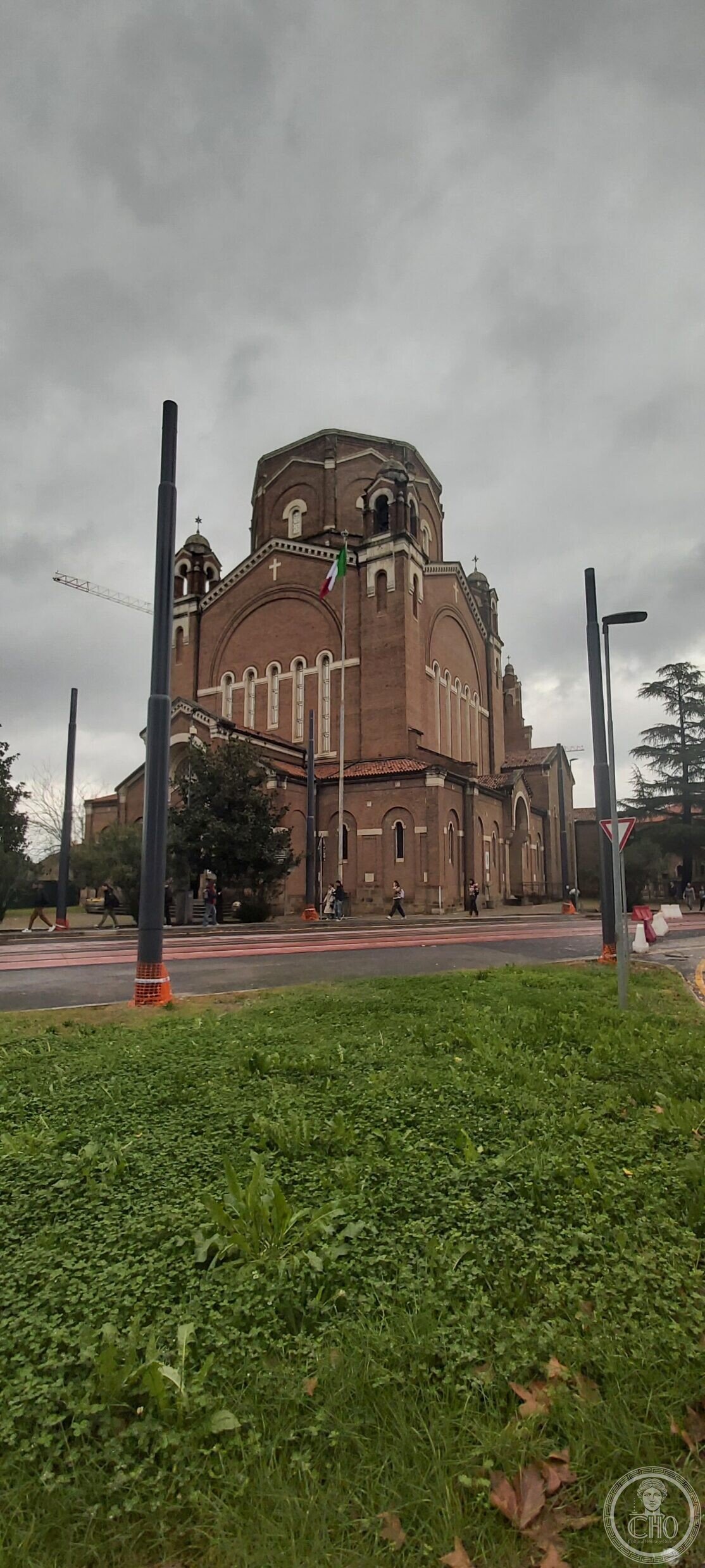
Brick, and a shape that wants to be older than it is: round arches, an arcaded gallery of small columns across the front, a rose above, and a low octagonal lantern over the crossing with a further ring of arched openings. Slim bell towers rise at the corners, capped with small pyramidal roofs. The white marble is used sparingly — the gallery, the arch mouldings, the string courses — against a wall left in bare brick.
Stand back and the proportions tell the story of the money. The body of the church is very large and the towers are small; where the design called for a hundred-metre campanile with an angel on top, there is nothing. What was built is the church a parish could afford with the state’s help, on the footprint of a monument it could not.
Reading the building
Italian war memorials of these years are usually either sculpture or architecture. This one is a working parish church that was made into a sacrarium as the price of being finished, and it still does both jobs: mass is said here, and 5,401 men are buried under it. That double function is the reason to visit, and it is not visible from outside — the building looks like an ordinary large church of the 1920s, which is exactly what it was meant to be before the state changed the terms.
Practical information
- An active parish church; the interior is open at service times and generally during the day.
- The ossuary is part of the building — visitors should behave as in a cemetery.
- Allow 20–30 minutes. Padua railway station is a few minutes away on foot.
Getting there
The temple stands on Via Niccolò Tommaseo, just north-east of Padua’s railway station. GPS: 45.41530, 11.88497 — open in Google Maps.
Nearby
- Casa del Mutilato — Padua — the disabled veterans’ house of 1926–27, the other side of the same story.
- Torre della Rotonda — the water tower built over the grave of the air-raid dead of 1916.
- Palazzo Liviano — Gio Ponti
Sources
- Wikipedia (Italian) — Tempio della Pace (Padova): the vow made during the First World War at the urging of Il Santo dei Miracoli; the first stone of 9 May 1920; the works halted until state funding arrived on condition the building serve as an ossuary; the transfer of the remains of 5,401 fallen of the province on 20 June 1934; the bomb on the left side during the raid of 30 December 1943; the reopening for worship on 19 March 1949; the neo-Romanesque design in red brick and white marble with octagonal tiburio and corner bell towers; the address on Via Niccolò Tommaseo.
- Parish of the Tempio della Pace, La Storia — Zanivan’s original project for “una chiesa con un campanile di cento metri, terminante con la statua dell’angelo della pace”; the temple left half-built after 1920 for want of money and because the community wanted a more modest church with recreational and sports buildings; the ossuary sacrarium; the two bombs of 30 December 1943 that brought down the left side with the sacristy and the altar of the Madonna; the reopening in 1949.
- The description of the elevations was made from the contributor’s photographs.
Find it on the map
See this place and what’s around it →Record researched and written by Stefano Vigolo for Cultural Heritage Online, 2026.
📷 Become a Cultural Heritage Online photographer
Share your photos of places: they stay published under your name as the author. The more they're seen, the more you get noticed — and soon a contest will reward the most appreciated photos.
Log in or sign up free to add a photoRequest to use these images
Each photograph is by the person named on it. Cultural Heritage Online is the seller: it runs the payment, handles tax and delivers the file, and the photographer receives 70% of the price net of tax. Buying gives you the right to use the image in your own project — a website, an article, a presentation — with the file and a written licence. Read the Terms of Sale.
What you receive. The file as it is held in our archive: the photographer's own original, without the Cultural Heritage Online watermark, unretouched and not enlarged. This is a working archive built over many years by many people, so the files differ — some were taken recently, others years ago with the equipment of their time. Older pictures are usually smaller: a camera from fifteen or twenty years ago simply recorded fewer pixels than a phone does today, so the resolution is lower and the print comes out smaller. We say so rather than hide it. The size, weight, format and year of each one are printed below it, and the print size is given at 300 dpi. Nothing is upscaled to make a number look better. Where the picture on this page has been cropped for the layout, the file you receive is the full frame, which may be wider or taller than what you see here.
Foto Tempio della Pace, Padova – fronte
Photo: Stefano Vigolo
€3.00
2514 × 1131 px · JPG · 991.3 KB
prints 21 × 10 cm at 300 dpi · taken 2025