
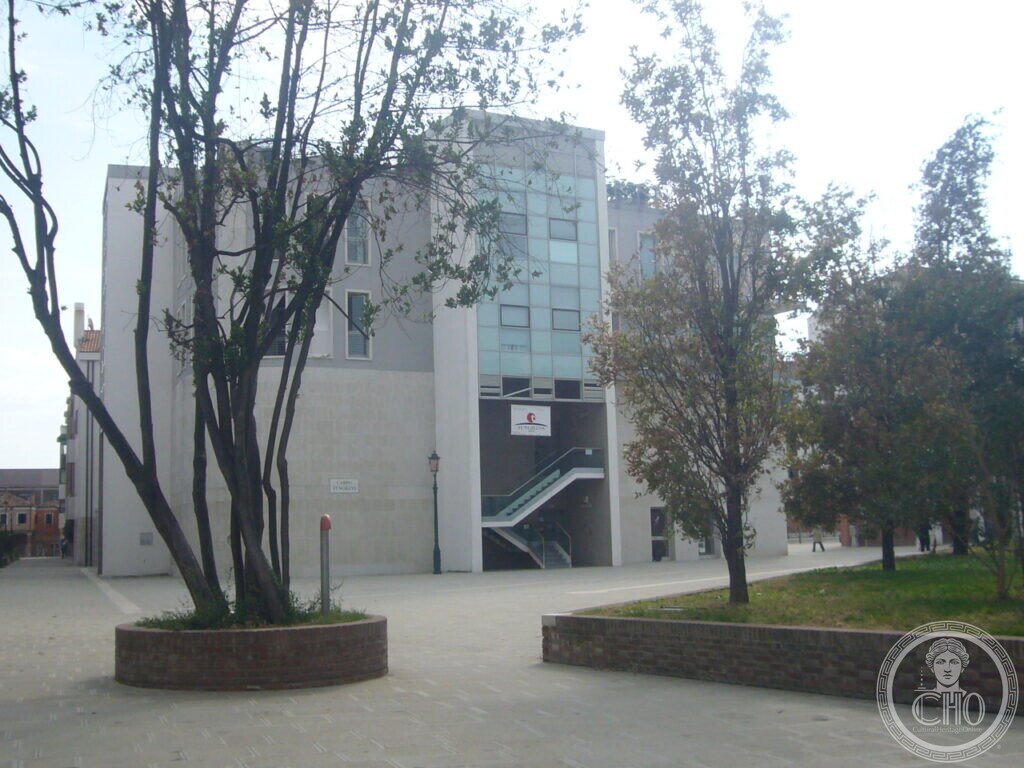
A 150-seat theatre opened in 2005 inside the air-raid bunker of the Junghans watch factory, whose century of industry shaped this corner of the Giudecca — and whose name the campo still carries.
At a glance
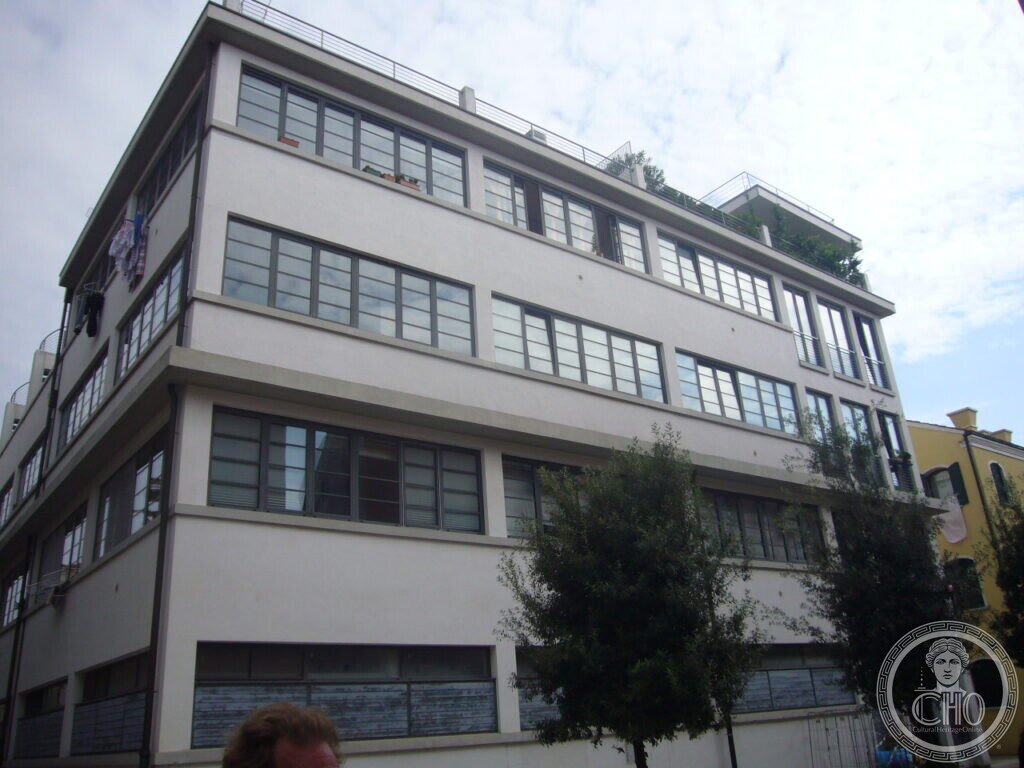
Teatro Junghans stands on Campo Junghans, the square at the centre of what was once the largest watch factory in Italy. It is the main venue of the Accademia Teatrale Veneta, Venice’s professional drama school, and holds an intimate tiered hall of 150 seats with three rehearsal rooms alongside. The theatre occupies the strangest survivor of the factory years: the plant’s air-raid bunker, converted for performance in 2005. Around it, the factory sheds themselves have become housing, keeping their industrial ribbon windows. The whole square is a compact lesson in how Venice reuses its working past.
Key facts
- Address: Campo Junghans, Giudecca 494/B, 30133 Venice
- Function: theatre and training venue, home of the Accademia Teatrale Veneta
- Hall: 150 tiered seats; three rehearsal rooms
- Origin: converted from the factory’s air-raid bunker; opened as a theatre in 2005
- The factory: founded in 1877 by the Herion brothers, agents of the German firm Junghans; closed in 1971
- Area regeneration: masterplan by Milanese architect Cino Zucchi (b. 1955), from a competition held by the city in 1995
- Location: approx. 45.4240 N, 12.3265 E
History
In 1877 the Herion brothers, Italian agents of the German watchmaker Junghans of Schramberg, opened the first watch factory in Italy here on the Giudecca. Arthur Junghans himself entered the firm in 1899, and the plant grew into one of the island’s defining industries: by the 1930s it employed more than 500 Venetians, half of them women, across some 20,000 square metres of workshops. The factory’s other trade was darker. During the Second World War around 4,000 people worked here producing military fuses, and in the post-war decades — once the Arsenale had wound down — Junghans remained insular Venice’s largest industrial employer, making ordnance until the plant closed in 1971.
The buildings then stood idle for a quarter of a century. In 1995 the city held an invited competition to regenerate the area, won by the Milanese architect Cino Zucchi, whose masterplan mixed subsidised housing, new construction and the careful reuse of the factory fabric. The theatre came in 2005, carved out of the factory’s concrete air-raid shelter; the last residential conversions followed in 2008. The name was never changed: the square itself is Campo Junghans, a German industrial surname set in Venetian toponymy.
What you see
The theatre reads as a deliberately contemporary object: a grey prismatic volume with a full-height glazed stair tower that throws the campo’s light back at it, and an external staircase climbing to the upper foyer under the Junghans sign. Nothing about it pretends to be old Venice. Across the square, the converted factory blocks tell the other half of the story — long white elevations, regular grids of steel-framed ribbon windows, roof terraces now thick with plants where machinery once stood.
Between the two, the campo itself is the rarest thing: an open, planted, modern square on an island short of both. Brick planters, young holm oaks and new paving mark it as part of the 1990s–2000s regeneration rather than the medieval city.
Cultural significance
The Giudecca was Venice’s factory island — flour mills, breweries, shipyards, watchworks — and its twentieth-century decline left more abandoned industrial fabric here than anywhere else in the historic city. The Junghans area is the most complete answer Venice has given to that inheritance: not a museum of industry, but housing, a square and a working theatre threaded through the old plant. For the Accademia Teatrale Veneta it provides what performing arts training rarely gets in Venice, purpose-adapted space; for the island, it keeps a place of work alive as a place of culture.
Practical information
- Performances, courses and public events are listed by the Accademia Teatrale Veneta; check the official website for the current programme.
- The hall seats 150 on a stepped rake; the format suits chamber theatre, readings and lectures.
- The surrounding buildings are private housing; the campo itself is freely accessible.
Getting there
Take the vaporetto to Palanca (lines 4.1, 4.2 or 2). Walk about 100 metres towards the Redentore, turn right into Calle dell’Olio, cross the bridge and the campo opens ahead. Google Maps: Teatro Junghans.
Sources & resources
Find it on the map
See this place and what’s around it →Record researched and written by Carla Szathvary for Cultural Heritage Online, 2026.
📷 Become a Cultural Heritage Online photographer
Share your photos of places: they stay published under your name as the author. The more they're seen, the more you get noticed — and soon a contest will reward the most appreciated photos.
Log in or sign up free to add a photoIs this page about you?
This page is read by travellers and heritage enthusiasts who find it on Google. Tell us how you are connected to this place and we will take it from there.