
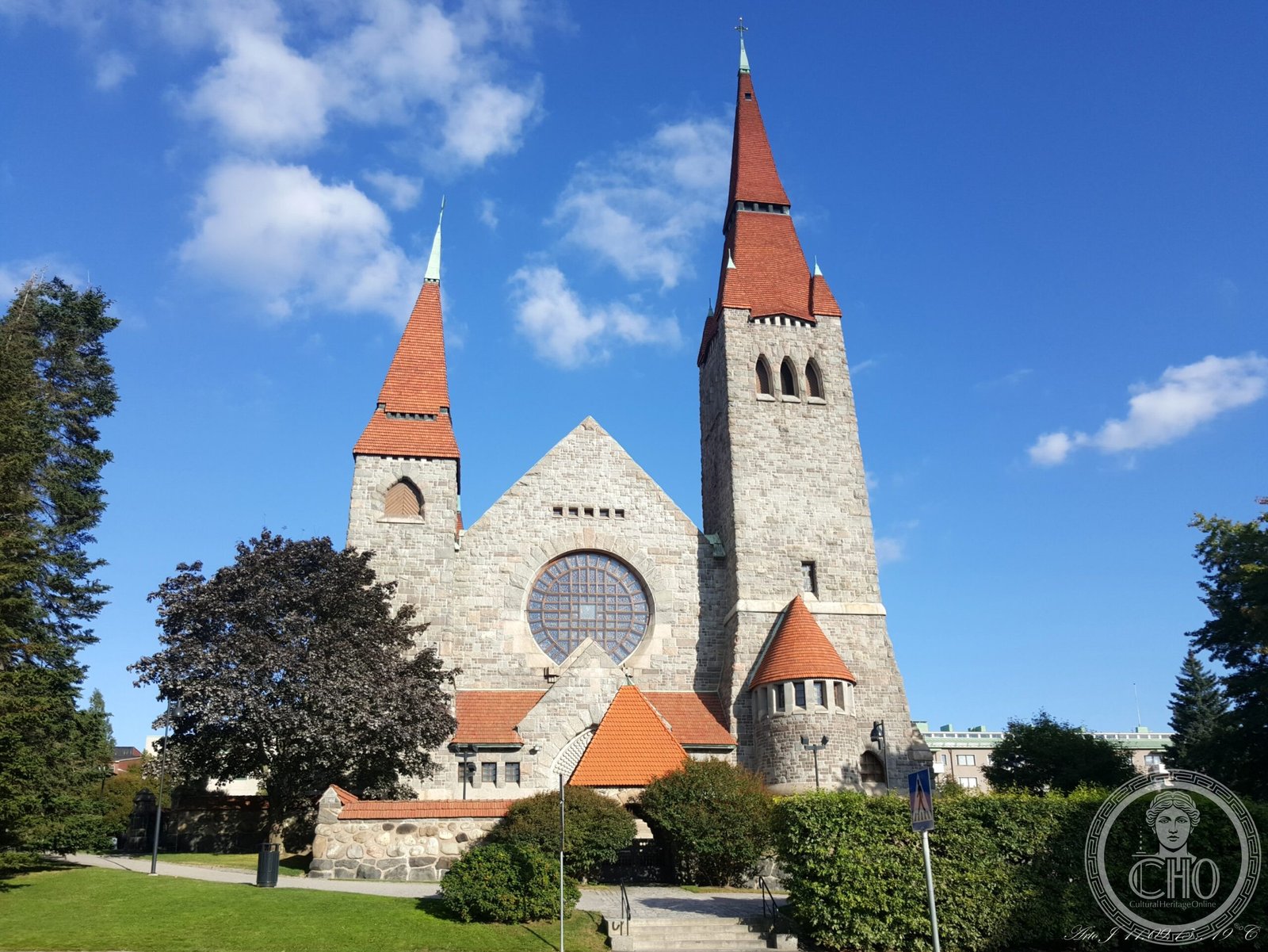
A granite church that scandalised its own age: wounded angels carried on a stretcher, and a serpent coiled over the congregation.
At a glance
Tampere Cathedral, first known as St John’s Church, was designed in the National Romantic style by Lars Sonck and built between 1902 and 1907. Outside it is a powerful mass of rough grey granite with twin towers; inside it is famous above all for its frescoes, painted by the symbolist Hugo Simberg in 1905–1906. The building is the seat of the Lutheran Diocese of Tampere and one of the most important works of Finnish architecture from the years around independence.
Key facts
- Architect: Lars Sonck
- Built: 1902–1907
- Style: Finnish National Romanticism
- Frescoes: Hugo Simberg, 1905–1906
- Altarpiece: Magnus Enckell
- Role: cathedral since 1923; seat of the Diocese of Tampere
History
Tampere was a fast-growing industrial city when it held a competition for a major new church. Lars Sonck, already known for Helsinki’s St John’s and Kallio churches, won with a design in heavy native granite, and the building rose between 1902 and 1907.
Sonck brought in the young painter Hugo Simberg to decorate the interior. Simberg’s frescoes, made in 1905–1906, were deeply unconventional and drew sharp criticism in their day.
Time reversed that verdict. The church became a cathedral with the creation of the Diocese of Tampere, and Simberg’s images are now among the best-loved in Finnish art.
What you see
The exterior is built of rough-faced grey granite blocks, massive and fortress-like, with two stair towers framing the west front. The detailing is restrained, letting the stone itself carry the weight of the design.
Inside, Simberg’s paintings dominate: versions of The Wounded Angel carried on a stretcher and a procession of boys in The Garden of Death, and, at the highest point of the ceiling, a winged serpent on a red ground that contemporaries read as a symbol of sin. The altarpiece, showing the resurrection of people of all races, is by Magnus Enckell.
Practical information
- The cathedral is an active Lutheran church; check visiting hours around services.
- The Simberg frescoes are the reason to go inside — allow time to look up.
- Time needed: 30–45 minutes.
Getting there
The cathedral stands a short walk east of Tampere city centre and the main railway station; Tampere is about 1.5–2 hours by train from Helsinki.
Nearby
- The central railway station and the industrial Tammerkoski rapids.
- Tampere’s museums and the Finlayson factory quarter.
- Other National Romantic churches by Lars Sonck.
Sources
- Wikipedia (EN), “Tampere Cathedral”.
- Parish and diocesan information, Diocese of Tampere.
Find it on the map
See this place and what’s around it →Record researched and written by Luigi De Marchi for Cultural Heritage Online, 2026.
📷 Become a Cultural Heritage Online photographer
Share your photos of places: they stay published under your name as the author. The more they're seen, the more you get noticed — and soon a contest will reward the most appreciated photos.
Log in or sign up free to add a photoIs this page about you?
This page is read by travellers and heritage enthusiasts who find it on Google. Tell us how you are connected to this place and we will take it from there.