
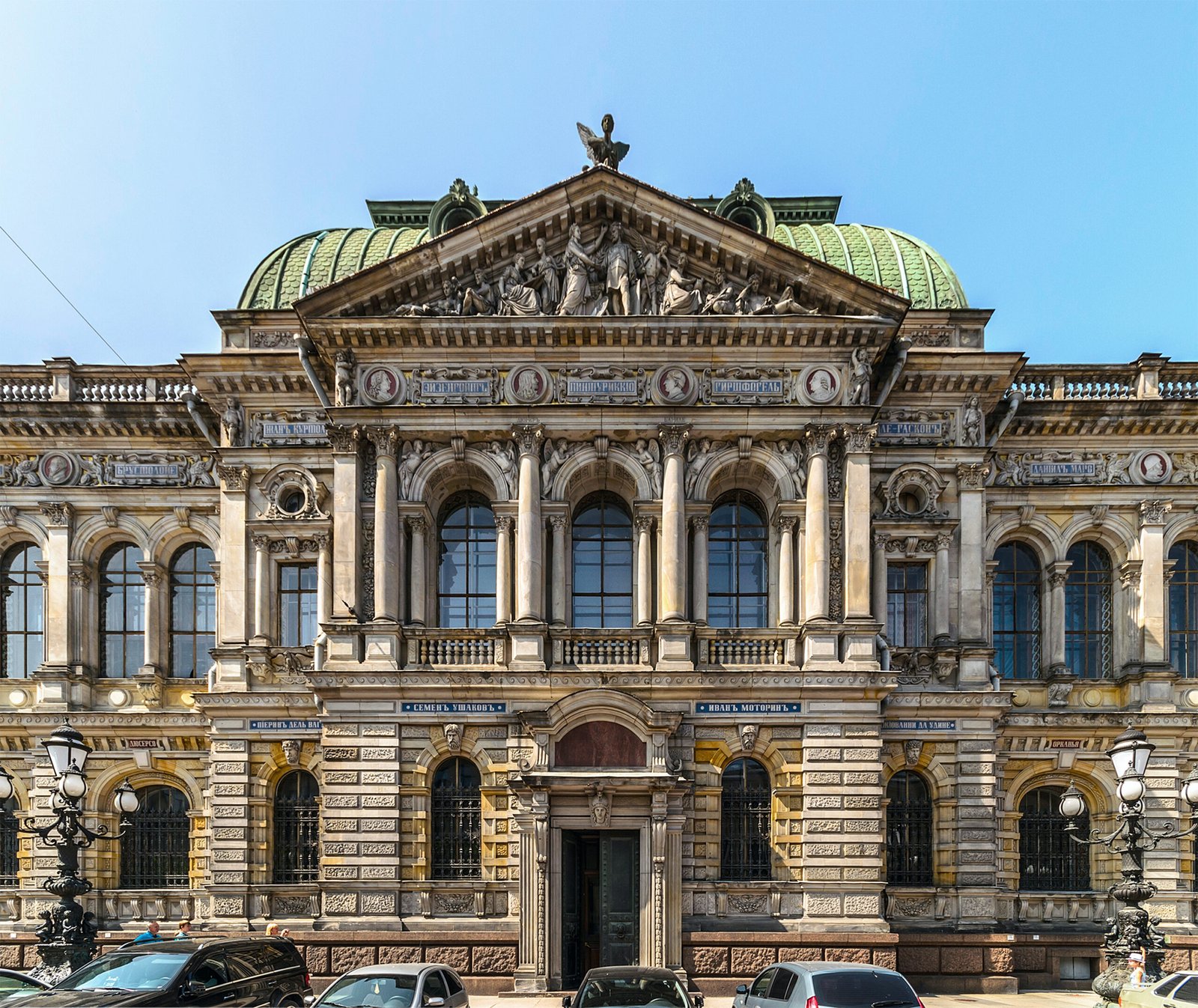
A Neo-Renaissance palace of glass, porcelain and tapestry, built to teach as much as to dazzle.
At a glance
Founded in 1878 through the philanthropy of Baron Alexander von Stieglitz, this museum was conceived alongside a school of applied art. Its building, raised between 1885 and 1896, still functions as both teaching collection and monument. Heritage-listed today, it remains one of Saint Petersburg’s most ornate interiors open to the public.
History
Baron Stieglitz made his fortune in banking and railways. He wanted students at his Central School of Engineering Design to learn from real objects, not drawings alone. So he funded a museum to house his own holdings of glassware, porcelain, tapestries, furniture and tiled stoves. By the time of the 1917 Revolution the collection numbered some 30,000 items. Soviet authorities transferred the finest pieces to the Hermitage. The Stieglitz became a Hermitage branch, was abolished in 1926, then reinstated three years later as an independent institution. Its interiors suffered during the Soviet decades; one hall served as a gymnasium, its painted walls simply covered over. Restoration only began in earnest after 1991, and it continues today, room by room.
What you see
Maximilian Messmacher, the museum’s first director, modeled the building on a Viennese precedent. The result is Neo-Renaissance pushed to its most emphatic register. Rustication weighs down the ground floor, its windows arched and deep-set. Above, the upper storey crowds itself with statuary and ornament. Inside, a central hall opens between two tiers of Italianate arcades. Other rooms were dressed to match what they held. One chamber echoes the Terem Palace in Moscow, gilded and dense with color; Lonely Planet’s Tom Masters called it “an opulent knockout.” Few museum buildings in the city commit so fully to theatrical excess.
Cultural significance
The Stieglitz occupies a curious position between school and shrine. It was built to train craftsmen, yet its rooms rival the palaces they imitate. Surviving Soviet neglect and institutional upheaval, it now stands as a rare surviving record of late Imperial taste in applied art. Its slow restoration mirrors the broader post-Soviet effort to recover what was painted over, literally and otherwise.
Key facts
- Founded: 1878, by Baron Alexander von Stieglitz
- Building constructed: 1885–1896
- First director and architect: Maximilian Messmacher
- Style: Neo-Renaissance
- Original collection: c. 30,000 objects at the time of the 1917 Revolution
- Status: heritage-listed; still tied to an applied-arts school
Practical information & getting there
The museum sits in central Saint Petersburg. You can check current opening hours and ticketing through the official website before visiting. Interiors are still under restoration in parts, so allow flexibility if a particular hall is closed. Photography rules vary by room, given the fragility of painted surfaces and gilding.
Sources & resources
Find it on the map
See this place and what’s around it →📷 Become a Cultural Heritage Online photographer
Share your photos of places: they stay published under your name as the author. The more they're seen, the more you get noticed — and soon a contest will reward the most appreciated photos.
Log in or sign up free to add a photoIs this page about you?
This page is read by travellers and heritage enthusiasts who find it on Google. Tell us how you are connected to this place and we will take it from there.