
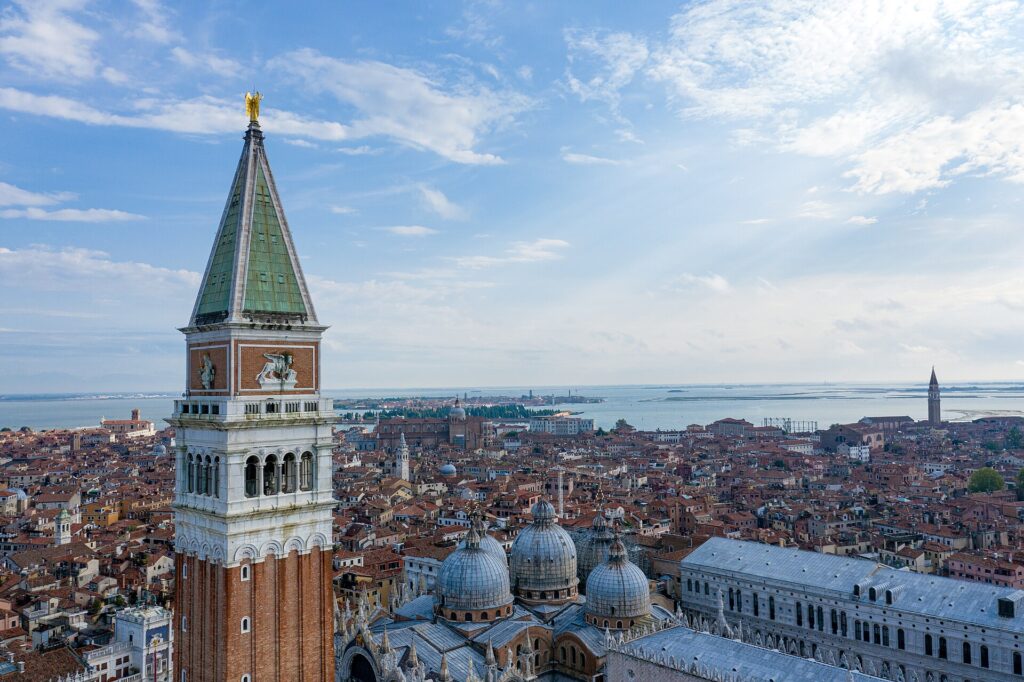
The brick shaft that closes Piazza San Marco is a little over a century old. The one before it came down in under a minute on a July morning in 1902, and Venice decided the same day to build it again as it had been.
At a glance
A bell tower stood on this spot from the tenth century: the foundations go back to the dogeship of Pietro Tribuno (888–912), and the tower was finished under Tribuno Menio (979–991). Raised and altered over the centuries without its base being strengthened, it collapsed on itself at about a quarter to ten on the morning of 14 July 1902. Nobody was killed, and the buildings around the square were left standing. What you look at today was inaugurated on 25 April 1912.
What you see
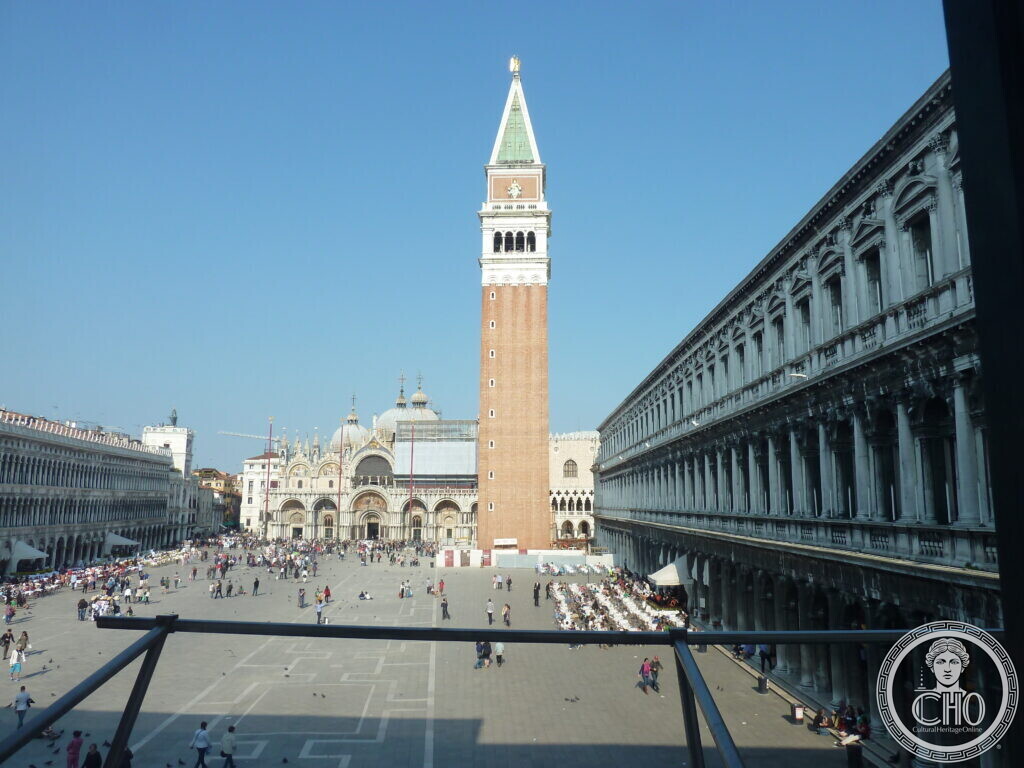
A square brick shaft, unbroken up to the belfry, then the white stone loggia, the green spire and the gilded angel. The proportions are those of the tower that fell; so is the detail, because the rebuilding reused historic material recovered from the rubble. The one thing the eye cannot check is the part that matters: underneath, the foundations are not those of the tenth century.
Why it matters
The city council met the same day as the collapse and voted, unanimously, to rebuild the tower where it was and as it was. The formula — dov’era e com’era — was defended by the mayor Filippo Grimani and by the archaeologist Giacomo Boni, and it was attacked at once. Otto Wagner and Giosuè Carducci both argued that putting back a copy falsifies the history of a building. The argument was never settled, and it is why the Italian national catalogue files this tower under historical forgeries in architecture. Venice answered it in practice: work began on 25 April 1903 and took nine years.
Practical information
- The tower is open to visitors and has a lift to the belfry; tickets are sold at the entrance on the square
- The view takes in the lagoon and, on clear days, the Dolomites; the bells ring on the hour and are loud at close range
Getting there
Waterbus to San Marco Vallaresso or San Zaccaria, then two minutes on foot. From the railway station the walk through the Merceria takes about thirty-five minutes.
Sources
- Istituto Centrale per il Catalogo e la Documentazione, Catalogo generale dei Beni Culturali — I falsi storici nell’architettura italiana: Venezia, il Campanile di San Marco
- Ateneo Veneto, Il campanile di San Marco 1902–1912. Dalla caduta alla ricostruzione, exhibition documentation, 2012
Editorial text © Cultural Heritage Online, 2026. Video filmed and narrated on site by Andrea Manzo.
Gallery
Find it on the map
See this place and what’s around it →
📷 Become a Cultural Heritage Online photographer
Share your photos of places: they stay published under your name as the author. The more they're seen, the more you get noticed — and soon a contest will reward the most appreciated photos.
Log in or sign up free to add a photoIs this page about you?
This page is read by travellers and heritage enthusiasts who find it on Google. Tell us how you are connected to this place and we will take it from there.