
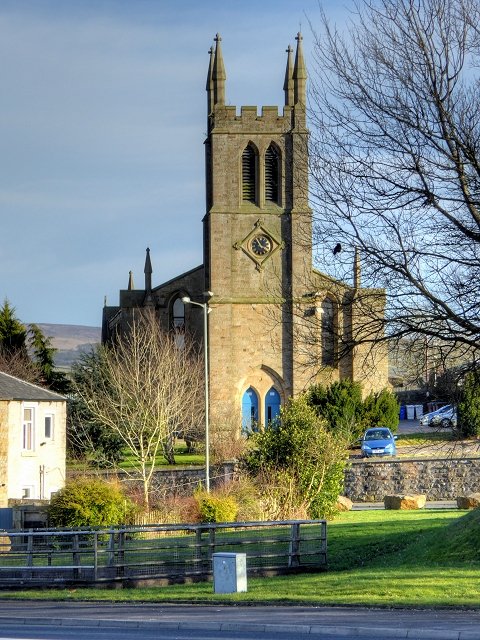
A Grade II listed Commissioners’ church in Lancashire, designed by Lewis Vulliamy in the Early English style and later converted to residential use.
At a glance
Holy Trinity Church stands on Accrington Road in Burnley as a surviving example of 19th-century Anglican parish architecture. Though the building no longer serves its original religious purpose, it retains architectural significance as a designated heritage structure.
History
Holy Trinity was erected as a Commissioners’ church—a category of Anglican parish church built with public funds in the 19th century to serve expanding industrial towns. Lewis Vulliamy designed the structure in the Early English Gothic style. The building was extended in 1871–72 to accommodate growing congregations. The church ceased active worship in 1990, after which it underwent conversion into residential flats.
What you see
The church exemplifies Early English Gothic design principles favored in Victorian ecclesiastical architecture. Vulliamy’s approach emphasizes the pointed arches, decorative details, and proportions characteristic of the style. The 1871–72 extension expanded the building’s interior volume while maintaining stylistic coherence.
Cultural significance
Holy Trinity represents an important phase in British religious building, when the state invested in new parish churches to serve industrial communities. Its Grade II listing acknowledges its architectural and historical merit within Burnley’s urban heritage. The conversion to residential use reflects contemporary approaches to preserving listed structures while adapting them to modern needs.
Key facts
- Location: Accrington Road, Burnley, Lancashire
- Country: United Kingdom
- Designer: Lewis Vulliamy
- Architectural style: Early English Gothic
- Classification: Grade II listed building
- Extension date: 1871–72
- Closure date: 1990
- Coordinates: 53.7898, -2.2571
Practical information & getting there
The building is privately owned and converted to residential use, so public access is not available. You can view the exterior from Accrington Road. Burnley town centre is accessible by train and bus; consult local transport services for current route information.
Sources & resources
Find it on the map
See this place and what’s around it →📷 Become a Cultural Heritage Online photographer
Share your photos of places: they stay published under your name as the author. The more they're seen, the more you get noticed — and soon a contest will reward the most appreciated photos.
Log in or sign up free to add a photoIs this page about you?
This page is read by travellers and heritage enthusiasts who find it on Google. Tell us how you are connected to this place and we will take it from there.